Quectel

Search documents
CES 2026 汽车领域发布要点:媒体日回顾
Counterpoint Research· 2026-01-12 02:45
Core Insights - The article discusses the significant advancements in the automotive industry showcased at CES 2026, focusing on the integration of AI, software-defined vehicles, and advanced driver-assistance systems (ADAS) [5][6][7]. Group 1: NVIDIA and AI Developments - NVIDIA launched Alpamayo, an open-source AI model and tools aimed at accelerating the development of safe, inference-based autonomous driving systems. The model features a Vision-Language-Action architecture with 10 billion parameters, enhancing decision-making capabilities to resemble human reasoning [4][5]. - NVIDIA also introduced AlphaSim, an end-to-end open-source simulation framework for validating autonomous driving systems, along with over 1,700 hours of real driving data [5]. Group 2: Collaborations and New Technologies - ZF and Qualcomm announced a partnership to develop a scalable ADAS platform integrating the ZF ProAI supercomputer and Snapdragon Ride platform, enabling up to Level 3 autonomous driving capabilities with 1,500 TOPS of computing power [6][7]. - Aptiv showcased its next-generation AI driving system capable of L2++ level autonomous driving, expanding its technology from automotive to robotics [9][11]. Group 3: Automotive Innovations - BMW introduced the iX3, featuring a new AI-driven personal assistant and the sixth-generation eDrive technology, which supports a range of advanced functionalities including fast charging and a WLTP range of up to 805 kilometers [13]. - Sony Honda Mobility unveiled the Afeela 1 electric vehicle, equipped with a dual-motor system and a 91 kWh battery, featuring AI-driven voice and infotainment capabilities [15][16]. Group 4: Battery Technology and Connectivity - Donut Lab launched the world's first mass-produced solid-state battery, achieving a high energy density of 400 Wh/kg and rapid charging capabilities, set to be used in the 2026 Verge electric motorcycle [30]. - Quectel introduced the 5G-Advanced AR588MA module, enhancing vehicle safety and connectivity with dual SIM support and satellite communication features [32]. Group 5: Mapping and Navigation - HERE Technologies presented AI maps integrated with the Snapdragon Ride platform, enhancing L2 and L2+ level ADAS capabilities and expanding its navigation services in over 100 countries by 2026 [25].



中国科技硬件领域 - 人工智能科技硬件高速发展-Greater China Technology Hardware AI Tech Hardware in High Gear





2025-11-16 15:36
Summary of Greater China Technology Hardware Conference Call Industry Overview - The conference focused on the Greater China Technology Hardware sector, particularly in AI technology and hardware advancements [7][8]. Key Insights - **Opportunities in AI GPU and ASIC Servers**: There are significant opportunities in upgrading AI GPU and ASIC server designs, with major projects like GB300, Vera Rubin platform, and Kyber architecture showing promise [7][8]. - **AMD Helios Server Rack**: The AMD Helios server rack project is gaining traction, indicating a positive trend in server hardware demand [7]. - **Enhanced Computing Power**: AI ASIC servers are expected to enhance computing power and increase rack density, which is crucial for data centers [7]. - **Power Solution Upgrades**: Transitioning to 800V HVDC power architecture and the growing adoption of liquid cooling solutions are highlighted as key upgrades [7]. - **PCB/Substrate Capacity Expansion**: There is a wave of capacity expansion in PCB/substrate to support ongoing design upgrades, which is essential for meeting increased demand [7]. - **Data Network Improvements**: Upgrades in data and power interconnects are anticipated to improve data network transmission speed and capacity [7]. - **Consumer Electronics Demand**: The demand for consumer electronics is being impacted by rising memory costs, with Android smartphones being more vulnerable compared to iPhones [7]. - **Upcoming Foldable iPhone Models**: Anticipation for the release of foldable iPhone models in the second half of 2026 is noted as a potential market driver [7]. Stock Recommendations - **Key Stock Ideas**: - AI Server Hardware: Wistron, Hon Hai/FII, Wiwynn, Delta Electronics, AVC, BizLink, King Slide, Accton, Chenbro, Gold Circuits, Innolight, FIT, and Fositek [7]. - Edge AI: Xiaomi, Lenovo, Luxshare [7]. Valuation Comparison - A detailed valuation comparison of various companies within the Greater China Technology Hardware sector was provided, including metrics such as price, target price, EPS, P/E ratio, P/B ratio, and ROE [8]. - Notable companies included: - **Lite-On Tech**: Current price at 162.50, target price at 150.00, with a P/E ratio of 23.3 for 2025 [8]. - **Delta Electronics**: Current price at 922.00, target price at 1288.0, with a P/E ratio of 38.9 for 2025 [8]. - **Hon Hai**: Current price at 241.00, target price at 317.0, with a P/E ratio of 16.4 for 2025 [8]. - **Foxconn Tech**: Current price at 66.80, target price at 54.00, with a P/E ratio of 26.0 for 2025 [8]. Additional Considerations - The report emphasizes the importance of considering Morgan Stanley Research as one of several factors in investment decision-making, acknowledging potential conflicts of interest [4][5].
Counterpoint Research:受益新兴市场需求拉动 2025年Q1蜂窝物联网模组出货量同比增长16%
智通财经网· 2025-06-19 03:05
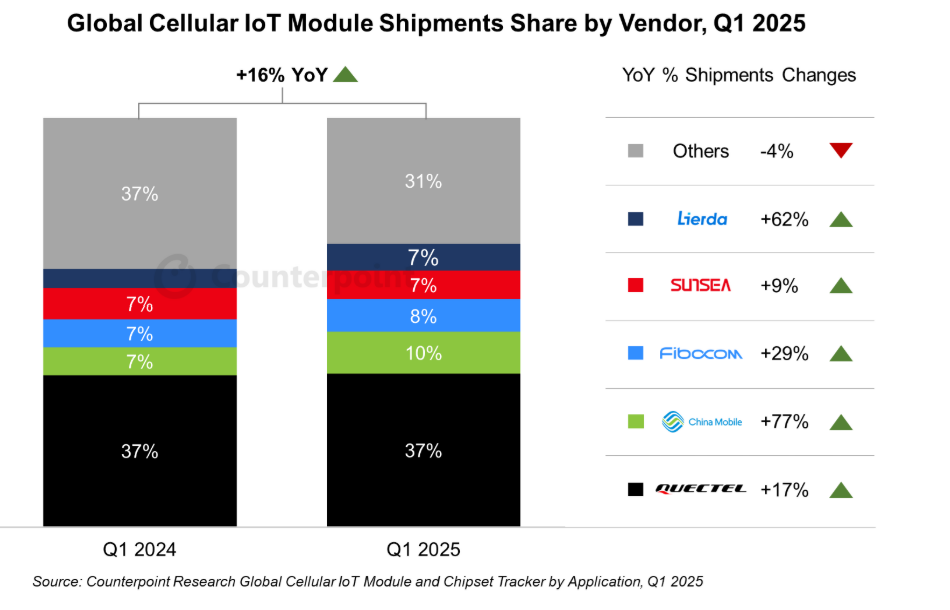
Core Insights - The global cellular IoT module shipments are expected to continue their growth trend, with a year-on-year increase of 16% in Q1 2025, driven by strong demand in India, China, and Latin America for smart meters, POS terminals, and asset tracking [1] - India leads the growth with a remarkable 32% year-on-year increase, while North America and some Asia-Pacific markets experience a decline due to weak demand and macroeconomic headwinds [1] - 5G technology is the fastest-growing segment, with a year-on-year growth of 37%, followed closely by Cat 1 bis technology, which also shows strong growth at 35% [1] Market Dynamics - China maintains its leadership in the global IoT module market with a 19% year-on-year growth, supported by the adoption of 5G and Cat 1 bis technologies in various sectors [1] - The average selling prices of modules and chips are decreasing, leading to increased price pressure from Chinese competitors, prompting companies to seek breakthroughs in higher-margin areas [4] - Qualcomm remains the leader in the chip market, with ASR and UNISOC following in second and third place, respectively [5] Manufacturer Performance - Quectel retains the top position in global cellular IoT module shipments, with China Mobile and Fibocom following closely, collectively accounting for over 50% of global shipments [4] - China Mobile's market share has surpassed double digits due to strong domestic demand for 4G Cat 1 bis modules [4] - u-blox has exited the cellular IoT module business to focus on its core strengths in GNSS and short-range connectivity [4] Future Outlook - The cellular IoT module market is expected to grow steadily in 2025, driven by demand for smart interconnected devices, asset tracking, and automotive applications in emerging markets [6] - Geopolitical tensions, strategic adjustments by manufacturers, and supply chain dynamics may constrain growth [6] - Chinese manufacturers are likely to maintain their global dominance, while Western manufacturers may benefit from demand recovery and easing geopolitical tensions [6]