Samsung Electro-Mechanics

Search documents
韩国存储行业:2025 年 12 月出口追踪-2025 年四季度存储芯片出口增长强劲-South Korea Tech_ December 2025 export tracker_ stronger memory exports growth in 4Q25
2026-01-04 11:35
3 January 2026 | 5:49PM KST Equity Research South Korea Tech: December 2025 export tracker: stronger memory exports growth in 4Q25 According to MOTIE (Ministry of Trade, Industry and Energy) and TRASS (Trade Statistics Service), exports for major tech products we track (memory, OLED, Li-ion batteries, MLCC) showed overall positive trend in December 2025 as exports value for memory (+64% yoy) and MLCC (+11% yoy), and display (+1% yoy) saw positive yoy growth while Li-ion batteries (-21% yoy) exports declined ...
South Korea Semiconductor Parts Industry Overview : High Growth Companies 21
QYResearch· 2026-01-04 08:52
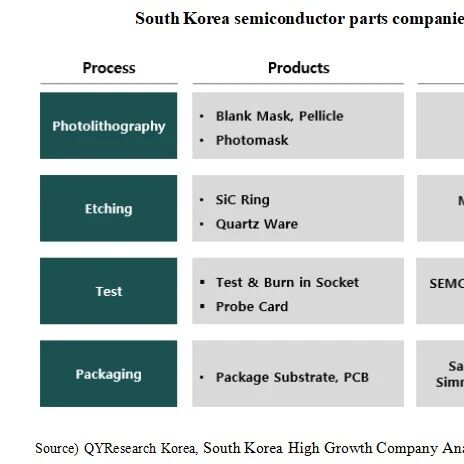
Industry Overview - The South Korea semiconductor parts industry is experiencing significant growth, driven by an AI-led "Super Cycle" in the overall semiconductor sector, with revenue projected to reach KRW 9.754 trillion in 2024, reflecting a 12.5% year-on-year increase [1][2]. Growth Drivers - The growth is attributed to a base effect following the downturn in 2023 and the rapid expansion of the AI semiconductor sector, with double-digit growth expected to continue into 2025 [2]. - A common factor behind the strong growth of leading domestic semiconductor parts companies is the increase in semiconductor production in Korea, China, and Taiwan, alongside qualitative improvements driven by AI-led trends toward process miniaturization and higher complexity [6]. Semiconductor Manufacturing Processes Photolithography Process - Demand for blank masks and pellicles is increasing as Chinese semiconductor manufacturers invest in advanced processes, benefiting Korean suppliers like FST and S&S Tech [7]. Etching Process - The transition from conventional silicon materials to silicon carbide (SiC) for ring components is enabling companies such as KNJ and TCK to expand their market presence, while Mecaro has increased exports amid rising investments in memory semiconductor equipment in China [8]. Testing Process - Components used in testing, including probe cards and sockets, are benefiting from favorable market conditions, with strong performance from South Korean companies like SEMCNS, TSE, and Tiger Electronics [9]. Packaging Process - Package substrates are emerging as a core growth driver, with companies like Samsung Electro-Mechanics and LG Innotek expanding their supply of BGA substrates for PCs and smartphones, as well as high-value segments like AI/server and automotive FC-BGA substrates [10]. High-Growth Companies - QYResearch Korea identified 21 companies achieving over 8% year-on-year revenue growth in 2024, including KC Parts Tech, SEMCNS, and Mecaro, with notable products spanning various semiconductor manufacturing processes [5][11]. Revenue Performance - Key companies and their projected revenues for 2024 include: - KC Parts Tech: KRW 37.439 billion, 100.87% YoY growth - SEMCNS: KRW 53.315 billion, 72.35% YoY growth - Mecaro: KRW 62.858 billion, 62.91% YoY growth - TSE: KRW 220.995 billion, 62.05% YoY growth - Samsung Electro-Mechanics: KRW 2,034.657 billion, 18.47% YoY growth [11].

Samsung Electro-Mechanics Signs MOU with Sumitomo Chemical Group to Establish a Joint Venture for 'Glass Core' Used in Package Substrates
Prnewswire· 2025-11-05 16:00
Core Insights - Samsung Electro-Mechanics and Sumitomo Chemical Group have signed a memorandum of understanding (MOU) to establish a joint venture for manufacturing 'Glass Core,' a crucial material for next-generation semiconductor package substrates [1][4] - The joint venture aims to address the limitations of current package substrate technology, particularly in the context of advancements in artificial intelligence (AI) and high-performance computing (HPC) [3][4] - The headquarters for the joint venture will be located at Dongwoo Fine-Chem's Pyeongtaek site, which will also serve as the initial production base for 'Glass Core' [4] Company Strategies - Samsung Electro-Mechanics will be the primary investor with a majority stake in the joint venture, while Sumitomo Chemical Group will hold a minority stake [4] - The companies plan to finalize details such as shareholding structure and business schedule, with the main agreement expected to be signed next year [4] - The collaboration is seen as a strategic move to combine technological strengths and accelerate market expansion in the advanced semiconductor packaging sector [4] Market Implications - The demand for ultra-high-performance semiconductor package substrates is anticipated to grow significantly as the AI era progresses, positioning 'Glass Core' as a key material in reshaping the substrate market [4] - The partnership is expected to generate significant synergies in the advanced semiconductor back-end process sector, enhancing the long-term relationship between the companies [4] - Samsung Electro-Mechanics is currently producing glass package substrate prototypes, with mass production planned to commence after 2027 [4]
人工智能需求激增,涨价将推动 2026 年上半年每股收益上调;SPE 是下一个受益者,2026 年无人工智能泡沫迹象-Asia Tech Strategy-Supercharged AI demand, price hikes to drive EPS upgrades into 1H26; SPE next beneficiary, no signs of AI bubble bursting in 2026
2025-10-14 14:44
Summary of Key Points from the Conference Call Industry Overview - **Industry**: Asian Technology Sector - **Focus**: AI Infrastructure and Semiconductor Supply Chain Core Insights and Arguments 1. **Positive Outlook for Asian Tech**: Continued strong demand for AI infrastructure is expected to drive earnings per share (EPS) upgrades in the Asian tech sector, with estimates suggesting a potential 20-25% increase in consensus estimates for 4Q25 and 1H26 [2][6][8] 2. **AI Demand and Pricing Dynamics**: The demand for AI is tightening the supply-demand equation across various segments, leading to price hikes in DRAM, NAND Flash, and other components. This trend is anticipated to persist into 2026 [6][7][9] 3. **SPE Stocks Recovery**: After a period of underperformance, stocks in the semiconductor equipment (SPE) sector are expected to catch up due to strong front-end capital expenditure (capex) expectations, particularly from Foundry and DRAM sectors [2][6][8] 4. **No AI Bubble Burst Expected**: The current semiconductor capacity remains tight, and the anticipated capex increase in response to AI growth is just beginning, indicating that an AI bubble is unlikely to burst in 2026 [2][6][8] 5. **CSP Capex Growth**: The top four cloud service providers (CSPs) are expected to see a 20% growth in capex in 2026, driven by strong demand from AI labs like OpenAI and Oracle [6][8][9] 6. **Margin Pressure on OEMs**: Rising commodity prices are likely to pressure gross margins for PC and smartphone vendors, with specific concerns for companies like Asustek and Xiaomi [9][10] 7. **Industrial and Automotive Demand**: Recovery in industrial and automotive sectors is expected to be slow, influenced by macroeconomic conditions and new tariffs imposed by the US on China [9][10] 8. **Supply Chain Resilience**: Despite concerns over rare-earth export restrictions from China, large semiconductor vendors are believed to have sufficient inventory to mitigate production disruptions [9][10] Additional Important Insights 1. **Stock Picks**: Recommended stocks include TSMC, ASE Technology, Unimicron, and Tokyo Electron, with specific price targets and expected returns outlined [44][45] 2. **CSP Capex Composition**: The funding for capex among smaller CSPs is increasingly reliant on debt, which could impact future spending dynamics [8][9] 3. **Market Dynamics**: The competitive landscape in the AI server market is intensifying, which may lead to margin compression for OEMs as they compete for supply from major players like NVDA [9][10] This summary encapsulates the key points discussed in the conference call, highlighting the positive outlook for the Asian tech sector driven by AI demand, the expected recovery in semiconductor stocks, and the challenges posed by rising commodity prices and macroeconomic factors.


行业聚焦:全球智能手机摄像头执行器市场头部企业份额调研(附Top10 厂商名单)
QYResearch· 2025-09-18 03:51
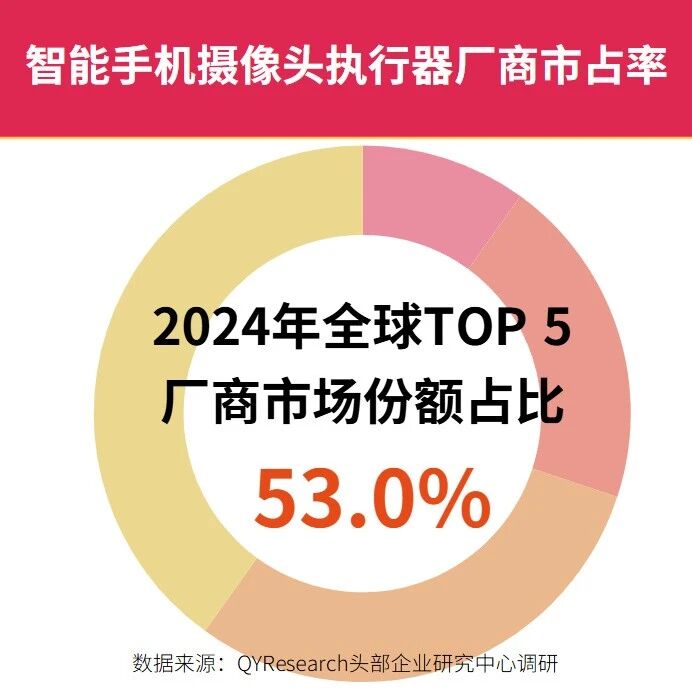
Core Viewpoint - The global smartphone camera actuator market is projected to reach USD 5.41 billion by 2031, with a compound annual growth rate (CAGR) of 3.9% from 2025 to 2031 [1]. Market Overview - The smartphone camera actuator is a micro-precision driving device used for automatic focusing (AF), optical image stabilization (OIS), and zoom functions [1]. - The market is dominated by VCM (Voice Coil Motor), which holds approximately 77.9% of the market share [6][5]. - The mid-range smartphone segment is the largest downstream market, accounting for about 52.6% of the demand [9][6]. Key Players - Major manufacturers in the global smartphone camera actuator market include Alps Alpine, MinebeaMitsumi, TDK, Jahwa Electronics, Samsung Electro-Mechanics, ActRO, and LG Innotek, among others [5][18]. - The top five manufacturers are expected to hold around 53.0% of the market share in 2024 [5]. Market Drivers - The growth of the smartphone camera actuator market is driven by the long-term trend of imaging upgrades in high-end and mid-range smartphones, with increasing reliance on high-performance actuators to ensure image quality [12]. - Consumer demand for mobile imaging experiences, including 4K/8K video recording and night scene optimization, is a significant growth factor [12]. - The rise of new smartphone forms, such as foldable screens and AI computational photography, is also boosting actuator demand [12]. Downstream Demand Trends - There is a growing emphasis on smartphone imaging capabilities among consumers, prompting brands to adopt higher-end camera module solutions [14]. - The penetration of triple-camera setups and beyond is expected to become standard in mid-to-high-end models, increasing the demand for actuators in terms of quantity and performance [14]. - The proliferation of AR/VR, social media short videos, and e-commerce live streaming is expanding the application scenarios for mobile imaging, driving the market towards higher precision, faster response times, and lower energy consumption [14].