Sprint

Search documents
American Tower Poised To Outperform Crown Castle
Seeking Alpha· 2026-02-25 00:31
We believe American Tower (AMT) remains in a substantially better position than Crown Castle (CCI) as the tower industry faces a final speed bump before renewed stability. Towers are facing an interesting conundrum in which the extreme stability of their internal business model has been repeatedly rocked by structural changes in the industry vertical. At this point, the impacts of T-Mobile’s (TMUS) acquisition of Sprint are mostly known, but similar disruptions remain ongoing from Dish’s sale to EchoStar (S ...



Cogent(CCOI) - 2025 Q4 - Earnings Call Transcript
2026-02-20 14:32
Financial Data and Key Metrics Changes - Total revenue for Q4 2025 was $240.5 million, with a full year total of $975.8 million, reflecting a sequential decline of $1.4 million or 0.6% [19] - EBITDA for Q4 2025 increased sequentially by $3 million to $51.7 million, with an EBITDA margin increase of 130 basis points to 21.5% [21] - Gross margin for Q4 2025 increased sequentially by $1.6 million to $112.5 million, with a gross margin percentage of 46.8% [20] Business Line Data and Key Metrics Changes - On-net revenues increased from 47% in Q3 2023 to 61% in Q4 2025, while off-net revenues decreased from 48% to 39% [4] - Wavelength revenue for Q4 2025 was $12.1 million, a 74% year-over-year increase, with a sequential growth of 19% [5] - Non-core revenues decreased to less than 1% of total revenues in Q4 2025 [4] Market Data and Key Metrics Changes - The company serves 1,715 carrier-neutral data centers and 187 Cogent data centers, with a total capacity of 213 megawatts [13] - The NetCentric business represented 43% of revenues in Q4 2025, with a year-over-year revenue increase of 10.4% [26] - The enterprise business accounted for 14.3% of revenues in Q4 2025, with a year-over-year decline of 24.7% [27] Company Strategy and Development Direction - The company aims for revenue growth in the 6%-8% range over the long term, with a focus on improving the on-net service mix [15][44] - Plans to refinance $750 million of unsecured notes with new secured notes are underway, aiming to enhance financial flexibility [39] - The company is actively working to monetize surplus data center facilities acquired from Sprint, which will aid in deleveraging [39] Management's Comments on Operating Environment and Future Outlook - Management expressed confidence in returning to positive revenue growth, citing a 27% growth in Cogent revenues since the acquisition of Sprint [43] - The company anticipates continued margin expansion driven by a shift towards more profitable on-net services [44] - Management noted that the acquired Sprint Wireline revenue base has significantly declined, impacting overall revenue performance [23] Other Important Information - The company reported a significant reduction in IP transit payments from T-Mobile, which impacted EBITDA [8] - IPv4 leasing revenue increased by 44% year-over-year to $64.5 million for full year 2025 [11] - The company has improved its leverage ratios, with gross debt leverage at 7.35 and net debt ratio at 6.64 in Q4 2025 [10] Q&A Session Summary Question: Update on total company revenues and EBITDA for 2026 - Management indicated that they do not provide specific quarterly or annual guidance but expect to return to positive revenue growth and maintain a 6%-8% annual growth rate over the long term [43] Question: Progress on the Waves business and expected connections or revenues - Management noted that the wavelength business is gaining credibility and expects continued acceleration in revenue recognition and installations [44] Question: Status of data center transactions and tax implications - Management confirmed that negotiations for data center sales are ongoing and clarified that tax implications from the Sprint acquisition would not result in income taxes being paid due to existing NOLs [51][52] Question: Analysis of Sprint revenue versus Cogent Classic - Management explained the challenges in separating the two revenue streams post-acquisition and noted that the Sprint business is continuing to deteriorate [78]

Cogent(CCOI) - 2025 Q4 - Earnings Call Transcript
2026-02-20 14:32
Financial Data and Key Metrics Changes - Total revenue for Q4 2025 was $240.5 million, with a full year total of $975.8 million, reflecting a sequential decline of $1.4 million or 0.6% [19] - Gross margin for Q4 increased by $1.6 million to $112.5 million, with a gross margin percentage of 46.8%, up 100 basis points sequentially [20] - EBITDA for Q4, excluding payments under the IP Transit Agreement, increased sequentially by $3 million to $51.7 million, with an EBITDA margin of 21.5% [21] - Full year EBITDA increased by $70 million to $192.8 million, with an EBITDA margin of 19.8%, up from 11.9% in 2024 [22] Business Line Data and Key Metrics Changes - On-Net revenues increased from 47% of total revenues in Q3 2023 to 61% in Q4 2025, while Off-Net revenues decreased from 48% to 39% [4] - Wavelength revenue for Q4 was $12.1 million, a 74% year-over-year increase, with a sequential growth of 19% [5] - Non-core revenues decreased to less than 1% of total revenues in Q4 2025, down from 5% in Q3 2023 [4] Market Data and Key Metrics Changes - The company serves On-Net customers in 3,579 buildings, with a total On-Net revenue of $146.4 million for Q4, reflecting a year-over-year increase of 7.8% [28] - Off-Net revenue for Q4 was $92.9 million, a year-over-year decrease of 17.9% [29] - The NetCentric business represented 43% of revenues in Q4, with a quarterly revenue increase of 10.4% year-over-year [26] Company Strategy and Development Direction - The company anticipates revenue growth in the 6%-8% range over the multi-year period, with a focus on improving the On-Net service mix [15][44] - The strategy includes monetizing surplus data center facilities acquired from Sprint, which will aid in deleveraging and returning capital to equity holders [39] - The company aims to refinance its $750 million unsecured notes with new secured notes, maintaining the same aggregate face value [14][65] Management's Comments on Operating Environment and Future Outlook - Management noted that the decline in Sprint-acquired revenues has been significant, with a 64% decrease since the acquisition, while Cogent's legacy revenues have grown by 27% [43][79] - The company expects to continue improving margins through a shift towards more profitable On-Net services, with 80% of Q4 sales being On-Net [44][82] - Management expressed optimism about the Wavelength business, highlighting its potential for growth and contribution to margin expansion [45] Other Important Information - The company has improved its leverage ratios, with a gross debt leverage ratio of 7.35, down from 7.45 in the previous quarter [10] - IPv4 leasing revenue increased by 44% year-over-year to $64.5 million for the full year 2025 [11] - The company is currently leasing 15.3 million IPv4 addresses, an increase of 17% year-over-year [12] Q&A Session Summary Question: Update on total company revenues and EBITDA for 2026 - Management indicated that they do not provide specific quarterly or annual guidance but expect to return to positive revenue growth and maintain a 6%-8% annual growth rate [43] Question: Expectations for the Wavelength business scaling in 2026 - Management noted that Wavelength products are significant contributors to margin expansion and expect growth to accelerate as credibility with customers increases [44][45] Question: Progress on data center transactions and tax implications - Management confirmed that negotiations are ongoing for multiple facilities and that tax losses from the Sprint acquisition will offset any taxable income from sales [51][52] Question: EBITDA contribution of the Sprint business - Management estimated the EBITDA contribution from the Sprint business to be close to zero but slightly positive, indicating ongoing efforts to improve margins [85]
Cogent(CCOI) - 2025 Q4 - Earnings Call Transcript
2026-02-20 14:30
Cogent Communications (NasdaqGS:CCOI) Q4 2025 Earnings call February 20, 2026 08:30 AM ET Speaker9Good morning, and welcome to the Cogent Communications Holdings fourth quarter and full year 2025 earnings conference call. As a reminder, this conference call is being recorded, and it will be available for replay at www.cogent.com. A transcript of this conference call will be posted on Cogent's website when it becomes available. Cogent's summary of financial and operational results attached to its press relea ...
Cogent Communications (NasdaqGS:CCOI) 2025 Conference Transcript
2025-12-08 21:02
Cogent Communications Conference Call Summary Company Overview - **Company**: Cogent Communications (NasdaqGS:CCOI) - **Industry**: Telecommunications, specifically focusing on WAVE network and internet services Key Developments - **WAVE Network Expansion**: Cogent has made significant progress in expanding its WAVE network, converting Sprint's former long-distance voice network into a monetizable optical transport network serving over 1,000 data centers [4][5] - **Data Center Conversion**: 125 former switch sites have been converted into data centers, with plans to divest 24 facilities that have 109 megawatts of inbound power [4][5] - **Core Business Growth**: The core business is reportedly growing slightly faster than prior to the Sprint acquisition, despite challenges in the acquired business [4][5] Financial Performance - **EBITDA Growth**: EBITDA margins improved from 1% post-acquisition to slightly above 20%, with expectations for continued growth [5][6] - **Leverage Increase**: Aggregate leverage increased to 6.6 times due to capital expenditures and operating losses, leading to a 98% reduction in dividends [6][29] - **Revenue Goals**: Aiming for a $500 million revenue run rate in the WAVE business by mid-2028, representing 25% market share of a $3.5 billion market [7][8] Market Position and Competitive Advantages - **Market Growth**: The North American WAVE market is growing, driven by increased demand from AI and other sectors [9][11] - **Competitive Edge**: Cogent's advantages include a larger number of data centers (1,000 vs. competitors' 300), faster provisioning times, unique routing capabilities, and aggressive pricing strategies [9][10][11] - **Customer Acceptance**: Improvement in customer acceptance of services is noted, with a growing sales funnel and faster installation rates [15][16] Corporate Business Challenges - **Declining Corporate Business**: The corporate segment has faced declines, particularly in off-net services, with a goal to eliminate non-core products [19][21] - **On-net vs. Off-net Services**: The mix of on-net services has improved from 47% to 61% since the acquisition, contributing to EBITDA growth despite overall revenue decline [22][23] Future Outlook - **Revenue Growth Projections**: Expected top-line revenue growth of 6%-8% and EBITDA margin expansion of about 200 basis points annually [29][30] - **Dividend Resumption**: Plans to resume dividend increases once leverage is reduced to four times [29][31] - **IPv4 Address Leasing**: Significant growth in the IPv4 leasing business, with a run rate increasing from $12 million to $65 million, indicating a strategic focus on leasing rather than selling [37][38] Additional Insights - **Data Center Monetization**: Cogent is negotiating letters of intent for surplus data centers, with a focus on maximizing value from these assets [35][36] - **CapEx Management**: Core CapEx is expected to remain stable at $100 million, with additional capital lease payments [39] This summary encapsulates the key points discussed during the conference call, highlighting Cogent Communications' strategic initiatives, financial performance, market positioning, and future outlook.
substack.com-泡沫的主要标志供给侧的贪婪 --- The Cardinal Sign of a Bubble Supply-Side Gluttony
2025-12-01 00:49
Summary of Key Points from the Conference Call Industry Overview - The discussion revolves around the concept of market bubbles, particularly focusing on the technology sector and historical parallels with the dot-com bubble of the late 1990s and early 2000s [6][7][24]. Core Insights and Arguments - **Innovation and Folly**: The U.S. is characterized by a culture of innovation that often leads to "creative destruction," where companies innovate themselves to failure, resulting in mass bankruptcies and job losses [3][5][6]. - **Historical Context**: The analysis begins with a retrospective on the "profitless dot-com" bubble of the 1990s, emphasizing that many misinterpret the nature of that era, which was driven more by infrastructure investment than by profitless companies [7][8][14]. - **Market Dynamics**: The NASDAQ index's performance during the late 1990s was largely influenced by profitable large-cap companies, contrary to the narrative that it was primarily driven by unprofitable dot-coms [10][14]. - **Investment Patterns**: A significant amount of capital was funneled into data transmission infrastructure, with companies like AT&T and MCI investing billions annually, which created an overbuilt supply without sufficient demand [17][21][20]. - **Current Trends**: The current AI boom is drawing parallels to past bubbles, with major companies like Microsoft, Google, and Nvidia committing substantial investments in AI infrastructure, raising concerns about sustainability and potential overvaluation [43][44][48]. Important but Overlooked Content - **Capital Cycle Theory**: The concept of Capital Cycle Theory is introduced, suggesting that stock market peaks often occur midway through investment booms, indicating a pattern that may repeat in the current market [50]. - **Stock-Based Compensation**: There is a notable increase in stock-based compensation today compared to 25 years ago, which may exacerbate the effects of market bubbles [30][31]. - **OpenAI's Financials**: OpenAI's commitment to $1.4 trillion in spending over the next eight years, with revenues and losses significantly lower than this figure, highlights the speculative nature of current investments in AI [45][46]. - **Nvidia's Role**: Nvidia is positioned as a central player in the current AI landscape, with its technology being critical across various applications, suggesting a potential for significant market influence [48][49]. Conclusion - The analysis emphasizes the cyclical nature of market bubbles, the importance of understanding historical precedents, and the potential risks associated with current investment trends in technology and AI sectors [50][51].



《经济学人》:AT&T和Verizon荣光不再
Xin Lang Ke Ji· 2025-11-26 08:17
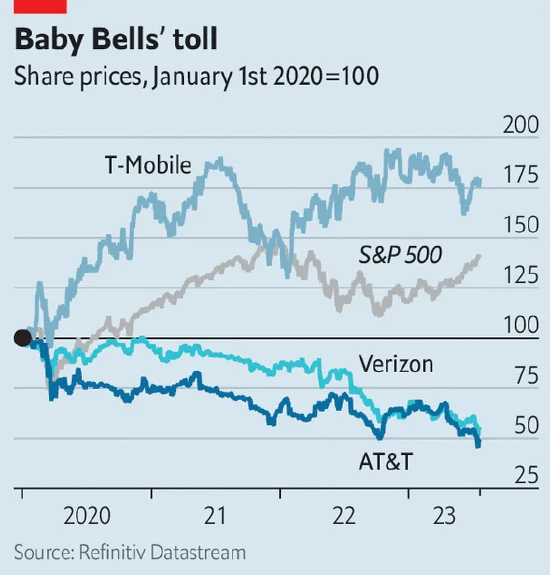
Core Viewpoint - AT&T and Verizon are struggling to find new growth opportunities as their performance stagnates, with their combined market capitalization halved since early 2020, while the S&P 500 has risen significantly [1][2][4]. Group 1: Market Position and Performance - In the early 1980s, AT&T was a leading technology giant with a 5.5% market share in the S&P 500, but now AT&T and Verizon together account for less than 0.7% [2]. - Their combined market capitalization is approximately $250 billion, which is about half of what it was in early 2020 [2]. - Verizon's revenue from mobile and broadband services grew only 1% year-over-year in Q2, while AT&T reported a 2.4% increase [4]. Group 2: Challenges and Competition - The companies face challenges from rising interest rates and liabilities related to outdated lead-covered cables, but many issues stem from their own decisions [4]. - The telecommunications market is saturated, making growth difficult, especially with significant debt burdens [4]. - T-Mobile's merger with Sprint has created a strong competitor offering lower prices, and DISH Network's partnership with Amazon is set to provide mobile services at competitive rates [5]. Group 3: Strategic Decisions - AT&T's past investments, including a $200 billion foray into the media sector, have not yielded expected results and have left the company with a net debt of $130 billion [5]. - Verizon has been more conservative in spending but invested $53 billion in 5G spectrum, which has not yet provided returns as the initial hype has subsided [5]. - Both companies are attempting to protect profit margins by raising prices and cutting costs, including closing retail locations [6]. Group 4: Future Directions - There are limited options for AT&T and Verizon, including protecting profit margins and potentially divesting fixed-line networks to focus on faster-growing wireless broadband [6]. - The trend of bundling services between cable and telecom companies is increasing, which may enhance customer retention and long-term profitability [6].


Cogent(CCOI) - 2025 Q3 - Earnings Call Transcript
2025-11-06 14:30
Financial Data and Key Metrics Changes - The company's revenue for the quarter was $241.9 million, with an adjusted EBITDA of $73.8 million, reflecting a sequential increase of $0.3 million and an adjusted EBITDA margin increase of 70 basis points to 30.5% [10][11] - Total gross debt was $2.3 billion, with a net debt of $1.9 billion after accounting for $224.2 million due from T-Mobile [16][17] - The net leverage ratio was reported at 6.65, slightly up from 6.61 in the previous quarter, while the adjusted gross debt to EBITDA ratio improved from 7.74 to 7.45 [4][16] Business Line Data and Key Metrics Changes - Wavelength services revenue increased to $10.2 million, a 93% year-over-year increase and a 12% sequential increase [6] - IPv4 leasing revenue rose by 14.1% sequentially to $17.5 million, with a year-over-year increase of 55.5% [7] - On-net revenues were $135.3 million, showing a slight year-over-year decrease of 0.9% but a sequential increase of 2.2% [13] Market Data and Key Metrics Changes - The company serves 1,686 carrier-neutral data centers and 186 Cogent data centers, with a total of 214 megawatts of installed and available power [8] - The average price per megabit for the installed base decreased by 10% sequentially to $0.16 and by 31% year-over-year [14] - The company anticipates long-term annual revenue growth rates between 6-8% [8] Company Strategy and Development Direction - The company has refined its capital allocation priorities to strengthen financial flexibility and accelerate its deleveraging strategy, including a reduction in the quarterly dividend to $0.02 per share [2][3] - The company is actively working to monetize its acquired Sprint assets, including data centers, to further accelerate capital delivery [21] - The goal is to capture 25% of the long-haul wavelength market in North America within three years, with a focus on enhancing service quality and provisioning speed [6][22] Management's Comments on Operating Environment and Future Outlook - Management expressed optimism about the long-term growth potential of the wavelength services business, citing a backlog of 5,221 opportunities [6][22] - The company expects to return to total revenue growth by mid-third quarter 2025, despite a revenue decline of $4.3 million or 1.7% for the quarter [8][9] - Management noted that the integration of the Sprint network has been completed, leading to reduced capital expenditures going forward [7][21] Other Important Information - The company has temporarily suspended its stock buyback program to focus on reducing leverage [4] - The average revenue per IPv4 leased was $0.31 per address, with a total of 14.6 million addresses leased at the end of the quarter [7][11] - The company has completed the grooming of low-margin Sprint-acquired contracts and is focused on selling higher-margin products [9][12] Q&A Session Summary Question: Dividend cut and future levels - Management indicated that the dividend cut was a strategic decision to reach a net leverage target of four times EBITDA before considering a return to previous dividend levels [23][24] Question: Data center sale valuation - Management confirmed that the recent data center sale was representative of the overall portfolio, but specific pricing details were withheld to avoid setting benchmarks for future negotiations [24][25] Question: Wavelength run rate expectations - Management clarified that the expected run rate of $20 million-$25 million by year-end is dependent on customer acceptance of installed wavelengths, with ongoing efforts to improve acceptance rates [26][30] Question: Competitive landscape and provisioning - Management acknowledged that while competitors are enhancing provisioning timelines, the company's unique route diversity and reliability remain significant competitive advantages [42][43] Question: IPv4 address leasing strategy - Management explained that the leasing strategy has accelerated revenue growth from IPv4 addresses, allowing for quicker depletion of inventory compared to outright sales [44][45]
Cogent(CCOI) - 2025 Q3 - Earnings Call Presentation
2025-11-06 13:30
Company Overview - Cogent operates a global network carrying approximately 25% of all internet traffic[10] - The company serves three customer bases: Corporate (44% of revenues), Netcentric (41% of revenues), and Enterprise (15% of revenues)[10] - IP Services (DIA, VPN and Transit) account for 86% of Cogent's revenue[10] - The company operates in 302 markets across 57 countries[10] Growth and Market Opportunity - Cogent is experiencing rapid growth in wave service locations, as shown by the increase from 22 in Q2 2023 to 996 in Q3 2025[13, 32] - The company has a growing addressable market, with on-net multi-tenant office buildings (MTOB) square footage increasing from 597 million in Q1 2010 to 1,017 million in Q3 2025[13] - The off-net market served has grown significantly, from 4,427 buildings in Q1 2015 to 28,138 in Q3 2025[13] - The company owns 37.8 million IPv4 addresses, with approximately 38% being utilized[11] Financial Performance - In Q3 2025, On-Net IP ARPU (Average Revenue Per User) was $515, Off-Net IP ARPU was $1,225, and On-Net Wave ARPU was $2,108[47] - Total revenue for Q3 2025 was $241.9 million, a decrease of 5.9% year-over-year[54] - Non-GAAP gross margin reached 45.8% in Q3 2025[54] - EBITDA, as adjusted for Sprint acquisition costs and cash payments under IP Transit Services Agreement, was $73.8 million in Q3 2025, representing a margin of 30.5%[54]
Inseego Strengthens Board of Directors with Experienced Operational Leaders in Carrier, AI, and SaaS
Globenewswire· 2025-11-03 13:00
Core Insights - Inseego Corp. has appointed Nabil Bukhari and Stephen Bye to its Board of Directors, enhancing its leadership in 5G mobile broadband and fixed wireless access solutions [1][2] - The new board members bring extensive experience in wireless networking, SaaS, and AI, which aligns with Inseego's strategy for growth and market expansion [1][2] Group 1: Board Member Profiles - Nabil Bukhari is currently the President of AI Platforms and CTO at Extreme Networks, focusing on AI integration in networking products and has a strong background in SaaS and cloud-based solutions [2][3] - Stephen Bye is the CEO of Ookla and has a history of helping carriers evolve their strategies, with leadership roles at DISH, C Spire, Sprint, and AT&T, providing him with a unique perspective on connectivity monetization [3][4] Group 2: Strategic Focus - Inseego aims to capitalize on the expanding Fixed Wireless Access (FWA) market, with a strong emphasis on technology leadership as 5G Advanced and 6G developments approach [5] - The company has increased its board size from six to eight members to support its strategic growth priorities and leverage the expertise of the new directors [5]