Tsakos Energy Navigation

Search documents
中方反制生效已满一周,关键在于这拳打开了
Guan Cha Zhe Wang· 2025-10-22 09:37
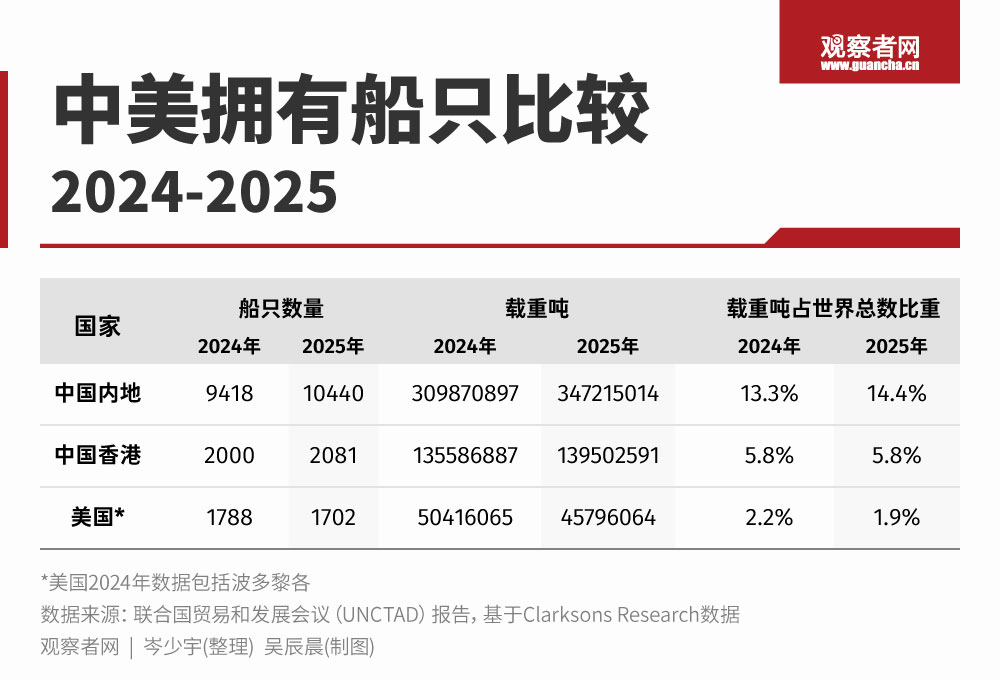
Core Points - The article discusses China's response to the U.S. imposition of special port fees on Chinese vessels, which is seen as a countermeasure to U.S. actions against China's maritime and logistics industries [1][2][34] - The implementation of the special port fee by China is viewed as a strategic move to maintain parity in the ongoing trade tensions between the two countries [2][34] Group 1: Impact on Shipping Industry - The U.S. will impose port service fees on Chinese-owned or operated vessels starting October 14, 2025, affecting a significant number of ships [1][3] - As of January 1, 2025, China is projected to have 10,440 vessels, an increase from 9,418 in 2024, while the U.S. will see a decrease from 1,788 to 1,702 vessels [4][6] - China's share of the global deadweight tonnage is expected to rise from 13.3% in 2024 to 14.4% in 2025, indicating a strengthening position in the global shipping market [6][8] Group 2: Financial Comparisons - The total value of Chinese vessels is projected to reach $255.236 billion in 2025, a 25.11% increase from 2024, while the U.S. total will be $116.447 billion, reflecting a 16.61% growth [13][17] - The value of bulk carriers in China is expected to be $68.454 billion in 2025, compared to $4.054 billion for the U.S., highlighting a significant disparity [17] - The value of container ships in China is projected to be $63.533 billion, while the U.S. will have $4.938 billion, further emphasizing China's dominance in this sector [17] Group 3: Regulatory Responses - The article notes that many U.S. companies have their own fleets, with significant numbers reported by major agricultural firms like Cargill and Bunge [19][22] - The complexity of ownership structures complicates the assessment of which vessels will be affected by the new fees, as many U.S. companies have foreign ownership or operations [25][29] - The article highlights that the U.S. has provided exemptions for certain vessels, which may influence the operational decisions of shipping companies [38] Group 4: Strategic Implications - China's countermeasures are seen as a way to disrupt U.S. efforts to weaken its shipping and shipbuilding industries, forcing global shipping companies to reconsider their strategies [34][39] - The article suggests that the ongoing situation may lead to a reevaluation of the relationships between shipping companies and their operational strategies in light of the geopolitical landscape [39]

Tsakos Energy Navigation: Reiterating My Strong Buy Rating After Earnings
Seeking Alpha· 2025-05-06 15:32
Core Insights - The logistics sector has seen significant engagement from investors, particularly in the ASEAN and US markets, highlighting its growth potential [1] - The diversification of investment portfolios has become a trend, with a shift from traditional savings in banks and properties to stock market investments [1] - The popularity of insurance companies in the Philippines since 2014 indicates a growing interest in financial products beyond traditional banking [1] Investment Focus - The focus on banking, telecommunications, and retail sectors in the Philippines suggests these industries are viewed as stable investment opportunities [1] - The entry into the US market in 2020 reflects a strategic move to capitalize on broader investment opportunities, particularly in banks, hotels, shipping, and logistics [1] - The use of platforms like Seeking Alpha for analysis indicates a trend towards utilizing online resources for informed investment decisions [1]

The 9.0%-Yielding Preferred Stock Of Tsakos Energy Navigation Is Highly Attractive Under Current Conditions
Seeking Alpha· 2025-03-25 16:05
Group 1 - The preferred stock of Tsakos Energy Navigation (TEN.PR.E) is recommended for holding due to its exceptional yield and a wide margin of safety for the dividend [1] - The stock is rated as a "hold" rather than a "buy" [1] Group 2 - The author has a background in chemical engineering and economics, and has authored multiple books on investing and mathematics [1] - The author emphasizes the use of fundamental and technical analysis in investment decisions, primarily utilizing options for both investing and trading [1] - The author achieved financial independence at the age of 45, following investment principles similar to those of Warren Buffett [1]