船舶

Search documents
张瑜:高油价带来“出清”,中国中游份额或“上行”——战略看多中游制造系列四
一瑜中的· 2026-03-27 13:30
Core Viewpoint - The report discusses the potential for China's midstream manufacturing share to increase amid sustained high oil prices, based on four key logical frameworks [2]. Group 1: Current Situation - Global manufacturing heavily relies on oil and gas imports, with 68.6% of the manufacturing value added coming from economies that are net oil and gas importers. China's oil and gas import dependency for manufacturing value added is 8.6%, which is lower than 25 other economies [4][13]. Group 2: Historical Experience - The analysis of the oil crises in the 1970s shows that during these periods, the midstream manufacturing share in the U.S. increased, while Germany's share declined due to higher oil import dependency. For instance, the U.S. midstream share rose from 19.0% in 1972 to an average of 19.8% during the first oil crisis [5][15][19]. Group 3: Future Outlook - **Pathway 1: Supply Chain Restructuring** - The pandemic has shown that global supply chains can shift, with China's share in machinery and transport equipment exports increasing from 17.7% in 2019 to 19.6% in 2020. High oil prices and geopolitical tensions may further benefit China's export share due to its strong energy security [6][27]. - **Pathway 2: Increased New Demand** - The pandemic created new demand in sectors like textiles and pharmaceuticals, with China's textile exports growing by 28.9% in 2020. Current high oil prices may similarly drive demand in energy security and defense sectors, benefiting China [7][31]. - **Pathway 3: Cost Advantages** - China's energy structure, with a higher proportion of coal and non-fossil fuels, results in lower electricity price fluctuations compared to Europe and the U.S. For example, while European electricity prices rose by 61% in 2022, China's only increased by 5.1%. Historical data shows that China's midstream manufacturing share tends to rise during years of significant oil price increases [8][35][36].


国泰海通|策略:原油链持续涨价,出海制造景气提升
国泰海通证券研究· 2026-03-20 09:20
Group 1 - The core viewpoint of the article highlights the differentiated economic conditions, with rising prices in the oil and chemical chain, an upward shift in emerging technology sectors, and strong growth in travel and consumer goods in the first quarter [1][2]. Group 2 - The oil chain continues to see price increases due to disruptions in oil transportation through the Strait of Hormuz, with Brent crude oil futures settling at a +11.3% increase as of March 13, and domestic chemical prices rising by +12.5% [2]. - Emerging technology sectors, particularly in semiconductors, show significant growth, with South Korea's semiconductor exports increasing by +40.0% year-on-year as of February 2026, and domestic machinery exports rising by +27.1% [3]. - Traditional consumer sectors are experiencing a slight decline, with real estate transactions in 30 major cities down by -3.8% year-on-year, while tourism remains strong, evidenced by a +281.9% increase in visitor numbers at Shanghai Disneyland [4]. Group 3 - Passenger transport volume in major cities has increased by +5.5% year-on-year, indicating robust travel activity, while freight transport also shows growth with national road and rail freight volumes up by +0.6% and +4.3% respectively [4].

瑞达期货热轧卷板产业链日报-20260318
Rui Da Qi Huo· 2026-03-18 10:11
1. Report Industry Investment Rating - Not mentioned in the provided content 2. Core View of the Report - The weekly output of hot-rolled coils continued to decline, and the capacity utilization rate dropped to around 75%. Terminal demand rebounded, and inventory decreased slightly. Overall, the decrease in hot-rolled coil output alleviated the supply pressure. The international situation was volatile with many uncertainties, and the international oil price corrected from its high level, weakening the support for furnace materials and steel prices. Technically, the 1-hour MACD indicator of the HC2605 contract showed that DIFF and DEA were operating above the 0 axis, with green bars expanding. It is recommended to conduct short-term trading and pay attention to risk control [2] 3. Summary According to Different Categories 3.1 Futures Market - The closing price of the HC main contract was 3,310 yuan/ton, a decrease of 3 yuan; the trading volume was 1,171,958 lots, a decrease of 7,990 lots. The net position of the top 20 in the HC contract was -12,695 lots, an increase of 3,937 lots. The HC5 - 10 contract spread was -1 yuan/ton, unchanged. The HC warehouse receipt on the Shanghai Futures Exchange was 478,788 tons, an increase of 600 tons. The HC2605 - RB2605 contract spread was 170 yuan/ton, an increase of 5 yuan [2] 3.2 Spot Market - The price of 4.75 hot-rolled coils in Hangzhou was 3,320 yuan/ton, an increase of 10 yuan; in Guangzhou, it was 3,290 yuan/ton, an increase of 10 yuan; in Wuhan, it was 3,340 yuan/ton, an increase of 10 yuan; and in Tianjin, it was 3,230 yuan/ton, an increase of 10 yuan. The basis of the HC main contract was 10 yuan/ton, an increase of 13 yuan. The price difference between hot-rolled coils and rebar in Hangzhou was 30 yuan/ton, an increase of 10 yuan [2] 3.3 Upstream Situation - The price of 61.5% PB powder ore at Qingdao Port was 799 yuan/wet ton, an increase of 8 yuan. The market price of quasi-primary metallurgical coke in Hebei was 1,490 yuan/ton, unchanged. The price of 6 - 8mm scrap steel in Tangshan (tax-excluded) was 2,190 yuan/ton, unchanged. The price of Q235 billet in Hebei was 2,980 yuan/ton, unchanged. The inventory of iron ore at 45 ports was 171.918 million tons, an increase of 690,800 tons. The inventory of coke at sample coking plants was 561,000 tons, a decrease of 69,300 tons. The inventory of coke at sample steel mills was 6.8762 million tons, an increase of 160,900 tons. The inventory of billets in Hebei was 2.4051 million tons, an increase of 78,600 tons [2] 3.4 Industry Situation - The blast furnace operating rate of 247 steel mills was 78.36%, an increase of 0.67 percentage points; the blast furnace capacity utilization rate was 82.9%, a decrease of 2.40 percentage points. The weekly output of hot-rolled coils at sample steel mills was 2.9526 million tons, a decrease of 58,500 tons; the capacity utilization rate of hot-rolled coils was 75.43%, a decrease of 1.49 percentage points. The inventory of hot-rolled coils at sample steel mills was 892,800 tons, a decrease of 8,000 tons; the social inventory of hot-rolled coils in 33 cities was 3.8231 million tons, an increase of 7,000 tons. The monthly output of crude steel in China was 6.818 million tons, a decrease of 169,000 tons; the net export volume of steel was 747,000 tons, an increase of 18,000 tons [2] 3.5 Downstream Situation - The monthly output of automobiles was 1.6724 million, a decrease of 777,400; the monthly sales of automobiles was 1.8052 million, a decrease of 541,300. The monthly output of air conditioners was 21.6289 million, an increase of 6.6029 million; the monthly output of household refrigerators was 10.0115 million, an increase of 569,500; the monthly output of household washing machines was 11.975 million, a decrease of 38,000 [2] 3.6 Industry News - In February 2026, China exported 740,000 automobiles, a year-on-year increase of 75.1%; from January to February, the cumulative export was 1.53 million, a year-on-year increase of 57.9%. In February, China imported 30,000 automobiles, a year-on-year decrease of 11.6%; from January to February, the cumulative import was 70,000, a year-on-year increase of 24.7%. In February, China exported 408 ships, a year-on-year increase of 35.5%; from January to February, the cumulative export was 930, a year-on-year increase of 9.2% [2] 3.7 Key Points to Watch - The weekly output, in-plant inventory, and social inventory of hot-rolled coils on Thursday [2]
经济开门红——全面解读1-2月经济数据
泽平宏观· 2026-03-16 16:06
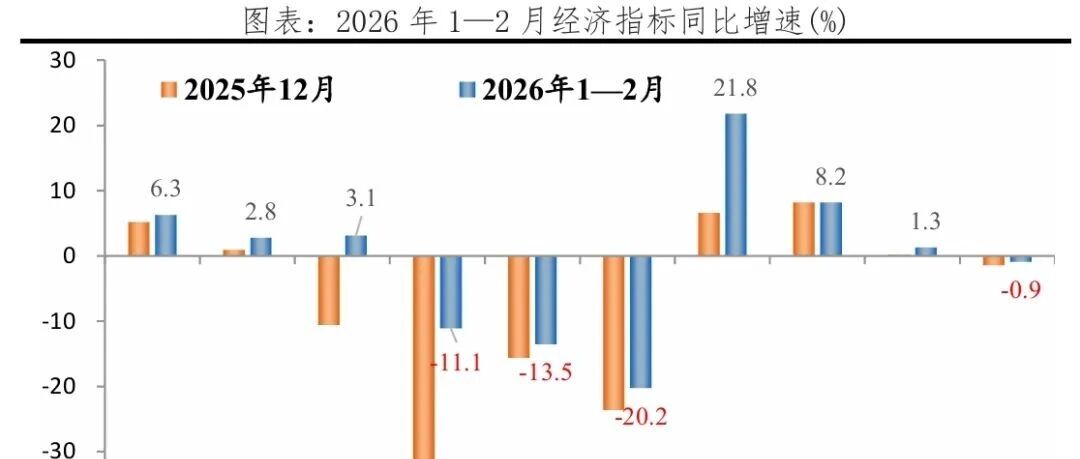
Economic Overview - The national economy showed a "new strong, old weak, external strong, internal stable" trend in the first two months of 2026, with high-tech manufacturing and equipment manufacturing leading the growth [2][3] - Industrial production accelerated, with a year-on-year increase of 6.3% in industrial added value, up 1.1 percentage points from December [2][8] - Fixed asset investment turned positive, growing by 1.8% year-on-year, a significant recovery of 16.9 percentage points from December [2][12] Industrial Production - High-tech manufacturing and equipment manufacturing sectors experienced significant growth, with high-tech manufacturing value-added increasing by 13.1% year-on-year [6][9] - The production of upstream raw materials improved due to rising international oil prices, while midstream machinery and equipment sectors benefited from policy effects [9][10] Investment Trends - Fixed asset investment (excluding rural households) showed a year-on-year increase of 1.8%, with high-tech industry investment growing by 5.1% [12][20] - Infrastructure investment surged by 11.4% year-on-year, driven by the acceleration of major projects and statistical adjustments [17][18] Real Estate Market - The decline in real estate investment narrowed, with sales area and sales amount decreasing by 13.5% and 20.2% respectively, but showing improvement from December [15][16] - Real estate companies are still cautious in land acquisition, with a significant drop in land transaction volume [16] Export Performance - Exports exceeded expectations, with a year-on-year growth of 21.8%, driven by global manufacturing recovery and enhanced competitiveness [25][26] - Exports to countries along the Belt and Road increased by 28.5%, accounting for over 50% of total exports [25][26] Consumer Spending - Social retail sales increased by 2.8% year-on-year, with service consumption performing well due to the long Spring Festival holiday [23][24] - Traditional consumer goods saw a significant demand boost during the holiday period, with restaurant income rising by 4.8% [23] Financial Data - Social financing maintained a stable growth rate of 8.2%, supported by government bonds and bank loans [28][29] - M2 growth remained at 9.0%, while M1 increased by 5.9%, indicating a shift in deposit trends towards non-bank institutions [29] Price Trends - CPI rose by 1.3% year-on-year, the highest in nearly three years, influenced by the timing of the Spring Festival [31][32] - PPI decline narrowed, reflecting input inflation and strong demand in certain technology sectors [31][32]
山西:一文读懂增值税纳税义务发生时间
蓝色柳林财税室· 2026-03-16 01:40
Core Viewpoint - The article discusses the timing of tax obligations for various transactions, emphasizing the importance of understanding when tax liabilities arise based on different scenarios. Group 1: Tax Obligation Timing - The tax obligation for sales is determined by the date of receipt of payment or the date of obtaining the sales payment request, with examples illustrating different scenarios [4][5]. - For deemed taxable transactions, the tax obligation occurs on the day the transaction is completed, such as donations made by companies [7]. - In the case of imported goods, the tax obligation arises on the day of customs declaration [9]. Group 2: Special Provisions - For large machinery, ships, and aircraft with production periods exceeding 12 months, the tax obligation occurs on the day of receipt of payment or the contractually agreed payment date [13]. - When services are sold with upfront payment followed by installment or phased delivery, the tax obligation is determined by the earlier of the actual service start date or the contractually agreed date [13]. - For real estate sales, the completion of ownership registration or actual delivery determines the timing of the tax obligation [13].

战略看多中游制造系列三:如何具象化和跟踪中游制造的价格?
Huachuang Securities· 2026-03-15 05:50
Group 1: Macro Overview - The midstream manufacturing sector is a key driver of economic stability, with 8 out of 10 tracked prices rising this year, indicating a positive trend[1] - The PPI weight of midstream manufacturing has increased by approximately 6 percentage points over the past decade to 41%[1] - Midstream manufacturing is expected to benefit from technological upgrades and global supply chain restructuring, marking a strategic era for the sector[1] Group 2: Price Tracking Indicators - In the computer and communication electronics sector, the PPI weight is projected to be around 12.5% in 2025, with DDR5 prices rising by approximately 33% this year[1] - The electrical machinery sector, with a PPI weight of about 8.5%, has seen a 7% increase in photovoltaic component prices this year[2] - The automotive manufacturing sector, accounting for 8.1% of PPI, is experiencing a marginal improvement in vehicle prices, with some companies indicating potential price increases due to rising costs[5] Group 3: Material Costs - The metal products industry, with a PPI weight of 3.4%, has seen steel prices decrease by about 2% this year, while copper prices have increased by 2%[6] - The new shipbuilding price index in the railway, shipbuilding, and aerospace sector, which has a PPI weight of 1.3%, has risen by 1% this year[7] - The price of battery-grade lithium carbonate, crucial for battery manufacturing, has surged by approximately 34% this year, reflecting its significant cost share in lithium batteries[3]
A股利润回升在即,戴维斯双击可期
雪球· 2026-03-13 08:09
Core Viewpoint - The article emphasizes the strong performance of China's exports, which grew by 39.6% year-on-year in the first two months, significantly exceeding institutional expectations of 7% growth. This growth is attributed to China's enhanced competitiveness and monopoly advantages in various industries [2][5][11]. Group 1: Export Performance and Economic Impact - In the first two months of the year, China's trade surplus reached $213.6 billion, with expectations to potentially break records and reach $1.5 trillion for the year [5][6]. - The article argues that strong external demand can stimulate domestic demand and boost the stock market, countering the notion that a focus on exports would detract from internal consumption [10][12]. - The article highlights that profits from foreign sales can lead to increased domestic consumption, provided that these profits are converted into cash flow within China [15][17]. Group 2: China's Role in Developing Countries - China has been actively investing in developing countries, providing infrastructure and technology, which helps these nations upgrade their industries and economies [37][38]. - The article notes that while developed countries often exploit developing nations, China takes a different approach by engaging in low-margin businesses that may not yield immediate returns but foster long-term relationships [36][38]. - The shift in China's export focus from the U.S. to ASEAN, Africa, and Latin America is highlighted, with the share of exports to the U.S. dropping from 19.2% to 11.4% between 2018 and 2025 [38][39]. Group 3: Product Structure Upgrade - The article discusses the evolution of China's export products, moving from low-end goods to intermediate and capital goods, which are essential for other countries' industrial growth [53][55]. - It mentions that China's exports of intermediate and capital goods are expected to grow by 10.4% and 5.6% respectively by 2025, while consumer goods exports are projected to decline by 1.0% [61]. - The increasing demand for high-tech manufacturing is noted, with significant growth in exports of integrated circuits, automobiles, and ships in early months of the year [61].

2026年1-2月进出口点评:出口会持续超预期吗?
Changjiang Securities· 2026-03-12 09:22
Group 1: Report Industry Investment Rating - Not provided in the content Group 2: Core Viewpoints of the Report - In January - February 2026, the Spring Festival misalignment factor significantly drove exports, and attention should be paid to the pressure of export decline in March. There is a structural recovery in external demand, with strong exports in the AI/semiconductor chain and automobiles, and a rebound in exports of traditional labor - intensive products. Exports to the US improved, with a year - on - year increase of 9.7% in February. The EU and ASEAN together contributed nearly 9 percentage points to the export growth rate. The export boom is generally neutral for the bond market, and the short - term expectation of double - rate cuts may cool down. However, the global stagflation expectation caused by the US - Iran conflict may disrupt external demand, and the sustainability of export growth remains to be observed. Recently, the view of maintaining a stable short - to - medium - term carry strategy and a weakening long - term oscillation for ultra - long - term bonds is maintained [2][10] - The Spring Festival misalignment effect is estimated to contribute more than two - thirds of the export growth rate. From January to February, China's export year - on - year growth rate increased by 15.2 percentage points compared to December 2025 to 21.8%, and the month - on - month growth also significantly exceeded the seasonal level. The main support comes from the Spring Festival misalignment and low - base effect. This year's Spring Festival was in late February, and the effective production and shipping time for traders before the festival was longer than the same period last year. In January - February last year, the cumulative year - on - year export was only 2.3%. It is estimated that this year's Spring Festival misalignment effect drove the January - February export year - on - year growth rate by about 14.9 percentage points. Looking back at "late Spring Festival" years such as 2015 and 2018, the export growth rates in January - February were 15% and 24% respectively, and then usually declined significantly in March, indicating that attention should be paid to whether the export data in March will decline [10] - Exports to the US improved marginally, ASEAN and the EU remained the main drivers of exports, and exports to South Korea increased significantly. From the perspective of the year - on - year export growth rate from January to February, except for a slight decline in exports to India (20.0%), the export growth rates to most major countries and regions increased. Among them, the export growth rates to ASEAN (29.5%), Africa (49.9%), the US (- 11.0%), and the "Belt and Road" region (29.9%) improved significantly, all increasing by more than 18 percentage points. In terms of the contribution to the growth rate, the contribution of major trading partners to China's export growth rate all rebounded to varying degrees. Among them, ASEAN, the EU, and Japan + South Korea + Hong Kong, China + Taiwan, China performed prominently, with their contributions to exports increasing by 2.76, 2.49, and 2.16 percentage points respectively to 4.76 percentage points, 4.08 percentage points, and 5.11 percentage points [10] Group 3: Summary by Relevant Catalogs Event Description - In January - February 2026, imports and exports exceeded expectations, and the trade surplus remained at a high level. In US dollar terms, the year - on - year growth rates of China's export and import values from January to February were 21.8% and 19.8% respectively, and the cumulative trade surplus from January to February reached $213.62 billion. Month - on - month, both exports and imports were stronger than the seasonal level. From January to February, the month - on - month export and import growth rates decreased by 16.6 and 20.5 percentage points respectively to - 8.2% and - 9.1%, both higher than the same period in previous years [5] Event Comment - The prosperity of the AI/semiconductor chain boosted the export of electronic products, and high - tech categories such as mechanical equipment had sufficient growth momentum, with a significant increase in exports of traditional categories. In terms of volume - price analysis, in the export growth rates of representative commodities from January to February, the driving effects of both price and quantity increased. The quantity - driven growth of electronics and electromechanical products increased, the price drag of labor - intensive products weakened, and the contribution of labor - intensive products to exports rebounded by 3.7 percentage points to 2.3 percentage points. The contributions of raw materials, electronics, and machinery to exports all increased. In the industrial chain, in the transportation industry, the year - on - year growth rates of automobiles including chassis (67.1%) and ships (52.8%) changed by - 4.5 and + 27.7 percentage points respectively compared to the previous value; in the machinery industry, general machinery (19.2%) and medical devices (20.8%) continued to grow at a high rate; in the electronics industry, only the year - on - year growth rate of mobile phones (- 8.3%) declined, and the year - on - year growth rate of integrated circuits (72.6%) increased by 24.9 percentage points; among raw materials, the year - on - year growth rates of grain (13.2%) and rare earths (- 15.9%) declined significantly; the year - on - year growth rates of exports of labor - intensive products all rebounded by more than 20 percentage points [7] - Import performance was also higher than the seasonal level, with imports from Japan, South Korea, and resource - rich countries contributing significantly. Industrial raw materials and electronic products were the main commodities with high import growth. From January to February, China's import year - on - year growth rate was 19.8%, an increase of 14.1 percentage points compared to the previous value. In terms of specific countries, among the main import trading partners, except for a slight decline in imports from the EU compared to the previous value, imports from other regions increased, and the year - on - year increase in imports from Japan and South Korea exceeded 25 percentage points to 31.7%. In terms of volume - price analysis, in the year - on - year growth rates of representative imported commodities, both price and quantity contributions increased [7]
1-2月外贸数据点评:出口超预期开局
LIANCHU SECURITIES· 2026-03-11 10:09
Export Performance - In the first two months of 2026, China's exports grew by 21.8% year-on-year, significantly exceeding the Wind consensus forecast of 7.3%[3] - The total export value reached $656.58 billion, well above the average of $550 billion in the same period over the past five years[3] - Key factors for the strong export performance include the late Lunar New Year, a rebound in global manufacturing PMI to 51.9, and the impact of RMB appreciation on export timing[3][4] Regional Export Growth - Exports to Africa surged by 49.9%, contributing 2.64 percentage points to overall export growth, with the share of exports to Africa increasing from 5% to 7%[4] - Exports to Hong Kong, ASEAN, and the EU grew by 38.7%, 29.4%, and 27.8% respectively, each significantly higher than the previous year's growth rates[4] - Exports to the US decreased by 11.0%, but the decline was less severe than in 2025, contributing approximately 1.5 percentage points to the overall export slowdown[4][16] Product Structure and Import Trends - Traditional labor-intensive product exports showed improvement, with categories like bags and textiles growing by 18.4% and 20.5% respectively, contributing about 2.3 percentage points to export growth[5][19] - High-tech and electromechanical product exports continued to rise, with growth rates of 26.9% and 27.1%, contributing 6.6 and 16.2 percentage points to overall export growth[5][19] - Imports increased by 19.8% year-on-year, significantly higher than the expected 6.9%, driven by a recovery in domestic demand and price stabilization[7][22] Future Outlook and Risks - While the strong export performance in early 2026 is encouraging, a potential decline in March is anticipated due to high base effects and pre-shipment factors[8][24] - Key risks include unexpected changes in overseas policies, slower-than-expected global economic recovery, and geopolitical tensions affecting manufacturing demand[26]
中游出口强劲的五大逻辑——1-2月进出口数据点评
一瑜中的· 2026-03-11 05:59
Core Viewpoint - China's export performance in January-February significantly exceeded market expectations, with a year-on-year increase of 21.8% in dollar terms, far surpassing Bloomberg's forecast of 7.2% [2][37]. Group 1: Strong Export Logic - The robust export growth is primarily driven by five key factors: proactive enterprise exports, credit expansion in Europe, increased AI and electricity investments in the U.S., rising overseas security demands, and improved midstream prices leading to higher export growth [4][13]. - Enterprises are increasingly exploring non-traditional markets, with exports to these markets growing by 25.5%, outpacing traditional markets by 5.9 percentage points [5][14]. - European credit expansion is driving manufacturing recovery, resulting in a 27.8% increase in exports to Europe, contributing 4.1% to overall export growth [6][18]. - Increased U.S. investments in AI and electricity are benefiting exports of electronic and electrical equipment, with integrated circuit exports surging by 72.6% [7][22]. - Global security concerns are boosting demand for capital goods and new energy products, with capital goods exports growing by 30.7% and new energy vehicle exports increasing by 103.6% [8][24]. Group 2: Import and Export Data - Imports also exceeded expectations, with a year-on-year increase of 19.8%, compared to a forecast of 7% [2][37]. - The strong performance in the electronics supply chain contributed to an 8.6% increase in imports during January-February [2][37]. - The trade surplus saw a significant year-on-year increase, reflecting the overall positive trade balance [10][37]. Group 3: Export Price and Volume - January-February saw a dual improvement in export volume and price, with the weighted average export price rising to 17% year-on-year, up from 9.2% in December [9][40]. - The average export quantity for 14 major products increased to 18.6% year-on-year, indicating strong demand [40][50]. - The export growth was notably driven by integrated circuits, automobiles, and electromechanical intermediate products, which collectively contributed significantly to overall export growth [50][52].