
WUS

Search documents
亚洲科技硬件 AI PCB 指南(第二部分):参与者、定位与盈利能力;欣兴电子看涨目标价-Bernstein-Asia Tech Hardware AI PCB primer (part 2)~Players, Positioning and Profitability; Unimicron bull case
2026-02-11 05:56
Summary of Key Points from the Conference Call Industry Overview - The PCB/substrate market is experiencing significant growth driven by increased content in AI servers and anticipated ASP hikes in 2026 [2][12] - The supply of ABF substrates is concentrated in Taiwan, Korea, and Japan, with China playing a crucial role in MLPCB and HDI production [3] Company Dynamics Unimicron - Forecasts a 25% revenue and 117% EPS CAGR from 2025-2027, with an OPM expected to reach 16% due to strong demand for high-end ABF substrates [6] - Current stock price is NT$347.50 with a target price of NT$270.00, indicating a potential upside of ~15% [10] - Anticipates improved utilization rates and ASP growth due to T-glass shortages, with revenue expected to grow by ~30% in 2026 [70][83] Ibiden - Strong outlook due to Nvidia's GPU ramp-up and Intel's server CPU demand, with a price target set at ¥9,200 [7] - Plans to increase capex to ¥500 billion over the next three years, focusing on advanced technology for high ASP products [47] Ajinomoto - Holds a 95% market share in ABF Film, generating a 54% operating profit margin, with expectations for continued growth driven by AI demand [8] - Revenue growth forecasted at 40%+ through 2027 [8] Financial Performance - AI-related products are currently enjoying elevated margins, with gross margin expansions ranging from ~1ppt to 14ppts across various companies [5][58] - Companies like EMC and WUS are generating around 20% ROIC, the highest in the supply chain [5] Market Trends - The PCB market is capital-intensive, requiring continuous capacity expansion to meet cyclical demand [45] - Companies are ramping up investments for capacity expansion, with VGT expected to see a 7.8x increase in capex in 2026 [45] - The demand for high-end materials, particularly T-glass, is expected to remain tight through 2026, impacting pricing and margins [48] Investment Implications - Unimicron, Ajinomoto, and Ibiden are rated as outperformers, with respective price targets indicating significant upside potential [10][11] - The overall PCB market is projected to see revenue increases in 2025-2027, particularly for companies with higher AI and server exposure [38] Additional Insights - The complexity of PCBs is increasing, which supports a double-digit market outlook [4] - New product cycles, including midplane and backplane MLPCBs, are expected to partially offset competitive pressures on margins [5][58] - The geopolitical sensitivity of PCBs is lower compared to IC substrates, as they are sub-components shipped to ODMs for assembly [3] This summary encapsulates the key points discussed in the conference call, highlighting the dynamics of the PCB/substrate industry and the performance outlook for major companies involved.
全球 PCB:供应分配细分;成本、竞争与收入确认常见问题解答-Global PCB_ Allocation breakdown; FAQs on cost, competition, and revenue recognition
2026-02-02 02:22
30 January 2026 | 12:23PM HKT Equity Research Global PCB: Allocation breakdown; FAQs on cost, competition, and revenue recognition Following the initiation of Victory Giant, WUS and Shengyi, we further breakdown our AI PCB and CCL allocation to reflect the important role these companies play in the AI server PCB/ CCL supply chain (Exhibit 2). We address key investor debates in this report, covering topics including increasing material costs, rising competition, and the time gap between building up new capac ...
亚洲科技硬件-AI PCB入门指南:技术与供应链-Asia Tech Hardware AI PCB primer (part 1)- technology & supply chain
2026-02-02 02:22
Summary of Asia Tech Hardware Conference Call Industry Overview - The global PCB market is valued at over **US$80 billion**, with AI-driven demand expected to grow at a **double-digit** rate this year [2][20] - The PCB market consists of various products, with **rigid PCBs** accounting for roughly half, while the remainder includes **flexible printed circuits (FPC)**, **high-density interconnects (HDI)**, and **IC substrates** [20] - The consumer sector represents **one-third** of the PCB market, while the server/storage sector is projected to grow from **18%** to **22%** by 2029, with an **11% CAGR** [20][24] Key Market Trends - **MLPCB (Multi-layer PCB)** is increasingly used in AI servers, with layer counts rising from **16 layers** to over **40 layers** in advanced applications [2][31] - **HDI demand** is accelerating, with its market share increasing to around **20%** of the PCB market, driven by the need for higher thermal robustness in AI servers [3][36] - The **ABF substrate** market is growing due to rising package sizes and manufacturing complexity in AI accelerators, with expectations of price increases due to material shortages [5][6] Competitive Landscape - **WUS** is the primary supplier of MLPCB for Nvidia's GB300 rack, followed by **Unimicron** and **Victory Giant (VGT)** [2] - **Victory Giant** has become the largest HDI supplier for Nvidia's GB200/GB300, thanks to investments in new facilities and equipment [37] - **Ajinomoto** is a leading supplier of Build Up Film for ABF substrates, experiencing mid-20% top-line growth [6] Material Insights - **CCL (Copper-Clad Laminate)** constitutes about **30%** of PCB costs, with a shift from **M6** to **M8** and plans to move to **M8.5/M9** next year [4] - The demand for **low-CTE glass fiber (T-glass)** is increasing, with market leader **Nittobo** achieving a CTE of **2.8 x10^-6/℃** [6] - The supply of high-end materials is tight, benefiting companies capable of producing advanced materials [45] Financial Performance and Projections - **Unimicron** is rated **Outperform** with a price target of **NT$270.00** [9] - **Ajinomoto** is rated **Outperform** with a price target of **JPY5,000.00** [10] - **Ibiden** is rated **Outperform** with a price target of **JPY8,250.00** [11] Investment Implications - The PCB market is expected to maintain a **mid-single-digit growth** rate over the next two years, with potential upside as demand for AI applications increases [20] - The overall substrate mix in the PCB market is projected to grow to approximately **20%** by 2027 [63] Additional Insights - The PCB market is fragmented, with the top three players in the IC substrate market holding about **35%** of the share [64] - The complexity of AI accelerators is increasing, driving demand for high-end ABF substrates [72] - The industry is exploring new materials like **glass-core substrates**, which could significantly enhance performance but face challenges in commercialization [73][77]
PCB的M9材料替换M8材料对设备和钻针影响
傅里叶的猫· 2025-10-23 14:39
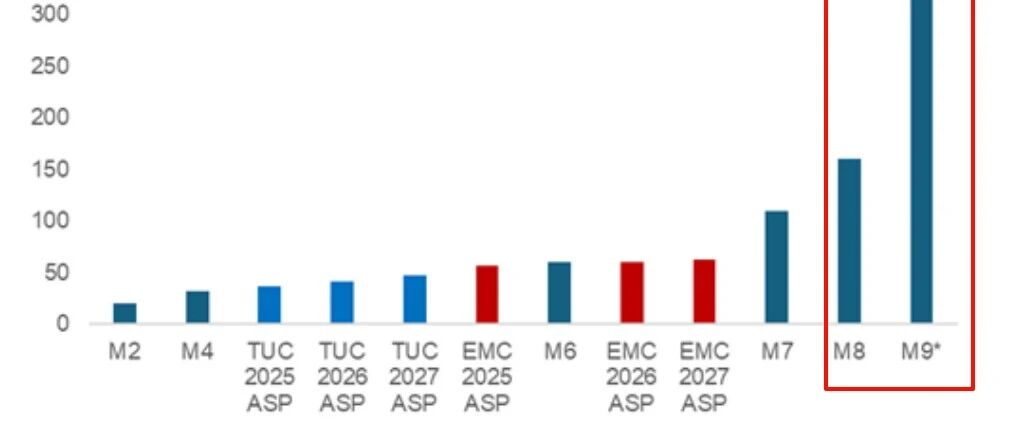
Group 1: PCB Material Solutions - The report from Nomura summarizes various PCB materials used by major companies like nVidia, AWS, Google, and Meta, detailing their respective generations, structures, and suppliers [1] - nVidia's H100 and B200 generations utilize M7 and M8+M4 CCL materials, with suppliers including EMC and Unimicron [1] - AWS's Trainium 2 and Google’s TPU v6p are also highlighted, with specific CCL materials and suppliers listed, indicating a trend towards advanced PCB structures [1] Group 2: Comparison of M8 and M9 - M9 CCL offers significant improvements over M8, including a lower loss factor (Df) of ≤0.0007 compared to M8's 0.001, representing a 30% reduction [7][8] - The dielectric constant (Dk) for M9 is also lower at 2.6-2.8, compared to M8's 2.8-3.1, indicating a 10% decrease [8] - M9 supports higher bandwidth capabilities, enabling 2.4T+ switches and servers, which is a 50% increase in bandwidth compared to M8 [8] Group 3: Impact on Upstream Equipment - The transition to M9 necessitates upgrades in CO2 drilling technology due to the higher melting point of Q-Glass, requiring new equipment development [9] - The wear on drilling needles has increased significantly, with a single needle now only able to drill 100-200 holes for M9, compared to 500 for M8 and 1000 for M7 [9] - The cost of new ultra-fast laser drilling equipment is estimated to exceed 5 million, indicating a substantial investment requirement for manufacturers [9]

野村:Meta 在 ASIC 服务器方面雄心勃勃,其 MTIA AI 服务器有望在 2026 年成为一个里程碑
野村· 2025-06-19 09:46
Investment Rating - The report does not explicitly provide an investment rating for the industry or specific companies involved in AI ASIC servers. Core Insights - The AI ASIC market is expected to grow significantly, with Meta's MTIA AI servers potentially marking a milestone in 2026. The total AI ASIC volume could exceed nVidia's AI GPU volume by 2026 [1][3][12] - nVidia currently dominates the AI server market with over 80% market value, while ASIC AI servers hold approximately 8-11% market value share. However, unit comparisons suggest that Google and AWS's AI ASICs could reach 40-60% of nVidia's GPU volume by 2025 [1][3] - Meta's MTIA AI server is projected to ramp up significantly, with expectations of 1 to 1.5 million units of MTIA V1 and V1.5 by late 2025 to 2026 [10][12] Summary by Sections AI ASIC Market Dynamics - The AI ASIC market is experiencing aggressive growth, with more cloud service providers (CSPs) developing their own ASIC solutions, including Meta and Microsoft [1][3] - nVidia is responding to competition by unveiling NVLink Fusion, which allows inter-chip connections between its GPUs and third-party CPUs, indicating a proactive approach to maintain its market position [2] Meta's MTIA AI Server Development - Meta's MTIA AI server is set to launch its first ASIC (MTIA T-V1) by late 2025, with subsequent versions (V1.5 and V2) expected in mid-2026 and 2027, respectively [9][10] - The MTIA T-V1.5 is anticipated to be significantly more powerful than V1, with a larger interposer size and complex design [9][10] Supply Chain and Component Insights - Key suppliers for Meta's MTIA projects include Quanta, Unimicron, EMC, WUS, and Bizlink, which are expected to benefit from the growing demand for AI ASICs [12][13][14][15][19] - The report highlights the importance of baseboard management controllers (BMCs) in Meta's ASIC AI server development, with an estimated 23 BMCs per rack [17][18] Competitive Landscape - Despite nVidia's current leadership in AI computing, the report suggests that the gap is narrowing as ASIC solutions improve in specifications and performance [3][7] - The specifications of AI ASICs from companies like Google and AWS are catching up to nVidia's offerings, although nVidia still holds advantages in connectivity and ecosystem [7][8]

