AI trade

Search documents
S&P 500 could fall to 6,150: analyst explains how to play the dip
Invezz· 2026-03-31 03:54
Core Viewpoint - The S&P 500 index is projected to potentially drop to 6,150, entering correction territory, due to escalating tensions from the Iran war, but this dip is seen as a buying opportunity for long-term investors [1][6]. Market Analysis - The anticipated lifting of the pause on targeting Iranian energy infrastructure by President Trump on April 6 could lead to higher oil prices, which historically have caused lasting economic damage. However, this situation is viewed as an inflection point for disciplined investors [2]. - Julian Emanuel, a senior analyst at Evercore ISI, suggests that during periods of "irrational volatility," investors should consider buying into the market rather than fearing the drop [3]. Investment Strategy - Emanuel recommends focusing on high-quality assets at discounted prices, particularly in the large-cap tech sector, as the Nasdaq 100's price-to-earnings (P/E) ratio is relatively low compared to the S&P 500, a valuation gap not seen since the pandemic [4]. - The "AI trade" is highlighted as a significant opportunity, with firms in this sector expected to have visible earnings streams that can endure economic slowdowns [4]. Historical Context - Emanuel draws parallels between the current market anxiety and last year's "tariff tantrum," where investors reacted to trade war fears. He successfully advised investors to accumulate shares during that period, which led to a strong market recovery [7]. - A potential "policy breakthrough" regarding Iran could trigger a similar market rebound, as the resolution of geopolitical fears may act as a catalyst for stock price increases [8]. Future Outlook - Despite the immediate risk of a drop to 6,150, the long-term outlook for the S&P 500 remains positive, with a year-end target of 7,750, indicating a potential 22% rally from current levels [9]. - Investors willing to accept a 3% downside may find significant rewards by December, particularly in the AI and tech sectors [10].

DoubleLine's Jeffrey Sherman on the Fed's TACO Trade & Fixed Income Strategy
Etftrends· 2026-03-23 14:33
Core Insights - The fixed income landscape is undergoing significant changes, with traditional strategies for inflation and interest rates being re-evaluated [1] - The Federal Reserve's current trajectory is a focal point, with skepticism about an immediate pivot in interest rates despite market expectations [2][3] Federal Reserve's Strategy - The market is adopting the "TACO trade" belief, anticipating that the Fed will lower rates when economic pain points are reached, but skepticism remains regarding the timing of such a move [2] - For the Fed to cut rates, a significant deterioration in the labor market is necessary, as current labor participation rates and unemployment claims are stable [3] Macroeconomic Factors - Three regressive taxes impacting American consumers have been identified: initial inflation, tariffs, and rising fuel prices, which are constraining economic growth [4] - Oil prices are highlighted as a critical factor influencing the rates market, with a potential threshold for the 10-year Treasury yield set at 5.002% [5] Private Market Risks - Concerns are raised about liquidity mismatches in private credit markets, particularly in products marketed to retail investors, which could lead to negative investor sentiment during redemption spikes [6][7] - The necessity of matching liquidity of underlying assets with redemption terms is emphasized, indicating that private credit should not be included in ETF structures [7] Strategic Positioning - Advisors are encouraged to focus on low-duration and ultra-short categories for high quality with less interest rate sensitivity, as well as the five-to-seven-year Treasury range to balance against economic slowdowns [9] - Emerging market local currency investments, yielding around 7%, are noted as attractive diversifiers for those willing to accept currency volatility [9] AI Trade Concerns - Caution is advised regarding AI-related investments in the bond market, as these often reside in riskier segments and may lead to disappointing returns if the current enthusiasm fades [10]

Aehr Test Systems: Sales Growth Expected, But A Show-Me Story (Downgrade)
Seeking Alpha· 2026-03-23 10:00
分组1 - The AI trade and momentum theme has faced pressure recently, impacting Aehr Systems (AEHR) negatively [1] - Aehr Systems' stock has returned 292% over the past year, significantly outperforming the market [1]


New Fed "Dot Plot" Sends Markets Sliding
ZACKS· 2026-03-18 22:40
Market Overview - Major market indexes experienced significant declines, with the Dow down 768 points (-1.63%), S&P 500 down 91 points (-1.36%), Nasdaq down 327 points (-1.46%), and Russell 2000 down 41 points (-1.65%) [2] - All indexes are down month-to-date, indicating a lack of positive momentum in the market [2] Federal Reserve Meeting Insights - The Federal Open Market Committee (FOMC) decided to keep interest rates unchanged at +3.50-3.75%, consistent since December [3] - The FOMC's dot-plot indicates only one anticipated rate cut this year and another in 2027, with the long-run neutral rate increasing by 10 basis points to +3.1% [4] - Inflation expectations have risen, with the FOMC projecting a +2.7% inflation rate for March, up from +2.4% in December [6] Micron Technology Performance - Micron Technology reported fiscal Q2 earnings of $12.20 per share, significantly exceeding the previous year's $1.56, with revenues nearly tripling year-over-year [7] - The company’s non-GAAP gross margins reached +74.9%, surpassing the projected +68.9% [7] - Guidance for Q3 indicates earnings growth of +50% to $19.15 per share and revenue growth of +35% to $32.5 billion, driven by strong performance in the AI sector [8] - Despite an initial dip of -1.2% in shares post-announcement, the stock has gained nearly +62% since the beginning of the year [8]


The AI trade still 'has legs': Wall Street analysts weigh tech stock picks amid market sell-off
Yahoo Finance· 2026-03-08 14:00
Group 1: Market Overview - Markets experienced a sell-off due to escalating US-Israeli strikes, leading to oil prices reaching their highest levels since 2024, prompting investors to reassess risks of a prolonged regional conflict [1] Group 2: Technology Sector Resilience - There is a "structural tailwind" for the AI trade, with hyperscalers expected to increase investments by 30% in 2026, indicating a long-term growth narrative despite broader market uncertainties [2] - Microsoft (MSFT) and Apple (AAPL) are identified as primary defensive anchors, essential for maintaining connectivity even during economic slowdowns [2][3] - Microsoft has a substantial backlog of $625 billion, while Apple boasts a strong cash flow, providing critical buffers against market volatility [3] Group 3: Alphabet and Meta Analysis - Alphabet (GOOGL, GOOG) is viewed as a resilient option due to its steady business model, while skepticism surrounds Meta (META) due to its heavy reliance on advertising, which constitutes approximately 98% of its revenue [4] - Microsoft and Alphabet benefit from enterprise cloud buffers, whereas Meta is vulnerable to reductions in marketing budgets from small and medium-sized businesses [4] Group 4: Amazon's Market Position - Amazon (AMZN) is seen as increasingly attractive on a sum-of-the-parts basis, with significant margin opportunities in both retail and its cloud service, Amazon Web Services (AWS) [5] Group 5: Cybersecurity and Defense Sector - The cybersecurity and defense sectors are becoming essential utilities amid global tensions, with companies like Palantir (PLTR), CrowdStrike (CRWD), and Palo Alto Networks (PANW) leading in providing digital protection against state-actor threats [6]



Why Telecoms Like AT&T And Verizon Are Trouncing Tech Giants
Investors· 2026-03-05 22:32
Core Viewpoint - AT&T and Verizon stocks are outperforming major tech stocks like Google and Meta, with AT&T up 16.6% and Verizon up 25.7% year-to-date, indicating a market rotation towards value-driven and defensive sectors [1][1][1] Market Trends - The market is experiencing a rotation away from growth-oriented stocks, with institutional investors shifting into defensive, low-volatility positions to protect gains [1][1] - Weakness in technology, communications, and financial sectors contrasts with the performance of other sectors, suggesting a significant leadership rotation in stocks [1][1] Stock Performance - AT&T stock has formed a 123-day cup-with-handle pattern with a potential entry point of 29.79, remaining above its 50-day and 200-day moving averages [1][1] - Verizon stock broke out of a 227-day consolidation on February 10, surpassing the 47.35 entry point and trading well above its pivot point and moving averages [1][1] Investor Insights - The current market dynamics provide valuable lessons for newer investors, highlighting that bull markets can be driven by defensive stocks rather than just growth stocks [1][1] - The sudden shift towards defensive stocks has been notable, contrasting with the typical growth-driven bull market expectations [1][1]


May You Invest in Interesting Markets
Etftrends· 2026-03-05 16:14
Core Insights - The investment landscape has shifted from a focus on the S&P 500 to a more diversified approach, with international equities gaining traction and sectors within the U.S. undergoing rotation [1][2] Group 1: U.S. Sector Performance - Historically, around 5 out of 11 U.S. equity sectors outperformed the S&P 500 on a trailing 1-year basis since 2008, but from Q2 2023 to the end of 2025, only 3 sectors on average were beating the index [1] - In 2026, 6 out of 11 sectors are now leading the S&P 500, indicating a potential sector rotation or de-risking rather than a fundamental change in market conviction [1] - Technology and Communication Services have notably underperformed, while Energy and Industrials have shown better performance this year compared to early 2023 [1] Group 2: International Equities - International equities have outperformed the S&P 500 over the last 2-3 months, marking the best simultaneous streak of outperformance since 2018 across various country ETFs [1] - In 2026, every region tracked is beating the S&P 500 on a trailing 3-month basis, with India and China noted for underperformance, suggesting future investment opportunities [1] Group 3: Low-Beta vs. High-Beta Stocks - Low volatility stocks have recently begun to recover against high beta stocks, which have historically performed in line with expectations during positive momentum-driven markets [2] - Since the beginning of the year, low volatility equities have gained approximately 34% against high beta equities, indicating a potential shift in market dynamics [2] - The current upward trend in low volatility stocks may be temporary, as previous recoveries have often been followed by continued declines [2]
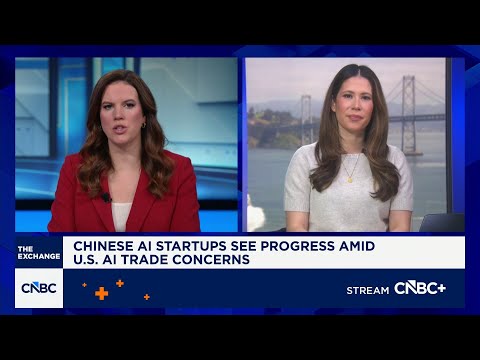
Chinese AI startups see progress amid U.S. AI trade concerns
CNBC Television· 2026-03-03 19:30
Welcome back. The drama between the Pentagon and our AI companies is highlighting the broader risk for the US that China's unified strategy in military AI will give it the ultimate edge. Deja Bosa has more in today's tech.Dearra, hey, Kelly. So, the AI trade, it was built on a core assumption, American dominance. But that is falling apart just as geopolitics are picking up.And Wall Street is noticing. Investors have already been asking whether the trillions of dollars being poured into American AI infrastru ...
Why the S&P 500 Is Looking ‘Toppy'
Barrons· 2026-02-27 19:42
Core Viewpoint - The AI trade has become overextended, and the market faces various other concerns that could impact investment strategies [1] Group 1: AI Trade Analysis - The current valuation of AI-related stocks has reached high levels, indicating a potential overvaluation in the sector [1] - Investors are advised to be cautious as the enthusiasm surrounding AI may not be sustainable in the long term [1] Group 2: Market Concerns - The market is grappling with multiple issues beyond AI, including inflation, interest rates, and geopolitical tensions, which could affect overall market performance [1] - These external factors may lead to increased volatility and uncertainty in investment decisions [1]

Apple, Alphabet could win the trillion dollar personal AI market: Intelligent Alpha's Doug Clinton
Youtube· 2026-02-25 21:38
Core Viewpoint - The discussion highlights a preference for companies like Amazon, Apple, and Google over Nvidia, with a focus on the potential of personal AI as a significant growth area not yet priced into these stocks [1][2][3]. Group 1: Company Performance and Expectations - Nvidia is expected to report strong numbers, but the market may have already priced in much of this performance, leading to muted price action compared to previous quarters [6][7]. - The free cash flow yield of Nvidia is currently the highest among major tech companies, indicating strong cash generation capabilities [4]. - Apple, while not heavily investing in capital expenditures, has the second highest free cash flow yield, presenting an interesting investment opportunity [5]. Group 2: Market Trends and AI Impact - The potential for personal AI is identified as a new market opportunity exceeding one trillion dollars, with Apple and Google positioned to capitalize on this trend alongside OpenAI [2][3]. - The AI trade is reaffirmed as a significant driver for the hyperscaler and hardware sectors, with ongoing questions about the implications of AI on information work and enterprise tools [8][10]. - The performance of software companies, particularly in the context of AI integration, is seen as a critical area to watch, with concerns about the future justification of certain tools as AI evolves [9][10].