
Consumption

Search documents
FXTRADING 经济数据汇总:欧元区消费复苏乏力,英国央行分歧加剧,欧洲央行维持观望与美联储警惕通胀回头
Sou Hu Cai Jing· 2026-02-05 19:11
Group 1: Eurozone Retail Sales - Eurozone retail sales fell by 0.5% month-on-month in December, continuing a trend of weakness and exceeding market expectations [2] - There is a clear divide between essential and discretionary spending, with food sales showing slight growth while non-food items declined significantly [2] - The performance of retail sales varies significantly among member countries, with consumption disparities between northern and southern regions further weakening overall recovery [2] Group 2: Bank of England's Interest Rate Decision - The Bank of England maintained the base interest rate at 3.75%, aligning with market expectations, but the voting structure revealed internal divisions [4] - The 5-4 vote indicates a split in views on whether to maintain rates or lower them, reflecting concerns over inflation and economic pressures [4] - The current stance suggests that the Bank of England is unlikely to change its position in the short term, but the voting outcome may foreshadow future policy shifts [4] Group 3: European Central Bank's Policy - The European Central Bank kept the deposit rate unchanged at 2.00%, maintaining a cautious approach [6] - The statement emphasized confidence in medium-term inflation returning to target and indicated no urgent need for action [6] - The ECB's current focus is on stabilizing expectations rather than guiding trends, with euro movements likely influenced more by external factors [6] Group 4: Federal Reserve's Inflation Concerns - The Federal Reserve is shifting its focus to inflation risks, with some officials noting an upward tilt in risk distribution despite overall stable inflation [8] - Recent increases in commodity inflation are linked to tariff adjustments, creating uncertainty in price transmission and sustainability [8] - The Fed's cautious approach to interest rate cuts reflects the ongoing uncertainties surrounding tariffs and policy, suggesting dollar rates will remain resilient in the short term [8]


X @The Economist
The Economist· 2026-01-30 01:40
Studies suggest moderate consumption is harmless. It may even be beneficial https://t.co/O5zsPVzsJL ...
BIS-中国住房财富效应
2025-12-31 16:02
Summary of Key Points from the Conference Call on Housing Wealth Effects in China Industry Overview - The report focuses on the housing market in China, particularly the relationship between house prices and household consumption in different city tiers [8][11][55]. Core Findings - **Housing Wealth Effects**: A 10% increase in house prices in Tier 1 and Tier 2 cities leads to a 1.6% increase in consumption. This effect is not observed in Tier 3 and Tier 4 cities [8][41]. - **Demographic Variations**: Older households exhibit stronger housing wealth effects compared to younger households. In Tier 1 and Tier 2 cities, younger individuals do not show significant wealth effects, while in Tier 3 and Tier 4 cities, rising house prices crowd out consumption among younger households [15][56]. - **Economic Contribution**: Tier 1 and Tier 2 cities account for over 37% of China's retail consumption, highlighting the importance of the housing market in these regions [13][14]. Additional Insights - **Debt Concerns**: Between 2015 and 2021, house prices and household debt in China rose by 49% and 23%, raising concerns about potential debt-deflation spirals [11]. - **Consumption Patterns**: The study utilized Alipay transaction data from 200,000 households, indicating that housing constitutes a significant portion of household assets, with nearly 70% of urban household assets tied to real estate [12][13]. - **Market Dynamics**: The oversupply of housing in Tier 3 and Tier 4 cities leads to weaker wealth effects, as these areas experience lower liquidity and demand [20][55]. Methodology - The analysis leverages a unique dataset of Alipay transactions from January 2017 to March 2023, allowing for a detailed examination of consumption patterns across different demographics and city tiers [12][22]. Implications for Policy - The findings suggest that public policies on real estate should be tailored to address the specific issues faced by different city tiers. Sustaining house prices in lower-tier cities may not spur consumption unless it addresses oversupply [57]. Conclusion - The study concludes that while housing wealth effects are significant in Tier 1 and Tier 2 cities, they are largely absent in Tier 3 and Tier 4 cities due to various economic factors, including oversupply and demographic trends [55][56].
X @The Economist
The Economist· 2025-12-22 02:20
Geopolitical Impact on Consumer Behavior - Despite public anger in China towards Japan due to the prime minister's comments about Taiwan, Chinese consumers continue to purchase Japanese products [1]
India's Advisor Sees US Trade Deal Signed by March
Bloomberg Television· 2025-12-11 14:57
Trade and Geopolitical Factors - Trade deal timeline is uncertain, influenced by geopolitical developments more than bilateral trade issues [1][2] - A trade deal agreement would significantly boost Indian market sentiment by removing risk premium [4] - Trade uncertainties impact GDP projections, but domestic economy and exporter diversification mitigate negative effects [5] Economic Growth and Reforms - India's potential growth has likely increased due to decade-long structural reforms, including public infrastructure investment, digital infrastructure rollout, GST, and insolvency/bankruptcy code [8] - The economy has consistently outperformed expectations in the last five years post-COVID, suggesting potential for continued positive surprises in fiscal year 2026-2027 [11] - RBI estimates India's growth at 73% for fiscal year 2025-2026, and predicts around 67% for the next fiscal year [10] Consumption and Household Savings - Consumption is expected to strengthen, particularly in urban India, supported by GST reform and direct tax relief [12][14] - Rural consumption is performing well due to successive good monsoons and real wage/income growth [12][13] - India's household savings rate has increased from 49% of GDP in 2022-2023 to 6% of GDP, indicating improved household balance sheets [15] Rupee and Inflation - Weaker rupee improves the Indian trade balance on a net basis, offsetting import costs and benefiting exporters [17][18] - Rupee weakness reflects investor caution and is undervalued relative to India's economic fundamentals [20][22] - The rupee could be undervalued by 5% to 15% in real effective terms [24] - Lower inflation is seen as beneficial for the Indian economy, reflecting the impact of structural reforms on supply-side constraints [32] Aviation Industry - Recent disruptions in the aviation sector, such as flight cancellations, are expected to lead to better systems and resilience in the long run [38] - The long-term impact of aviation issues on Indian domestic and foreign tourism is not expected to be significant, given growing market and purchasing power [40]

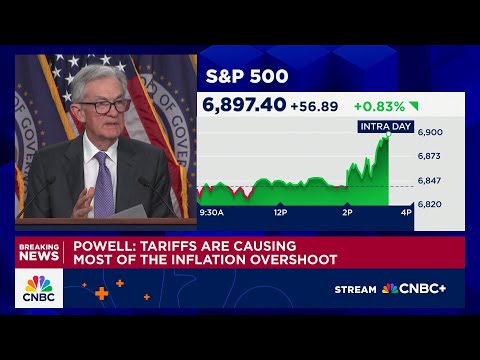
Fed Chair Powell: Housing market faces significant challenges
CNBC Television· 2025-12-10 20:52
I wanted to ask you about how the higher inome households are really [clears throat] driving spending right now. They're backed by home equity and stock market wealth, but lower-income consumers are really struggling with the accumulation of 5 years now of rising prices. It's price levels, not really the inflation rate holding some of these families back.How sustainable is this so-called K-shaped economy and and what are the Fed's thoughts on whether that's a risk going forward. So we do um through our vast ...
X @The Economist
The Economist· 2025-12-10 03:40
Studies suggest moderate consumption is harmless. It may even be beneficial https://t.co/e12xnlvvxB ...
X @The Economist
The Economist· 2025-12-07 03:20
With their latest plans to revive consumption, you could be forgiven for thinking that China’s leaders are freelancing as retail consultants https://t.co/m0EEpjZA7u ...
X @The Economist
The Economist· 2025-12-06 01:00
The Communist Party’s plan for reviving consumption in China is almost entirely focused on supply rather than demand. That might be the wrong approach https://t.co/kCQJtQaERu ...
X @Bloomberg
Bloomberg· 2025-12-05 04:44
China’s leaders are widely expected to stick with its manufacturing-led growth strategy in key policy meetings this month, even as calls grow at home and abroad for a more urgent shift toward consumption https://t.co/qdvby56RAC ...