
Federal Reserve monetary policy

Search documents
One of the Most Dovish Fed Governors Just Raised the Bar for Rate Cuts
Barrons· 2026-02-23 16:50
Core Viewpoint - Christopher Waller, a member of the Federal Reserve, recently shifted his stance from advocating for interest rate cuts to indicating that the next decision on rates is uncertain, describing it as a "coin flip" [1] Group 1 - Waller's previous dissent was in favor of cutting interest rates, highlighting a significant change in his perspective [1] - The current economic conditions have led to increased uncertainty regarding future interest rate decisions [1]


4 Worst Sectors To Invest In This Year, According to Experts
Yahoo Finance· 2026-02-02 15:40
Core Insights - The stock markets performed well in 2025, with the S&P 500, Nasdaq, and Dow all gaining 13% or more year-to-date as of December 23, but not all sectors shared in this success [1] - The Federal Reserve's monetary policy is expected to shift towards a more dovish stance in 2026, which will have varying impacts on different sectors [2] Real Estate Sector - Real estate is currently identified as the worst-performing sector, receiving an average score of only 30 out of 100 for key signal upsides [3][4] - A significant challenge for the real estate sector is a "massive" refinancing wall, with over $1.5 trillion to $2 trillion in commercial mortgages maturing through 2026-27, leading to refinancing at much higher rates [5] - This refinancing pressure is expected to crush free cash flow, increase default risk, and result in dividend cuts and dilutive equity issuance, negatively impacting equity performance [5] Banking/Finance Sector - Financial stocks are expected to struggle in a falling interest rate environment, as profitability tends to be challenged [6] - The rates banks earn on new and existing variable-rate assets decline faster than the rates they can reduce on deposits, which squeezes net interest margins [6]
Dow closes higher on first day of 2026, still no Santa Claus rally
MINT· 2026-01-02 21:02
Market Overview - The Dow Jones Industrial Average rose by 311.99 points, or 0.67%, closing at 48,383.22, marking the end of a four-day losing streak [3] - The S&P 500 gained 12.52 points, or 0.18%, ending at 6,858.02, while the Nasdaq Composite fell by 5.30 points, or 0.02%, to 23,236.69 [3] Sector Performance - Chip stocks, particularly Nvidia and Intel, contributed positively to the market, with the Philadelphia SE Semiconductor index showing significant gains [2] - Industrials and utilities sectors also experienced upward movement, with companies like Caterpillar and Boeing seeing sharp increases [2] Consumer Discretionary Sector - The consumer discretionary sector faced pressure, notably with Amazon's stock declining [3] - Tesla's shares slipped as the company reported a second consecutive year of annual sales decline [3] Economic Indicators - The Federal Reserve's monetary policy is expected to influence global markets in 2026, with expectations of a more dovish Fed chair leading to potential interest rate reductions [5] - Upcoming labor market data is anticipated to be a key focus, especially in light of the Fed's cautious stance on further interest rate cuts until job market clarity is achieved [6] Tariff Developments - President Trump's decision to postpone tariff hikes on upholstered furniture, kitchen cabinets, and vanities for another year positively impacted furniture retailers, with stocks of Wayfair, Williams-Sonoma, and RH rising sharply [8]


Further rate cuts in question as Fed policymakers deeply divided over December cut, minutes show
Fox Business· 2025-12-30 23:41
Core Viewpoint - The Federal Reserve's decision to cut interest rates in December was contentious, reflecting a divided stance among policymakers amid economic challenges, including a slowing labor market and elevated inflation [1][2]. Interest Rate Decision - The Fed reduced rates by 25 basis points for the third consecutive time, bringing the benchmark federal funds rate to a range of 3.5% to 3.75% [2]. - Two voting members dissented against the rate cut, advocating for maintaining rates, while one member favored a larger cut of 50 basis points [3]. Economic Outlook - A majority of participants supported the rate cut as a proactive measure to stabilize the labor market, although some expressed concerns about stalled progress towards the 2% inflation target [4]. - Some policymakers suggested that it might be appropriate to keep the target rate unchanged for a period following the recent cut [6]. Future Rate Cuts - Fed Chair Jerome Powell indicated that the policy level is nearing neutral, suggesting that further rate cuts may be paused as the Fed awaits new economic data [7]. - Policymakers noted that upcoming labor market and inflation data would be crucial for assessing the need for further rate reductions [10]. Economic Disparities - The minutes revealed concerns about a "K-shaped" economy, where spending patterns diverge significantly between high- and low-income households [13]. - Evidence indicated stronger spending growth among high-income households, while lower-income households were becoming more price-sensitive due to rising costs of essential goods and services [14]. Upcoming Meetings and Market Expectations - The next monetary policy meeting is scheduled for January 27 and 28, with an 85% probability that rates will remain steady, an increase from 67.1% a month prior [15][16].

Wall Street ends mixed, healthcare and energy stocks weigh on S&P
The Economic Times· 2025-12-17 01:54
Economic Data and Market Reactions - Retail sales were flat in October, slightly below economists' expectations of a 0.1% increase, with analysts suggesting potential distortion due to slow data collection from a recent government shutdown [1][8] - Nonfarm payrolls increased by 64,000 jobs in November, following a decline in October, while the unemployment rate rose to 4.6% amid economic uncertainty linked to President Trump's trade policies [8] - Investors are anticipating interest rate cuts of at least 58 basis points next year, significantly higher than the 25 basis points indicated by the Federal Reserve [8] Stock Market Performance - The Dow Jones Industrial Average fell by 302.30 points (0.62%) to 48,114.26, while the S&P 500 lost 16.25 points (0.24%) to 6,800.26, and the Nasdaq Composite gained 54.05 points (0.23%) to 23,111.46 [8] - Eight of the 11 S&P 500 major industry sectors closed down, with energy stocks leading the decline, falling nearly 3%, and crude prices reaching their lowest level since 2021 [5][8] - Health stocks decreased by 1.28%, with Pfizer slipping 3.4% due to forecasts of challenging sales in 2026, and Humana falling 6% after announcing leadership changes [8] Notable Company Movements - Comcast shares rose by 5.4% following speculation about potential involvement from an activist investor [6][8] - B. Riley's stock surged by 53.8% after reporting a profit for the second quarter, contrasting with a loss in the previous year [8] - Nasdaq has submitted paperwork to the U.S. Securities and Exchange Commission for round-the-clock trading of stocks, following similar announcements from the New York Stock Exchange and Cboe Global Markets [6][8] Market Breadth and Trading Volume - On the NYSE, declining issues outnumbered advancers by a ratio of 1.63-to-1, with 127 new highs and 88 new lows recorded [7][8] - The Nasdaq saw 2,064 stocks rise and 2,596 fall, with a declining issues to advancers ratio of 1.26-to-1 [7][8] - Total trading volume on U.S. exchanges was 16.70 billion shares, slightly below the 20-day average of 16.99 billion shares [9]


Are Today’s Mortgage Rates Good or Should You Hold Out for Better?
Yahoo Finance· 2025-12-14 12:05
Core Insights - Current mortgage rates are not at the ultra-low levels seen during the COVID-19 pandemic, but there may be an optimal time for better rates in the near future [2] - The Federal Reserve's monetary policy is a significant factor influencing mortgage rates, with expectations of rate reductions throughout 2026 [3] - Current mortgage rates are slightly lower than a year ago, and they are expected to hover around the mid-sixes through 2026 [4] Group 1: Federal Reserve Influence - The Federal Reserve's easing monetary policy is expected to lead to lower mortgage rates in the near future, with a positive correlation between Fed actions and mortgage rate changes [3] - Market consensus indicates that the Fed will lower rates throughout 2026, impacting mortgage rates positively [3] Group 2: Current Market Conditions - Current mortgage rates are slightly lower than they were a year ago, with forecasts suggesting they will remain around mid-sixes through 2026 [4] - The extremely low sub-3% pandemic rates are no longer available, and potential buyers are encouraged to act if they find a suitable home [5] Group 3: Buyer Strategies - Buyers are advised to "buy the house and rent the mortgage," as rates may drop unexpectedly, allowing for refinancing opportunities in the future [5]
Fed Has 'One or Two' More Rate Cuts Left, BlackRock's Lynam Says
Yahoo Finance· 2025-12-04 22:33
Core Viewpoint - Amanda Lynam, head of macro credit research at BlackRock, addresses concerns regarding the private credit market and shares her perspective on the Federal Reserve's monetary policy outlook [1] Group 1: Private Credit Market - Lynam discusses the fears surrounding the private credit market, indicating that there are significant concerns among investors [1] - The conversation highlights the current state of the private credit market and its implications for investment strategies [1] Group 2: Federal Reserve Monetary Policy - Lynam provides insights into her outlook for the Federal Reserve's monetary policy, suggesting potential future directions based on current economic indicators [1] - The discussion includes the impact of monetary policy on credit markets and overall economic conditions [1]

Wall St eyes Washington standoff with stocks near records
Yahoo Finance· 2025-10-03 10:02
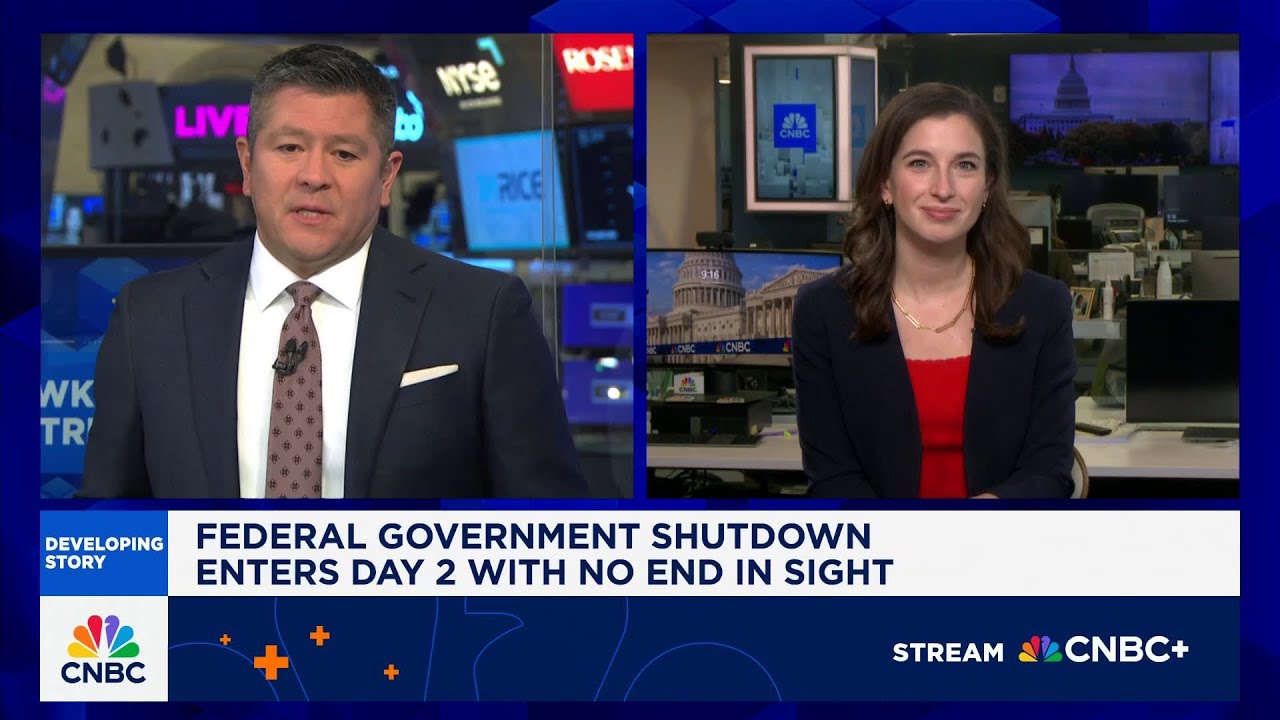
Group 1 - The U.S. government shutdown is a primary concern for investors as markets enter the strong fourth quarter, with equities near record highs and an upcoming earnings season [1][2] - The shutdown is expected to dominate investor focus, particularly due to the potential suspension of timely economic data, which could impact the Federal Reserve's monetary policy decisions [2][3] - Analysts project an 8.8% increase in earnings for S&P 500 companies in Q3 compared to the previous year, indicating strong corporate performance despite some labor data softness [4] Group 2 - Companies like Levi Strauss and Delta Air Lines are set to report earnings soon, providing insights into the upcoming earnings season [5] - If the government shutdown extends for two to four weeks, it may lead to additional economic stimulus through rate cuts, potentially accelerating growth in both the economy and equity markets [6] - The release of the Federal Reserve's meeting minutes from September will offer further insights into policymakers' thoughts regarding recent rate cuts [6]
S&P Global: U.S. government shutdown adds uncertainty to economic outlook
Youtube· 2025-10-02 14:13
Core Points - The government shutdown is impacting federal employees, with layoffs expected to begin soon, affecting approximately 750,000 workers [10] - The shutdown is anticipated to delay the September jobs report, which is crucial for economic data collection and could add uncertainty to the Federal Reserve's monetary policy [9][7] - The White House is exerting pressure on Senate Democrats to reach an agreement, with significant cuts to infrastructure and green energy projects announced [11][12] Economic Impact - The shutdown could lead to a reduction in GDP, with past estimates indicating a potential loss of about $11 billion or 0.3% of real GDP from previous shutdowns [3] - The current GDP stands at 3.8%, and the shutdown is expected to negatively affect growth and working Americans [2] Legislative Developments - President Trump is meeting with budget officials to discuss potential cuts to Democratic agencies, which may complicate negotiations [5][7] - The Senate is scheduled to vote on funding the government, but bipartisan support appears uncertain at this time [8][13] - There are ongoing discussions among Republicans and Democrats regarding tax credits and other fiscal measures, but a clear solution remains elusive [14]
X @Bloomberg
Bloomberg· 2025-09-11 00:34
UBS CEO Sergio Ermotti said the impact of global tariffs on the US economy and Federal Reserve monetary policy remains unclear https://t.co/F5T267H7Oz ...