deficit

Search documents
Watch CNBC's full interview with Treasury Secretary Scott Bessent
CNBC Television· 2026-02-13 15:05
Dunn and Goldman Sachs CEO David Solomon. And of course, let's begin this special. Yeah.What do you think of that. Not bad. Let's begin, though, with a special guest.I guess you'd call him almost a keynote speaker. Treasury Secretary Scott Bessent. Mr.. Secretary, thank you for for gracing us today. Even though I'm out. I wish you could be here, Joe.>> Good to good to see you. And thanks for getting up so early. >> Yeah.You are. Yeah. And work with me on this.If I get a little groggy or my questions don't m ...


X @Cointelegraph
Cointelegraph· 2026-02-10 23:00
🇺🇸 LATEST: Donald Trump said the U.S. should have the world’s lowest interest rates, arguing each 1% cut could save $600B and help erase the deficit. https://t.co/JQJ6Jz5f1x ...
A lot of silver needed for AI and data center buildout, says Pan American Silver CEO
CNBC Television· 2025-12-17 22:00
driving these big moves higher. Well, joining us now for an exclusive interview is Michael Steinman, CEO of Paname American Silver. Michael, welcome to the show.Thanks for joining us. >> Thanks for having me. >> So, what is driving silver to these record levels.>> Well, there's really two things to silver, right. A, it's a really important uh metal for the economy. It's a critical metal actually right now declared in the US as a critical uh metal and added to the critical strategic uh list for metals uh in ...


Shutdown stalemate day 34: The battle over health care costs
CNBC Television· 2025-11-03 13:45
Fiscal Discipline and Deficit Concerns - The US is facing a \$2 trillion annual deficit [2] - The national debt has increased from \$1 trillion to \$38 trillion over the past 40 years [3] - The current deficit is 6% of GDP and is projected to rise to 8-9% by the end of the decade [7][8] - Republicans are proposing \$1.5 trillion in budget cuts over 10 years, representing a small fraction (1.875%) of the total \$80 trillion budget [3] Healthcare Affordability and the Affordable Care Act (ACA) - Healthcare costs have almost tripled since the Affordable Care Act was passed 15 years ago [11] - The average family is now paying \$35,000 to \$40,000 per year for healthcare [13] - Concerns exist that expanding the ACA will primarily benefit large insurance companies, with 80% of the money potentially going to them [17] - Some argue that the ACA has been unaffordable and may have exacerbated healthcare inflation [6] Potential Consequences of Healthcare Cuts - Cuts to healthcare programs could lead to approximately 100,000 excess premature deaths over the next decade [9] - Reducing health insurance coverage may have adverse health consequences for families who have already budgeted for current premiums [19] Fraud in Healthcare Programs - Government auditors estimate over \$200 billion in fraud occurs annually in Medicare and Medicaid, involving ineligible individuals receiving benefits [4] Future Fiscal Challenges - Social Security and Medicare trust funds are set to expire within the next decade, posing significant fiscal challenges [20]
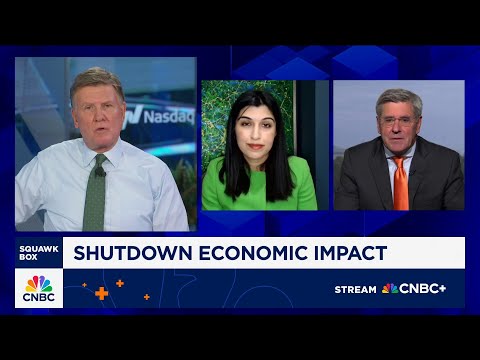
Spending trajectory looks key to continue narrowing the deficit: Treasury Sec. Counselor Lavorgna
CNBC Television· 2025-10-23 16:48
Let's bring in Joe Leavia, counselor to the Treasury Secretary to discuss this. Joe, uh, it's great to have you on to to kind of flesh this out a little bit. And I I guess first of all, most important I would be to get at what the drivers of this narrower deficit are and whether they're structural, whether they're durable, whether they're going to continue because I mean you hear things about obviously tariff revenue, uh pretty high capital gains tax collections and then some maybe foregone spending that ma ...
Sen. Rand Paul weighs in on government shutdown, believes it will be 'short lived'
NBC News· 2025-10-02 00:12
Joining us tonight is the Republican senator for Kentucky, Dr. . Ran Paul. He's the chair of the Senate Homeland Security Committee and was the only Republican to vote no on the continuing resolution.Senator Paul, thanks for joining Top Story tonight. Like I said, you did not vote for this Republican spending bill. You have said it prolongs the Biden era spending.Can you tell our viewers more about your decision and the government shutdown. >> Whenever spending bills come before the Senate, I look at what i ...
U.S. government reports $345 billion deficit for August, larger than expected
CNBC Television· 2025-09-11 18:43
All right, we got some breaking news out of Washington DC. The Treasury Department is releasing its monthly interest statement and Megan Cassella is all over the story. She's got the details.Megan, Don, that's exactly right. This time it was another big deficit month for the US Treasury. The US running a $345 billion deficit for the month of August.That compares with about $300 billion expected among economists surveyed by Dow Jones. Now, on an adjusted basis, that accounts for standard calendar differences ...
Jamie Dimon on the deficit: We can fix it but we need line-by-line budgeting
CNBC Television· 2025-07-31 17:00
Fiscal Deficit & Debt - The US deficit is at $2 trillion [1] - The national debt is projected to increase from $30 trillion to $50 trillion in 10 years [1] - Current deficits of 6.5% to 7% are unsustainable [2] Fiscal Policy & Solutions - Tariffs will partially offset the deficit [1] - Tax breaks should be re-evaluated and potentially eliminated [3] - Multi-year budgeting could improve fiscal management [3] - Increased tax collection is a potential solution [3] - Congress needs to actively engage in responsible fiscal policy, including line-by-line budgeting [3]
Ray Dalio's Update on U.S. Government Debt
Principles by Ray Dalio· 2025-07-23 14:55
Economic Outlook - The US may face economic challenges in approximately three years [1][3] - Moody's downgraded US debt, becoming the third ratings agency to do so [1] - Failure to address the debt issue could lead to an "economic heart attack" due to supply-demand problems [3] Fiscal Policy - Cutting the deficit to 3% of GDP is possible by adjusting spending and tax income by 4% each [2] - Achieving a 3% GDP deficit could lead to lower interest rates [2] - A balanced approach, where everyone contributes, is necessary to achieve fiscal stability [2]
The Deficit Debate: Was Elon's First Instinct Right?
ARK Invest· 2025-07-10 16:05
Government Spending & Taxation - Government spending is viewed as taxation [1] - Lowering employment and evolving a different mindset inside the government are happening [1] Economic Growth & Deficit - Getting growth going is the key to lowering the deficit [2]