Tariffs

Search documents
Can Modi and #India 🇮🇳 Bounce Back in 2026? #politics #shorts
Bloomberg Television· 2025-11-14 20:56
Well, right now the tariffs are very high on India because of the Russian oil and they've stopped doing the Russian oil that's it's been reduced very substantially. Yeah, we're going to be bringing the tariffs down. >> Trump's tariffs, a US trade deal that hangs fire, China hostility and middling growth.2025 seems like a year in which India's political and economic fortunes were clouded. But economist Nil Kant Mishra disagrees. The real story is in the business cycle in India on how the reversal of monetary ...

Retractable Technologies, Inc. Results for the Periods Ended September 30, 2025
Businesswire· 2025-11-14 20:13
Core Insights - Retractable Technologies, Inc. reported total net sales of $10.1 million for Q3 2025, a slight decrease from $10.3 million in Q3 2024, while operating losses improved from $5.1 million to $3.7 million [1][10] - For the first nine months of 2025, net sales reached $28.8 million, up from $24.0 million in the same period of 2024, with operating losses decreasing from $13.9 million to $13.5 million [1][15] Financial Performance - The company experienced a net income of $371 thousand for Q3 2025, influenced by unrealized gains of $2.4 million on third-party debt and equity investments [3] - The net loss for the first nine months of 2025 was $10.2 million, which included unrealized losses of $3.2 million in third-party debt and equity investments [3][15] - Domestic sales accounted for 91.1% of total revenues in Q3 2025, with a decrease in domestic revenues by 4.6% and a 20.4% drop in domestic unit sales [5] Tariff Impact - Tariffs on needles and syringes imported from China were at 130% as of September 30, 2025, significantly impacting financial results, with the company spending $2.3 million on tariffs in the first nine months of 2025 [2][14] - The company has shifted production to its U.S. facility, with 38.3% of products manufactured domestically in the first nine months of 2025, compared to 10% in the same period of 2024 [2] Sales and Product Mix - International revenues increased by 25% in Q3 2025 compared to the same period in 2024, although the average international selling price per unit declined due to a shift in product mix [6][13] - Overall unit sales decreased by 12.4% in Q3 2025, while the cost of manufactured products decreased by 20.1%, reflecting a favorable shift in product mix towards higher-margin products [7][10] Operating Expenses - Operating expenses increased by 4.3% primarily due to product donations and higher bad debt expenses [9] - The loss from operations improved to $3.7 million in Q3 2025 from $5.1 million in Q3 2024, driven by higher gross margins and lower tariff costs [10]


Trump to Cut Tariffs on Beef, Tomatoes, Coffee to Lower Prices
Bloomberg Television· 2025-11-14 20:00
Trade Policy Changes - The U S government is considering eliminating or reducing tariffs on certain food products, like beef, coffee, and tomatoes, that the U S either doesn't produce or doesn't produce enough of [2][3] - The U S and Switzerland have reached a preliminary trade agreement to lower tariffs on many Swiss goods, including watches, from 39% to 15% [7] - Switzerland is committing to a $200 billion investment pledge over five years, with $67 billion (one-third) in the next year in the U S [9] Trade Agreement Status - The administration is working to finalize trade deals with various countries, with India being one of the remaining countries without a deal [11] - Canada and Mexico are in a separate category due to the USMCA, which provides them with lower average effective tariff rates [12][13] Tariff Impact & Strategy - The tariff exclusions acknowledge the impact of tariffs on prices, a point previously downplayed by the Trump administration [5] - The scope of the tariff exclusions is still unclear, including which countries and products will be affected [5][6]
X @Bloomberg
Bloomberg· 2025-11-14 19:10
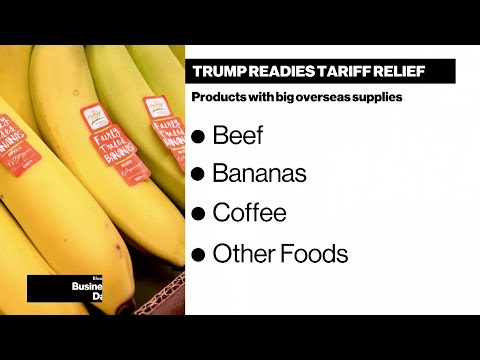
Trade Policy - The US President is expected to sign an order reducing tariffs on beef, tomatoes, coffee, and bananas [1]
Can Xiaomi (XIACF) Overcome Safety and Production Issues in Its EV Business?
Insider Monkey· 2025-11-14 18:24
Core Insights - Artificial intelligence (AI) is identified as the greatest investment opportunity of the current era, with a strong emphasis on the urgency to invest in AI technologies now [1][13] - The energy demands of AI technologies are highlighted as a critical concern, with data centers consuming energy equivalent to that of small cities, leading to potential crises in power supply [2][3] Investment Opportunity - A specific company is presented as a unique investment opportunity, positioned to benefit from the increasing energy demands of AI, owning critical energy infrastructure assets [3][6] - This company is not a chipmaker or cloud platform but is described as the "Toll Booth" operator of the AI energy boom, collecting fees from energy exports [4][5] Market Position - The company is noted for its ownership of nuclear energy infrastructure, which is crucial for America's future power strategy, and its capability to execute large-scale engineering projects across various energy sectors [7][8] - It is highlighted that this company is debt-free and has significant cash reserves, equating to nearly one-third of its market capitalization, making it financially robust compared to other firms in the sector [8][10] Growth Potential - The company also holds a substantial equity stake in another AI-related venture, providing investors with indirect exposure to multiple growth engines in the AI sector [9][10] - The stock is described as undervalued, trading at less than seven times earnings, which presents a compelling investment case given its ties to the booming AI and energy markets [10][11] Industry Trends - The narrative emphasizes the ongoing disruption caused by AI across traditional industries, suggesting that companies that adapt to AI will thrive while those that do not will struggle [11][12] - The influx of talent into the AI sector is noted as a driving force for innovation and growth, reinforcing the argument for investing in AI-related companies [12][14]

X @The Wall Street Journal
The Wall Street Journal· 2025-11-14 17:11
Our compulsive purchasing of cheap, foreign-made goods may be coming to an end as tariffs drive prices higher and social trends make overconsumption uncool https://t.co/BLnx7fQFQb ...
X @Bloomberg
Bloomberg· 2025-11-14 17:02
A deal has “essentially” been reached between the US and Switzerland to lower tariffs from 39% to 15%, US Trade Representative Jamieson Greer said: Here’s your Evening Briefing https://t.co/LaqHQ1Ps2h ...
US to Lower Swiss Tariffs to 15% in Breakthrough Deal
Bloomberg Television· 2025-11-14 15:54
Working with the Swiss. What we've done is we've identified the areas in the reasons why we have a big deficit with them in goods. And it really boils down to things like pharmaceuticals, gold, right.Trade in gold and a handful of other things. And so the Swiss, as part of their agreement, you know, they said we are going to have $200 billion in investment. The trade as in Trump's term, you know, starting with about $70 billion investment next year.And it will be in these areas, we expect that the Swiss wil ...

Soybean Markets on Edge Over US-China Trade Deal | Presented by CME Group
Bloomberg Television· 2025-11-14 15:07
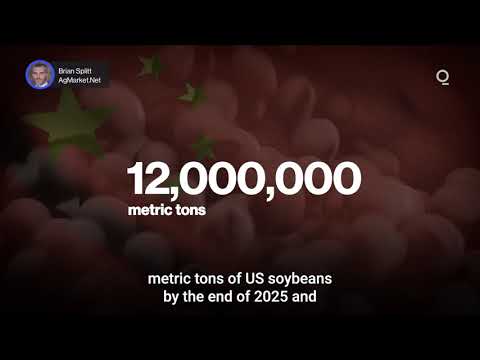
[Music] Will China buy US soybeans before the end of 2025. While China did purchase 5.9% million tons of the 2024 US soybean harvest for delivery in early 2025, this question has plagued the soybean market since February when President Trump first signed an executive order to impose tariffs on China. This event cascaded into additional retaliatory tariffs from both sides over the next several months, which inevitably led to a complete absence of Chinese purchases of the 2025 US soybean harvest.A trade deal ...