Inflation

Search documents
Inflation Cools, Micron Shines: Tech ETFs Catch Tailwind
Benzinga· 2025-12-18 19:49
Group 1: Market Overview - U.S. tech ETFs experienced a rally due to a cooler-than-expected inflation figure, which dampened Treasury yields [1][2] - The Consumer Price Index (CPI) for November was reported at 2.7% year-over-year, alleviating inflation concerns, while the core inflation rate softened to 2.6%, the lowest since March 2021 [2] - The 10-year Treasury yield moved closer to 4.11%, providing strong support for long-duration growth assets [2] Group 2: Semiconductor Sector Performance - The VanEck Semiconductor ETF (SMH) saw a 2.4% increase, benefiting from strong earnings reported by Micron Technology Inc [3][4] - The iShares Semiconductor ETF (SOXX) advanced by 3%, as easing inflation allowed the Federal Reserve to support growth without reigniting price pressures [4] - Micron's earnings beat reinforced optimism regarding memory pricing and AI-driven demand, lifting the broader chip complex [4] Group 3: Broader Tech Sector Gains - Nasdaq-linked ETFs, including the Invesco QQQ Trust ETF, showed gains due to lower yields, which lifted valuations in megacap tech companies [5] - The Vanguard Growth Index Fund ETF gained traction, reflecting renewed investor appetite for companies with longer-dated cash flows, as inflation effects dampened and bond yields receded [6] Group 4: Investor Sentiment and Risks - Despite the enthusiasm in semiconductor ETFs, there are concerns about valuations having little margin to withstand potential disappointments if inflation figures and earnings trends turn negative [7] - Some investors are pairing tech-intensive ETFs with equal-weight or low volatility strategies to hedge against downside risk [7] - Cooling inflation and reduced yields are currently seen as potent catalysts for tech ETFs, with semiconductors leading the charge [8]



Bonds are having their best year since 2020. But don't expect the same returns next year.
MarketWatch· 2025-12-18 19:36
Core Viewpoint - The uncertain outlook for inflation and interest rates is expected to drive yields higher in the coming year, which will negatively impact bond prices [1] Group 1 - The potential increase in yields is attributed to the unpredictable nature of inflation and interest rate trends [1] - Higher yields could lead to a decrease in demand for bonds, as investors may seek better returns elsewhere [1] - The bond market may face significant challenges as these economic factors evolve [1]

US midday market brief: S&P 500 rebounds on cooler inflation as Micron sparks Nasdaq surge
Invezz· 2025-12-18 19:28
The S&P 500 appears poised to snap a four-day losing streak on Thursday as unexpectedly cooler inflation data reignited hopes for Federal Reserve rate cuts in 2026. The rebound was turbocharged by Mic... ...

Inflation Keeps Shifting—Here's the Smartest Way to Keep Your Savings From Shrinking
Yahoo Finance· 2025-12-18 19:22
Group 1 - The current Consumer Price Index (CPI) is at 2.7%, indicating that inflation remains high and continues to impact the purchasing power of savings [2][7] - Traditional banks are offering significantly lower savings yields, with the national average at 0.39% and major banks like Chase and Bank of America providing only 0.01%, which exacerbates the loss of value in savings [3][4] - To counteract inflation, it is essential for savers to earn a return that exceeds the inflation rate, which can be achieved through high-yield savings accounts that offer rates between 4.20% and 5.00% [6][8] Group 2 - High-yield savings accounts provide a viable solution for savers to protect their funds from inflation, allowing for real growth in savings rather than a decline in purchasing power [5][6] - The disparity between inflation and savings account yields highlights the importance of moving funds to accounts that offer higher returns to maintain financial health [4][5] - Certificates of Deposit (CDs) can also be considered for locking in higher APYs, providing additional protection against inflation over a longer term [7]
X @Bloomberg
Bloomberg· 2025-12-18 19:16
Mexico’s central bank lowered its benchmark interest rate by a quarter point, the latest in a series of cuts aimed at sparking economic growth despite worries over stubborn inflation https://t.co/BymDAqxY7f ...
X @Anthony Pompliano 🌪
Anthony Pompliano 🌪· 2025-12-18 19:15
From the Desk of Anthony Pompliano0:00 Inflation Comes In Ice Cold Below Expectations4:10 Coinbase Announces 24/7 Stock Trading8:56 President Trump Announces $1,776 “Warrior Dividend”Enjoy! https://t.co/sUMQzh26nC ...
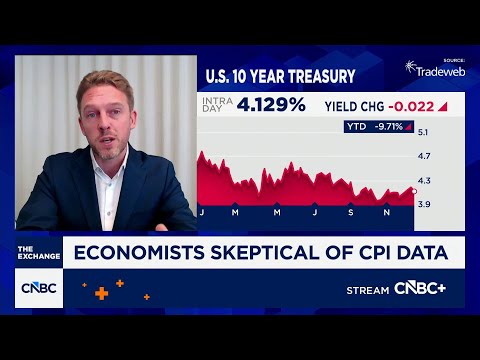
Trust these numbers? Economists see a lot of flaws in delayed CPI report showing downward inflation
CNBC· 2025-12-18 19:11
Core Insights - The consumer price report for November showed a lower-than-expected annual inflation rate of 2.7%, with core CPI at 2.6%, both below economists' estimates of 3.1% and 3% respectively [2] - The release of the November data was delayed due to a U.S. government shutdown, and the cancellation of October data led to unclear methodological assumptions regarding prior months' inflation levels [3] - Analysts noted that the surprising decline in inflation may be influenced by methodological issues, with some categories potentially reflecting 0% inflation, leading to uncertainty in interpreting the data [4]

X @Bloomberg
Bloomberg· 2025-12-18 19:08
Inflation Trends - US underlying inflation cooled to a four-year low in November [1] Economic Analysis - Economists agreed that "something was off" regarding the government data on inflation [1]
First inflation report since government shutdown shows an ease to 2.7%
NBC News· 2025-12-18 18:54
Inflation Overview - November year-over-year inflation rose by 27%, lower than economists' expectation of 31% [1][5] - The Bureau of Labor Statistics did not collect October data due to government shutdown [2][6][14][15][16] - The Federal Reserve ideally prefers inflation to be closer to 2% [7] Consumer Spending & Prices - Food prices increased by 26% year-over-year, lower than the previous reading of 31% [9] - Energy costs increased by 42% year-over-year, with electricity costs up by approximately 7% [10] - Shelter costs increased by 3% year-over-year, slower than the previous reading of 32% or 36% [11] - Apparel costs were essentially flat, up by two-tenths of a percent year-over-year [12] Federal Reserve & Interest Rates - There is approximately a 25% chance the Federal Reserve will cut interest rates at the January 28th meeting [12] - The Federal Reserve may cut rates once or twice in 2026, depending on the labor market [12][13] - Weaker jobs data could lead the Federal Reserve to cut rates more than once in 2026, potentially triggering some inflation [13]

CPI data provided 'downwardly biased view of inflation,' says EY-Parthenon's Daco
CNBC Television· 2025-12-18 18:49
Let's bring in Greg Do. That's a good idea. >> He thinks this report wasn't just noisy and full of gaps, but that it shows a downwardly biased view of inflation.Greg, am I saying that correctly. What do you see here that jumps out to you. >> Yeah, that's absolutely right, Kelly.And I think Steve put it well. Uh, it was full of gaps for sure. It was very noisy.It was messy, but there was a downward bias. And this downward bias to clarify what Steve was mentioning is due to the BLS methodology when it comes t ...