
Monetary policy

Search documents
December Fed Rate Cut Still Likely, Despite Powell Pushback; S&P 500 Wavers
Investors· 2025-10-30 12:59
Economic Policy and Market Impact - The Federal Reserve is expected to announce a rate cut during today's meeting, which could support the ongoing rally in the S&P 500, marking a potential fifth consecutive session of gains and a fourth record closing high [1][5] - Economic uncertainty stemming from trade wars may be easing, with potential deals in Japan and South Korea, which could positively influence market sentiment [2] - The likelihood of a quarter-point rate cut at the December 10 Fed meeting has increased, supported by recent consumer price index data indicating a decrease in core services inflation [3] Federal Reserve Actions - Chair Powell indicated that the Fed may end balance-sheet runoff soon to facilitate smoother monetary policy operations, with expectations of a shift to asset purchases early next year [6][9] - The Fed has been reducing its $6.3 trillion holdings in Treasury and mortgage securities by up to $35 billion per month, although the actual pace has been around $20 billion per month due to various constraints [7][8] Market Performance - The S&P 500 has seen a 2.9% increase over the last four trading days and is up 17.2% year-to-date, reflecting strong market performance since President Trump's tariff adjustments [10]

If a FOMC Rates Cut Won’t Move Bitcoin Price, What Will?
Yahoo Finance· 2025-10-30 11:38
Everyone wanted a crypto moonshot. For OG Bitcoin holders deep in green, perhaps the FOMC event didn’t matter much. However, all smart degens who bought the top, Jerome Powell, and the Federal Reserve were their only saviors. There was so much hope for the Bitcoin price to move higher until it didn’t, and as Murphy’s Law struck, the world’s most valuable crypto crashed, falling by -5% below $110,000. The Bitcoin price, and crypto in general, is yet to recover from yesterday’s crickets. With hopes smashed, ...
"A further reduction in the policy rate at the December meeting is not a forgone conclusion."
Yahoo Finance· 2025-10-29 19:44
Monetary Policy Outlook - A further reduction in the policy rate at the December meeting is not a foregone conclusion [1] - Policy is not on a preset course [1] - The committee has not made a decision about December [2] - The committee will be looking at the data, how that affects the outlook and the balance of risks [2] Committee Dynamics - There were strongly differing views about how to proceed in December [1][2] - There are strong views across the committee [2] - There are 19 participants on the committee [1]

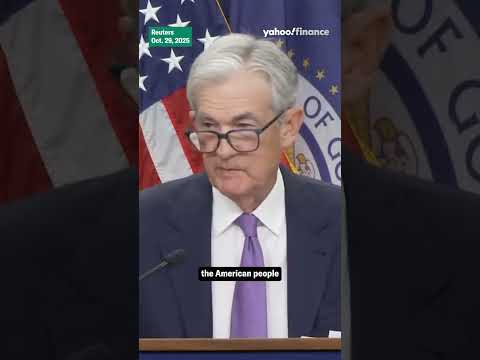
Federal Reserve System (:) Update / Briefing Transcript
2025-10-29 19:30
Summary of Key Points from the Federal Reserve System Update / Briefing Industry Overview - The briefing primarily discusses the economic outlook and monetary policy of the Federal Reserve, focusing on employment, inflation, and interest rates. Core Points and Arguments 1. **Monetary Policy Adjustment**: The Federal Open Market Committee (FOMC) decided to lower the policy interest rate by a quarter percentage point to a target range of 3.75% to 4% to support maximum employment and stable prices [1][4][6]. 2. **Economic Growth**: GDP growth was reported at 1.6% for the first half of the year, down from 2.4% the previous year, with stronger consumer spending noted as a key driver [2][49]. 3. **Labor Market Conditions**: The labor market is showing signs of cooling, with job gains slowing significantly and the unemployment rate remaining low at 4.3% [2][54]. There are concerns about declining labor force participation and immigration affecting job availability [3][38]. 4. **Inflation Trends**: Inflation remains elevated, with total Personal Consumption Expenditures (PCE) prices rising 2.8% over the past year. Core PCE prices also increased by 2.8%, indicating persistent inflationary pressures [3][4][24]. 5. **Risks to Employment and Inflation**: The balance of risks has shifted, with downside risks to employment increasing and upside risks to inflation remaining [5][58]. The FOMC is navigating a challenging situation where one goal may conflict with the other [5][58]. 6. **Balance Sheet Management**: The FOMC plans to cease the reduction of aggregate securities holdings as of December 1, indicating a shift towards a more neutral policy stance [6][8][21]. 7. **Diverse Views within the Committee**: There are strongly differing views among committee members regarding future policy actions, particularly concerning the potential for further rate cuts in December [10][36][58]. 8. **Impact of Tariffs**: Higher tariffs are contributing to inflation in certain goods, but the FOMC believes these effects may be short-lived and should not lead to ongoing inflation problems [4][25][40]. 9. **Investment in AI and Infrastructure**: Significant investments in AI and infrastructure are noted, with the FOMC indicating that these investments are not particularly sensitive to interest rate changes [27][28][48]. 10. **Consumer Spending**: Despite a cooling labor market, consumer spending remains strong, particularly among higher-income consumers, which is a significant driver of economic growth [48][49]. Other Important Considerations - **Data Availability**: The ongoing federal government shutdown has delayed some important economic data, complicating the FOMC's ability to assess the labor market and inflation accurately [2][19][50]. - **Long-term Inflation Expectations**: Most measures of longer-term inflation expectations remain consistent with the Fed's 2% inflation goal, despite current elevated levels [4][24]. - **K-shaped Economic Recovery**: The economy is exhibiting a K-shaped recovery, where higher-income consumers are faring better than those at the lower end of the income spectrum [32][55]. This summary encapsulates the key points discussed in the Federal Reserve's briefing, highlighting the current economic landscape, monetary policy decisions, and the challenges faced by the committee.
FOMC has 'strongly differing views' about how to proceed in December, says Fed Chair Powell
CNBC Television· 2025-10-29 19:03
Monetary Policy Stance - The Fed acknowledges a challenging situation with upside risks to inflation and downside risks to employment, requiring a balanced approach [1][2] - The Fed took a step toward a more neutral policy stance, considering increased downside risks to employment [2] - Future policy decisions will be based on incoming data, the evolving outlook, and the balance of risks, with no pre-set course [3][4] Balance Sheet Normalization - The Fed decided to conclude the reduction of aggregate securities holdings as of December 1 [4] - Over three and a half years, the Fed's securities holdings have declined by $22 trillion [6] - As a share of nominal GDP, the Fed's balance sheet has fallen from 35% to about 21% [6] - In December, the Fed will hold the size of its balance sheet steady while reserve balances continue to move gradually lower [7] - The Fed will continue to allow agency securities to run off and reinvest the proceeds in Treasury bills [7] Dual Mandate - The Fed is committed to supporting maximum employment, bringing inflation sustainably to the 2% goal, and keeping longer-term inflation expectations well anchored [8] - The Fed understands its actions affect communities, families, and businesses across the country and is dedicated to achieving its maximum employment and price stability goals [9]
Federal Reserve Lowers Interest Rates Again
Forbes· 2025-10-29 18:11
Core Points - The Federal Reserve has lowered interest rates for the second consecutive month, responding to pressure from President Donald Trump for more significant cuts [1][2] - The Federal Open Market Committee voted 10-2 to reduce rates by a quarter-point to a range of 3.75% to 4% [2] - There is speculation about a potential additional quarter-point reduction in December, which could lower rates to between 3.5% and 3.75% [3] Summary by Sections Interest Rate Decisions - The Federal Reserve's recent decision marks a continued easing of monetary policy, with a focus on addressing economic pressures [1][2] - The current interest rate range is now between 3.75% and 4%, down from the previous range of 4% to 4.25% [2] Economic Outlook - Fed officials are divided on the necessity of further rate cuts, with ongoing uncertainty due to a federal government shutdown affecting economic data availability [3] - Fed Governor Christopher Waller has indicated a shift in focus towards a "softening" labor market rather than inflation, suggesting caution in future rate adjustments [3] Leadership Considerations - There is anticipation regarding President Trump's potential nomination for a new Fed Chair, as Jerome Powell's term expires in May 2026 [4] - Treasury Secretary Scott Bessent mentioned five candidates under consideration for the role, indicating a possible shift in Fed leadership dynamics [4]
US dollar stablecoins to raise challenges for global monetary policy, India chief economic advisor says
Yahoo Finance· 2025-10-29 10:27
Core Insights - The rising popularity of U.S. dollar stablecoins is expected to pose challenges for global monetary policy in the coming year [1] - The global market capitalization of U.S. dollar stablecoins has exceeded $300 billion, driven by favorable regulations in the U.S. [3] Group 1: Monetary Policy Implications - The introduction of dollar stablecoins will create challenges for monetary transmission and seigniorage benefits for countries [1] - Stablecoins will compete with banks as financial intermediaries and in attracting customer deposits [2] Group 2: Regional Context - India's existing instant domestic payments system, Unified Payments Interface (UPI), reduces the necessity for stablecoins compared to advanced economies [2] - India is currently not inclined to create legislation to regulate cryptocurrencies [3]
Global Economic Headwinds and Geopolitical Tensions Mount as Consumer Confidence Dips and EU Budget Faces Scrutiny
Stock Market News· 2025-10-28 22:38
Economic Indicators - U.S. consumer confidence declined by 1.0 point to 94.6 in October, reflecting concerns over a softening labor market and high living costs [2][7] - The Expectations Index fell by 2.9 points to 71.5, remaining below the 80-point threshold that often signals an impending recession [2] - The unemployment rate rose to 4.3%, the highest since October 2021, with only 22,000 jobs added in August and 79,000 in July [2] Corporate News - UnitedHealth Group (UNH) raised its 2025 earnings outlook, projecting adjusted net earnings of at least $16.25 per share and net earnings of at least $14.90 per share [3][7] - The company reported third-quarter 2025 revenues of $113.2 billion, a 12% year-over-year increase, with UnitedHealthcare revenues climbing 16% to $87.1 billion [3] - Despite the positive outlook, UnitedHealth anticipates significant pressure on its Medicaid business in 2026 [3][7] Monetary Policy - The Reserve Bank of New Zealand (RBNZ) confirmed that recent interest rate cuts are effectively easing borrowing costs, with the Official Cash Rate (OCR) lowered by 50 basis points to 2.5% [4][7] - Financial conditions in New Zealand have improved, with credit flowing more easily across the economy [4] Legal and Regulatory Issues - Edison International (EIX) faces potential liability related to the Eaton Fire, with the U.S. Department of Justice suing Southern California Edison for over $40 million in costs [5] - The company's valuation has reportedly dropped from $30 billion to $22.6 billion since the fires [5] European Politics - Centrist groups in the European Parliament are demanding significant changes to the proposed €2 trillion seven-year budget for the EU, citing concerns over renationalization of funds and lack of parliamentary oversight [6][7]


Yen Rebounds on Verbal Intervention, US-Japan Security Pact
Yahoo Finance· 2025-10-28 10:16
Core Viewpoint - The yen has rebounded after verbal intervention from Japanese officials, while US and Japanese leaders have committed to enhancing security ties and defense funding [1][2]. Currency Performance - The yen rose by as much as 0.7% against the dollar, marking its first day of gains in eight, although it remains near its weakest level since February and is the worst performing currency among the Group-of-10 this month, having declined approximately 3% against the dollar [1]. Government Response - Japan's Minister for Growth Strategy, Minoru Kiuchi, stated that authorities will continue to monitor the effects of yen weakness on the economy [2]. - US Treasury Secretary Scott Bessent emphasized the importance of sound monetary policy in mitigating excessive currency fluctuations during discussions with Japan's Finance Minister Satsuki Katayama [3]. Market Sentiment - Derek Halpenny from MUFG Bank Ltd. noted that the US Treasury's statement suggests that the current monetary policy of the Bank of Japan may no longer be justified, indicating a potential decrease in appetite for selling the yen at current USD/JPY levels [4]. - There is an expectation of no change in interest rates from the Bank of Japan in the upcoming meeting, although pressure for a hike is increasing due to high inflation and ongoing yen weakness [4]. Broader Economic Context - Attention is shifting to the Federal Reserve's upcoming meeting, with traders anticipating a quarter-point rate cut. Additionally, Amazon's announcement of cutting approximately 14,000 jobs raises concerns regarding the US labor market's health [5]. - The yen's recent performance is attributed to mild verbal intervention from Japanese authorities, with market focus heightened due to a lack of US data amid a government shutdown [6].
中国人民银行三季度调查_贷款需求和经营状况略有改善,就业情绪疲软但家庭部门意愿-China_ PBOC Q3 Surveys_ Loan demand and business conditions marginally better, employment sentiment weak but households want to
2025-10-27 12:06
Summary of PBOC Q3 Surveys Industry Overview - The report focuses on the banking and financial sector in China, specifically the People's Bank of China (PBOC) and its quarterly surveys of bank loan officers, enterprises, and urban depositors [1][3]. Key Findings 1. **Loan Demand and Approval** - Loan demand increased slightly in Q3 2025, with the index rising to 58.0 from 56.2 in Q2 2025 [6] - Loan approval index remained stable at 53.9 in both Q3 and Q2 2025 [6] - Bankers anticipate a slightly less accommodative monetary policy in the next quarter, with the sentiment index dropping to 73.5 from 75.5 [6] 2. **Business Conditions** - The business conditions index for enterprises improved to 50.1 in Q3 2025 from 49.3 in Q2 2025, indicating a marginal recovery [9] - Export orders index rose to 44.7 from 43.2, while domestic orders remained unchanged [9] - Price indices for raw materials and sales increased, suggesting inflationary pressures [9] 3. **Urban Depositors' Sentiment** - Urban depositors reported a decline in inflation expectations and employment sentiment, with the net share expecting rising property prices slightly decreasing to -13.6% from -13.5% [6][9] - The willingness to consume decreased to 19.9% from 22.4%, while the desire to invest rose to 18.7% from 13.5% [9] - The share of households wanting to save more decreased from 64.1% to 61.2%, likely influenced by a recent stock market rally [9] Additional Insights - The surveys included responses from 5,000 enterprises and 20,000 urban depositors across 50 cities, providing a comprehensive view of economic sentiment [3] - The mixed signals from the surveys indicate a cautious optimism in loan demand and business conditions, but persistent bearish sentiment in the property market and consumer spending [1][9] Conclusion - The PBOC's Q3 surveys reflect a complex economic landscape in China, with slight improvements in loan demand and business conditions, but ongoing challenges in consumer sentiment and property market expectations [1][9]
