Tariffs

Search documents
Snap-on(SNA) - 2025 Q3 - Earnings Call Transcript
2025-10-16 15:00
Financial Data and Key Metrics Changes - Third quarter sales reached $1,190.8 million, an increase of 3.8% from $1,147 million last year, with organic sales up 3% [7][41] - Operating income margin was 23.4%, including a 190 basis point benefit from a legal settlement, while the adjusted margin was 21.5%, down 50 basis points year-over-year [8][40] - Earnings per share (EPS) was $5.02, or $4.71 excluding the one-time legal benefit, marking the highest EPS for a third quarter [8][45] Business Line Data and Key Metrics Changes - **C and I Group**: Sales were $367.7 million, reflecting an organic sales decrease of 0.8%, with operating margin at 15.6%, down 110 basis points year-over-year [17][48] - **Tools Group**: Sales were $506 million, with a 1% organic gain and operating margin of 21.7%, up 10 basis points from last year [22][49] - **RS and I Group**: Sales increased to $464.8 million, with an organic growth of 8.9% and operating margin at 30.4%, including a legal benefit [33][52] Market Data and Key Metrics Changes - The automotive repair market showed continued strength, with spending on repairs up double digits and an aging vehicle fleet averaging nearly 12.8 years [10][11] - The critical industries segment demonstrated growth despite geopolitical uncertainties, with increasing order activity noted [15][16] Company Strategy and Development Direction - The company is focusing on faster payback items and innovative products to adapt to market challenges, leveraging its flexible manufacturing capabilities [5][13] - The strategy includes enhancing customer connections and expanding product offerings to meet the evolving needs of repair shop owners and managers [14][38] Management's Comments on Operating Environment and Future Outlook - Management expressed confidence in the resilience of markets and the company's ability to navigate challenges, citing strong performance despite economic headwinds [5][61] - The outlook remains positive, with expectations for continued growth driven by strategic advantages and a robust product pipeline [65][66] Other Important Information - The company celebrated its 105th anniversary with a successful franchisee conference, which saw increased orders and positive feedback from franchisees [24][26] - The effective income tax rate for the third quarter was 22.6%, with expectations for a similar rate in the upcoming quarters [45][59] Q&A Session Summary Question: Consistency in RS and I growth - Management noted improved product launches and consistent performance across the line, indicating a positive trend in diagnostics and repair systems [70][71] Question: OEM share accrual and undercar stabilization - OEM business is gaining share, while undercar sales showed signs of stabilization, contributing to overall growth [73][75] Question: Sequential volume strength and capacity investments - Capacity increases over the past years have helped match volume fluctuations, but the sequential improvement was primarily due to effective product pivots rather than SFC orders [81][82] Question: Organic growth in Snap-on Tools - The organic growth of 1% in Snap-on Tools was attributed to a mix of promotions and product performance, with margins remaining stable [86][89] Question: Off-truck sales comparison - Off-truck sales were slightly lower than on-truck sales, but within the normal variability range, indicating no major concerns [90][92]

J.P. Morgan's Meera Pandit: 2026 catalysts are playing out in market right now
CNBC Television· 2025-10-16 14:42
Market Trends & Geopolitics - Trade tensions between the US and China are expected to persist, with potential implications for tariffs and government revenues [2][4] - The market has adapted to ongoing US-China risks, treating them as chronic rather than acute [6] - The US Treasury Secretary estimates the shutdown is costing $15 billion per day [5] AI & Technology - Bullishness surrounds the AI trade, supported by Taiwan Semiconductor Manufacturing's (TSM) results and guidance from Salesforce (CRM) [1] - AI is viewed as a cyclical boom-and-bust cycle, not just a bubble or boom, requiring monitoring of adoption and financing [9] - Innovation cycles in AI may involve circular deals in the early stages to achieve exit velocity [8] - AI spend trajectory is expected to be sustained due to productivity gains, potentially starting as early as Q2 [8] Economic Outlook - Policy risks for the remainder of the year may be to the downside, but stimulative impacts are expected in 2026 from tax refunds and AI-related provisions [7] - Potential economic weakening down the line could impact downstream adopters of AI and change the economics [10][11]

President Trump says U.S. is in a trade war with China now
CNBC Television· 2025-10-16 14:40
Trade War Status - The President acknowledged the US is currently in a trade war with China [2][4][5] - This acknowledgement might be an attempt to deflect questions about the duration of the trade tensions [5][9] - The trade war involves imposing tariffs, quotas, and other trade barriers [8] US-China Relations - Treasury Secretary criticized a lower-level Chinese negotiator, leading to a defense from the Chinese side [6][7] - The President is scheduled to meet with President Xi in the coming weeks [3] Trade War Definition - A trade war is an economic conflict where countries use trade barriers to protect domestic industries or gain leverage [8]
Fed's Waller: Fed should reduce another rates by another 25 bps points in October
Youtube· 2025-10-16 13:52
Group 1 - The Fed is expected to reduce rates by 25 basis points in October, but further cuts depend on the reconciliation of strong GDP and a soft labor market [1][2] - Fed Governor Chris Waller expresses caution about rekindling inflationary pressures and emphasizes the need for a balanced approach [2][3] - If the labor market weakens further and inflation remains controlled, the Fed may consider additional cuts of 100 to 125 basis points to reach a neutral rate [3][4] Group 2 - Waller highlights a prevalent "no hire, no fire" stance among companies, indicating potential job losses as businesses reassess their workforce needs [5][6] - The impact of AI on the labor market is significant, with expectations of job losses occurring before any job gains, suggesting a shift in employment dynamics [5][6]
Warehouse market ‘found its footing,’ Prologis CFO says
Yahoo Finance· 2025-10-16 13:40
Core Insights - The executives' tone has improved compared to the Q1 call, reflecting a more optimistic outlook on the industry despite ongoing tariff challenges [3][5] - Prologis raised its 2025 guidance for net earnings attributable to common stockholders to a range of $3.40 to $3.50, up from $3 to $3.15, indicating confidence in future performance [5] - The company reported a decrease in net earnings attributable to common stockholders to $0.82 in Q3 from $1.08 in the same period last year, while total revenues increased to $2.21 billion from $2.03 billion year-over-year [6] Financial Performance - Prologis' total revenues rose to $2.21 billion in Q3, reflecting a year-over-year increase [6] - Occupancy rates improved slightly to 95.3% at the end of Q3 from 95.1% in Q2, although it remains below the 95.9% recorded in Q3 of 2024 [6] Market Outlook - There are early signs of demand picking up, with low supply-side deliveries, suggesting potential for a sharp increase in market rents if macroeconomic conditions remain strong [6] - Prologis management noted a shift in customer strategies towards "network optimization rather than contraction," indicating a more stable planning environment for businesses [5][6] - The overall sentiment in the market appears to be strengthening, with improved leasing velocity and success in build-to-suit activities, suggesting a potential inflection point for occupancy and rent [6]

Fed Governor Christopher Waller on Careful Rate Cuts, Labor Market Concerns, AI
Youtube· 2025-10-16 13:01
Economic Outlook - The Treasury Secretary is seeking a visionary approach to economic policy, emphasizing the importance of forward-thinking rather than solely relying on historical data [2][3][4] - Current economic indicators suggest a weak labor market despite signs of stronger growth, creating a puzzling situation where a growing economy cannot coexist with negative or stagnant job growth [7][8][22] Interest Rate Policy - The discussion around interest rates indicates a cautious approach, with suggestions to reduce rates gradually while monitoring economic data [9][10][18] - The financial conditions for corporate America differ significantly from those for Main Street America, with rising costs for mortgages and loans impacting households [15][19] Labor Market Dynamics - There is uncertainty in hiring practices among firms due to tariff-related concerns, leading to a slowdown in payroll growth [11][12][13] - The labor market's current weakness is not reflected in the financial markets, raising questions about the sustainability of economic growth [22][23][35] Structural vs. Cyclical Changes - The potential for structural changes in the labor market poses a challenge for monetary policy, which is typically designed to address cyclical fluctuations [35][36] - The distinction between cyclical and structural changes is critical for future policy decisions, as misjudging the nature of the changes could lead to ineffective responses [37]

Fed Governor Christopher Waller on Careful Rate Cuts, Labor Market Concerns, AI
Bloomberg Television· 2025-10-16 13:01
Monetary Policy & Economic Outlook - The speaker advocates for a cautious approach to interest rate cuts, suggesting a 25 basis points reduction at a time, to avoid potential mistakes given conflicting data on the labor market and GDP growth [6][9][10] - The speaker believes the labor market is weak, contrasting with stronger GDP growth, creating a puzzle that requires either GDP numbers to decline or the labor market to rebound [7][8] - The speaker notes that tariff uncertainty and firms waiting to assess the impact of AI are contributing to the slowdown in hiring [11][12][13] - The speaker suggests that current financial market conditions are bifurcated, with loose conditions for corporate America but tighter conditions for Main Street America due to higher mortgage, auto loan, and credit card interest rates [15][16] - The speaker acknowledges the risk of being "lulled" into reducing rates based on weak payrolls data, potentially fueling financial market excesses, but emphasizes the Fed's mandate of maximum employment and stable prices [21][22] Inflation & Sectoral Reallocation - The speaker is not overly concerned about inflation, including tariff-induced or AI-induced inflation, as sectoral reallocation may offset demand increases in one sector with decreases in others [25][26][27][28] - The speaker estimates inflation is running at approximately 25%, and suggests focusing on core inflation to avoid volatility from energy prices [28] AI Impact & Structural Changes - The speaker expresses concern that the potential impact of AI on the labor market could be a structural change, which monetary policy is not designed to address [35] - The speaker differentiates the current situation from the previous year, citing tariff uncertainty and the AI factor as key differences, with unemployment not being a major concern last year [34]
Zervos: The market has been extremely resilient despite rising trade tension
CNBC Television· 2025-10-16 12:07
All right. What do you make of just the kind of the market movements we've seen in the last, you know, four or five trading days or so after the president kind of ramped up the tensions in the trade war. We saw a big decline and since then we've been kind of rangebound.What does that say about investors and their confidence that this trade war is going to be resolved in a positive way. Well, I think the market has been equity market in particular, Frank, has been uh extremely resilient in the face of a pret ...
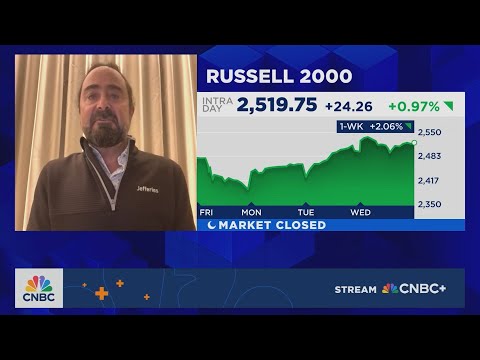
Greene: Small caps may finally be breaking out for good this time
CNBC Television· 2025-10-16 11:59
All right. So, what do you make of the action that we saw yesterday. I think I want to start off with the small caps hitting another record yesterday.What does that say about the market right now and the fact that investors are going into small caps, what we thought was a catch-up trade, uh, looking for, I guess, gains. What What do you think they're looking for there. >> I I think it's great.You're looking for something cheaper than the mega cap tech, right. You're looking for something that hasn't moved u ...
Bombas CEO Jason LaRose on brick-and-mortar expansion, tariff impact and state of the consumer
CNBC Television· 2025-10-16 11:47
Business Strategy & Expansion - Bombas is opening its first physical retail store in New York City, followed by two more in Florida and Texas [1] - The company's expansion into brick-and-mortar retail is driven by the fact that 65% of sales in the category still occur in physical stores [2] - Bombas has broadened its product line beyond socks to include intimates, t-shirts, slippers, and other footwear [3] Supply Chain & Tariffs - Bombas has a flexible and diversified supply chain, manufacturing products in about nine different countries [4][9] - The company's largest manufacturing countries are Vietnam and Cambodia [9] - The company estimates that over 20% of its supply chain has shifted in the last 6 months due to changing rules and tariffs [10] - Manufacturing in the US is currently not feasible due to a lack of capabilities and yarn production [11] Financial Performance & Consumer Behavior - Bombas' business has been up more than 20% year-over-year [12] - The company's basket size is 10% higher year-over-year, with every business up double digits [13] - Customers are showing trust in the brand, leading to continued success even when the macro environment is uncertain [14] Product Innovation - Bombas' sport socks are moisture-wicking [15] - Marino wool socks are highlighted for their sweat-wicking capabilities [16]