Tariffs

Search documents
Trump threatens new tariffs on China
NBC News· 2025-10-11 05:20
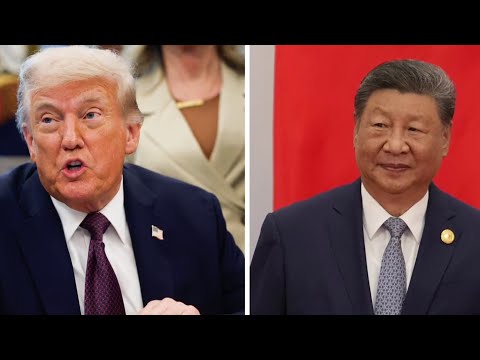
that the United States will impose a steep 100% tariff on China, 100% on top of what they're already paying. The president revealing this in just the last few minutes here in a truth social post. That sudden escalation came just as it looked like the trade war was cooling off a bit and it triggered a very rough day on Wall Street.The markets went into a sell-off. All three indices way down. The Dow dropping almost 900 points.That's a 2% loss, more or less. S&P down 2 and a.5%, NASDAQ down three and a half%. ...

The trade war is back: Trump announces new tariffs on China after threats sent stocks plunging
Yahoo Finance· 2025-10-11 05:18
Core Points - US stocks experienced a significant sell-off following President Trump's threats to escalate the trade war with China, marking the S&P 500's largest decline since April [1] - Trump announced a 100% tariff on Chinese goods, effective November 1, in response to China's export controls on rare earth metals [2][3] - The announcement of increased tariffs has raised concerns among investors regarding the stability of trade relations with China and its potential impact on the market [5] Market Impact - The stock market reacted negatively, with oil prices also dropping by 4% due to fears of reduced economic activity affecting energy demand [3] - The 10-year Treasury yield fell by nine basis points to 4.05%, indicating a flight to safety among investors [3] Trade Relations - Trump's comments highlighted the ongoing tensions in US-China trade relations, with potential for further countermeasures being considered by the US government [4][5] - The imposition of tariffs and export controls could disrupt global markets and affect various industries reliant on Chinese imports, particularly in technology and energy sectors [5]
India's Mahindra Expands in South Africa as Tariffs Hit Autos
Bloomberg Television· 2025-10-11 05:00
Nice bakkie. This is South Africa's best selling truck, a Toyota Hilux, better known at home as a bakkie. It's not a bakkie. It's a Hilux.They're popular for handling the country's diverse landscape, from rural farmlands to city potholes. Produced domestically. since the seventies, it's become a proud export.One popular destination, India. If you consider that India is is a market that produces in the region of about 6 million vehicles and we as a continent are under 2 million. That then tells you that the ...

Trump announces extra 100% tariffs on China, control ‘critical software' exports
Invezz· 2025-10-11 04:07
US President Donald Trump announced on Friday sweeping new tariffs on China, declaring an additional 100% tariff on all Chinese goods and tighter controls on exports of critical US software, effective... ...
J.B. Hunt, United earnings should give us a read on the economy, says Jim Cramer
CNBC Television· 2025-10-11 00:27
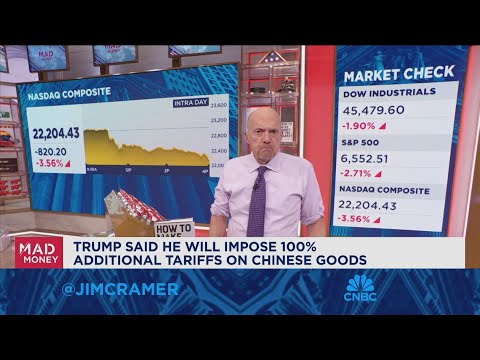
Hey, I'm Kramer. Welcome to Mad Money. Welcome to Crane America.If you want to make friends, I'm just trying to save a little money. My job is not just to entertain, but to put a day like today into context. So call me 1800 743 CBC.Tweet me at Jim Kramer. Happy third anniversary of the great bull market of the 2020s. Nothing like a major flare up in the trade war with China to put an end to the celebration before it even started though.Dow plunging 879 points. S&P plummeting 2.71%. NASDAQ nosed diving 3.56% ...
X @Ash Crypto
Ash Crypto· 2025-10-11 00:02
🚨 This Hyperliquid whale opened shorts just 30 minutes before Trump announced 100% tariffs on China. He closed the trades for $192 million in profit. These accounts were opened today and He have already Withdrawn most of the moneyLucky whale or insider ?Cc @martypartymusic https://t.co/uWv5lBsJ5N ...
X @Ash Crypto
Ash Crypto· 2025-10-10 23:48
In few days 🇺🇸 Trump will post “ Had great call with President of China, our relation is stronger than ever, We have reached a deal and Tarrifs are canceled ”Markets will explode to new highs.Stop panicking. Q4 will be Bullish. ...
X @Investopedia
Investopedia· 2025-10-10 22:30
The major U.S. equities indexes dropped Friday afternoon, wiping out early gains after President Trump threatened "massive" tariffs against China. https://t.co/iGdBe8A42a ...
Crypto prices plunge as Trump hits China with 100pc tariffs
Yahoo Finance· 2025-10-10 22:26
Group 1: Tariff Announcements and Market Reactions - Donald Trump announced a new 100% tariff on Chinese goods, effective November 1, which would increase the total tariff rate to approximately 130% [30][31][32] - Following the tariff announcement, US stocks experienced significant declines, with the S&P 500 dropping 2.71%, marking its worst trading day since April [4][34] - The Nasdaq fell by 3.56% and the Dow Jones Industrial Average decreased by 1.9%, reflecting broader market fears regarding the potential escalation of the US-China trade war [3][35] Group 2: Cryptocurrency and Commodity Impact - Cryptocurrencies plummeted in value, with Bitcoin falling over 10% to below $110,000 before recovering slightly, while Ethereum dropped by 11.2% [5][24] - Soybean prices fell by 1.9% to $10.0275 per bushel, as investors anticipated reduced Chinese purchases of US soybeans due to the trade tensions [25][26] - The US dollar weakened by 0.69% against a basket of currencies, indicating market uncertainty following the tariff threats [29] Group 3: Rare Earths and Export Controls - China's recent export controls on rare earth minerals have raised concerns in the US, as China produces approximately 90% of the world's rare earths, critical for various industries [12][13] - Trump criticized China's export restrictions, stating that the US would impose export controls on "critical software" in response [9][32] - Analysts suggest that the US's reliance on Chinese rare earths could undermine its manufacturing base and economic growth, particularly in AI development [46][47] Group 4: Market Sentiment and Future Outlook - Market analysts express concerns that the renewed trade tensions could lead to a recession in the US, with the potential for higher inflation due to increased import costs [72] - The volatility in the stock market has led to a surge in the "fear index," indicating heightened investor anxiety regarding the economic outlook [71] - Some analysts believe that the current situation may be a negotiating tactic by the Trump administration, but the risk of retaliation from China remains significant [16][47]
Trump Says U.S. Will Impose 100% Tariffs Against China Following Mineral Trade Dispute
Forbes· 2025-10-10 22:00
Group 1 - Trump announced new tariffs on China, set to begin on November 1st, 2025, or sooner depending on China's actions [1] - The new tariffs will be in addition to existing tariffs that China is already paying [1] - Export controls will be implemented on all critical software starting November 1 [1]