中小盘风格

Search documents
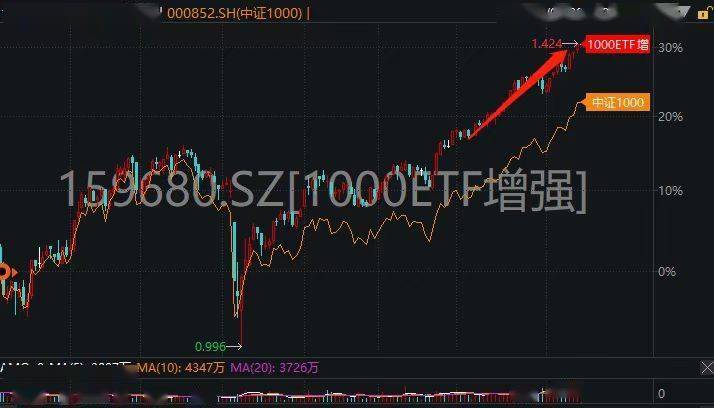
沪指八连阳!1000ETF增强(159680)净值再刷历史新高
Sou Hu Cai Jing· 2025-08-14 01:29
Group 1 - The Shanghai Composite Index (沪指) achieved a trading volume exceeding 2 trillion yuan, marking an eight-day consecutive rise to a new high [1] - The net value of the popular small-cap ETF 1000ETF Enhanced (159680) reached 1.4196, setting a new historical peak, with a year-to-date scale growth of nearly 160% [1] - Market analysts attribute the significant outperformance of small-cap stocks over large-cap stocks to four main factors: ongoing global liquidity easing expectations, a weak dollar environment leading to increased foreign investment in A-shares, clear policies in the technology sector attracting capital, and a general market rally driving up valuation levels [1] Group 2 - The narrowing of the basis between stock index futures reflects an ongoing improvement in market risk appetite [1] - Analysts caution about the potential divergence risk between fundamental performance and market behavior [1]

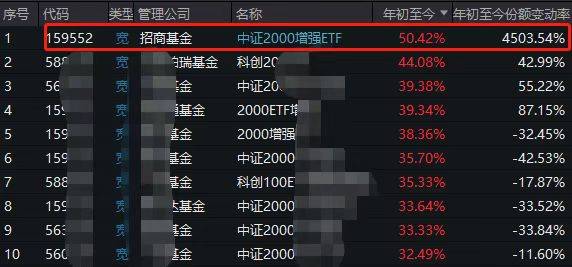
沪指新高,两市惊现收益破50%宽基!中证2000增强ETF(159552)再成焦点
Sou Hu Cai Jing· 2025-08-14 01:16
Core Viewpoint - The Shanghai Composite Index reached a nearly four-year high on August 13, with trading volume in both markets exceeding 2 trillion yuan, indicating strong market momentum and investor confidence [1]. Group 1: Market Performance - The CSI 2000 Enhanced ETF (159552) achieved a year-to-date return of over 50%, becoming the first broad-based ETF to surpass this threshold in 2023 [1]. - The fund's share volume expanded more than 45 times this year, making it the ETF with the largest share increase in the market [1]. Group 2: Market Drivers - Four main factors contributed to the outperformance of small-cap stocks compared to large-cap stocks: 1. Expectations of domestic and international liquidity easing, with a weaker dollar facilitating foreign capital inflow into A-shares, benefiting small-cap stocks [1]. 2. Strengthened narratives around technology and other industries, with clear policy directions leading to sustained capital inflow [1]. 3. A general market rally raising the overall market baseline, with policy expectations catalyzing a rebound in previously undervalued stocks [1]. 4. The significant narrowing of the basis for IC and IM futures contracts, reflecting a recovery in market risk appetite [1]. Group 3: Market Outlook - There is a need to monitor the uncertainty arising from the divergence between fundamentals and market performance [1].
2025年第一只40%+宽基ETF,为什么是中证2000增强?
Sou Hu Cai Jing· 2025-07-29 05:31
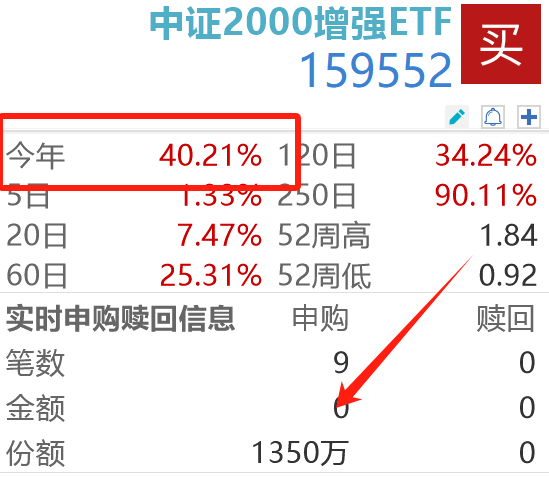
Core Insights - The article highlights the remarkable performance of the "Zhaoshang CSI 2000 Enhanced ETF" (159552), which achieved a 40.83% increase year-to-date, making it the first broad-based ETF to surpass the 40% return threshold in the market this year [1][2] - The ETF's success is attributed to its active management strategy, which has generated nearly 19% of its total returns through excess contributions, showcasing the effectiveness of enhanced strategies in the current market environment [2][6] Group 1: Performance Metrics - As of July 28, the CSI 2000 Enhanced ETF (159552) has shown a 40.21% return over the last 120 days and a 34.24% return over the last 50 days, indicating strong short-term performance [2] - The ETF has experienced a significant increase in trading volume, with a 17-fold increase in shares and over 22 times growth in scale this year, marking it as a phenomenon in the ETF sector [2][5] Group 2: Market Trends - The CSI 2000 index, which includes companies ranked 1801-3800 by market capitalization, has become a flagship index for small and micro-cap stocks, capturing over 30% of emerging industries and niche market leaders [5] - The current market trend favors small-cap stocks due to their higher volatility and market sensitivity, which tend to rebound faster when market sentiment improves [5][11] Group 3: Active Management Strategy - The enhanced strategy employed by the ETF's management team utilizes a multi-factor stock selection model and dynamic rebalancing to capture various market signals, resulting in a significant alpha generation [6][8] - The active management approach has allowed the ETF to outperform similar products and other small-cap indices, highlighting the importance of strategic positioning in the current market [6][11] Group 4: Liquidity and Market Dynamics - The liquidity of the CSI 2000 index has improved significantly, with its average daily trading volume surpassing that of the CSI 300 and CSI 500 indices, facilitating large capital movements in related ETFs [9][11] - The combination of market style, precise tool positioning, excellent active management, and strong liquidity has created a feedback loop that enhances the ETF's performance [11]
灵均投资36.79%领跑!量化1000指增策略碾压300指增,中小盘风格主导私募业绩分化
Sou Hu Cai Jing· 2025-07-26 16:41
Core Insights - Quantitative private equity has shown significant performance differentiation in the market this year, with small and mid-cap strategies outperforming large-cap strategies, reflecting structural changes in the market that deeply impact different investment strategies [1] Group 1: Performance of Quantitative Strategies - As of July 11, the Quantitative 1000 index enhancement strategy has performed the best, with Lingjun Investment leading at a 36.79% year-to-date return, while other institutions like Xinhong Tianhe, Longqi, and Qilin also surpassed the 30% mark [3] - The Quantitative 500 index enhancement strategy also performed well, with Xinhong Tianhe and Abama's related products achieving over 30% year-to-date returns [3] - In contrast, the Quantitative 300 index enhancement strategy lagged, with the highest year-to-date return at only 19.13% [3] - The Quantitative stock selection strategy demonstrated the strongest profitability, with Xiaoyong's strategy leading the market at 46.26% year-to-date return, and other institutions like Ruishengming and Ziwuyou also exceeding 40% [3] Group 2: Market Trends and Structural Changes - The market this year has clearly favored small and mid-cap stocks, providing abundant sources of excess returns for related quantitative strategies [4] - The CSI 1000 index, primarily composed of small and mid-cap stocks, has significantly outperformed the CSI 300 index, benefiting from policies favoring specialized and innovative enterprises [4] - The lower research coverage of small and mid-cap stocks leads to more pricing discrepancies, creating opportunities for quantitative strategies to capture excess returns [4] - Increased market volatility has also created a favorable environment for quantitative strategies, as small and mid-cap stocks typically exhibit higher volatility, allowing strategies to profit from capturing liquidity premiums [4] Group 3: Scale Effects and Strategy Differentiation - Billion-yuan private equity firms exhibit clear scale advantages in index enhancement strategies, dominating the top 20 in both the Quantitative 1000 and 500 index enhancement strategies [5] - Large institutions, with assets under management exceeding 5 billion, achieved an average return of 18.30% in their index enhancement products, with a staggering 99.25% of products generating positive excess returns [5] - Medium-sized private equity firms had an average return of 17.30%, while small firms saw their average return drop to 16.41% [5] - The performance differentiation among quantitative private equity firms is increasingly evident, with over a 15 percentage point difference between the highest and the 20th return in the Quantitative 1000 index enhancement strategy [5]