光波导技术

Search documents
方寸之间,智见未来——AI智能眼镜的趋势与展望
2025-07-25 00:52
Summary of AI Smart Glasses Industry Conference Call Industry Overview - The smart glasses market is projected to reach 5 million units in sales by 2025, potentially doubling in 2026, indicating strong market potential for the integration of AI with smart glasses [1][2] - The global optical and sunglasses market is substantial, with demand expected to reach 2 billion pairs in the next three to five years, leading to a market space of 1 billion units for smart glasses [1][9] Core Insights and Arguments - Smart glasses are categorized into three main types: audio glasses, shooting glasses, and AR glasses, with a focus on shooting glasses due to their advantages in mass production, cost, and functionality [1][5] - The integration of functions in smart glasses is significant, allowing them to replace TWS earbuds and action cameras, monitor health metrics, and provide features like e-book reading and projection [1][8] - The combination of AI technology with smart glasses enhances human-computer interaction, making them effective personal assistants [3][4] Market Dynamics - The smart glasses industry has seen rapid growth, particularly benefiting from advancements in AI models, with sales reaching 1.52 million units in 2024 [2] - The average price of smart glasses, such as Xiaomi's priced at 1999 yuan, is considered reasonable given the quality of components used [15] - By 2035, it is estimated that 70% of traditional glasses will be smart, potentially leading to a market size of 1.4 billion units [9] Key Players and Competitive Landscape - Major companies involved in the smart glasses sector include Meta, Google, ByteDance, Baidu, Alibaba, and smartphone manufacturers like Xiaomi, Samsung, and Huawei [10][12] - The entry of various players, including those from VR/AR backgrounds, indicates a growing interest and investment in the smart glasses market [11] Technological Innovations - Electronic tinting technology is highlighted as a significant future direction for smart glasses, enhancing usability in various scenarios [16][17] - The application of waveguide technology is crucial for the development of lightweight and efficient display systems in smart glasses [19][23] Challenges and Opportunities - The traditional eyewear industry faces challenges in customization and the complexity of fitting processes during the transition to smart glasses [27] - The shift towards smart glasses is expected to increase industry concentration, with a few leading companies dominating the market [28][29] Future Trends - The smart glasses market is anticipated to become more concentrated, with leading companies collaborating with established brands to enhance market share and product value [28][29] - The demand for higher quality components, such as lenses with increased refractive indices, will drive up product prices and influence the entire supply chain [28][29]
2025年中国智能眼镜行业政策、产业链、出货量、竞争格局及行业发展趋势研判:全球科技巨头与创新企业竞相布局,中国市场呈现出蓬勃发展的态势[图]
Chan Ye Xin Xi Wang· 2025-07-15 01:34
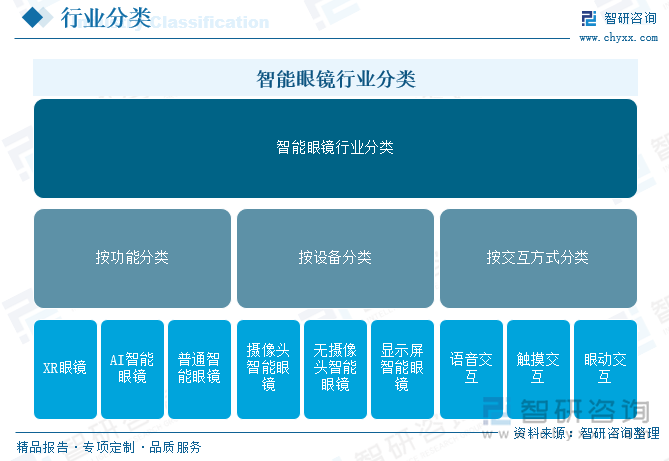
Core Viewpoint - The smart glasses industry is rapidly evolving, with significant growth potential in various applications, including industrial, military, emergency response, and public health monitoring. The global shipment of smart glasses is projected to reach 14.518 million units by 2025, with China showing a particularly promising market growth trajectory [1][4][6]. Industry Definition and Classification - Smart glasses are wearable devices that integrate optical display technology, sensors, computing units, and wireless connectivity, providing information interaction and immersive experiences. They can be classified by function (XR glasses, AI smart glasses, ordinary smart glasses), by device type (camera-equipped, non-camera, display-equipped), and by interaction method (voice, touch, eye movement) [1][10]. Industry Development Status - The smart glasses market is experiencing robust growth, with global shipments expected to reach 14.518 million units by 2025. In China, shipments are projected to rise from approximately 680,000 units in 2023 to 1.307 million units in 2024, and further to 2.907 million units in 2025. Audio and audio-capturing glasses are expected to account for 2.165 million units, while AR/VR devices are projected to reach 742,000 units [4][8]. Industry Value Chain - The smart glasses industry value chain includes upstream components such as lenses, frames, and key electronic parts (optics, chips, displays, sensors, etc.), midstream manufacturing of smart glasses systems and terminals, and downstream sales through traditional optical channels and e-commerce. Applications span various sectors, including media, healthcare, military, and personal use [10]. Industry Policies - The industry is supported by various government policies aimed at enhancing product quality, innovation, and market competitiveness. Recent initiatives include promoting high-value product exports, upgrading consumer electronics standards, and encouraging the development of smart wearable devices in various applications [12][14]. Industry Competitive Landscape - Major players in the smart glasses industry include GoerTek, Jiahe Intelligent, Skyworth Digital, and others. These companies are investing in R&D and production capacity for smart glasses, with GoerTek and Jiahe Intelligent leading in production capabilities. The market is characterized by competition from both domestic and international tech giants [15][18]. Industry Development Trends - The smart glasses market is expected to see advancements in AR/VR technologies, with a focus on enhancing user interaction through AI integration and visual enhancement. The industry is poised for rapid growth, driven by technological innovations and an expanding consumer market [24].

兴业证券:全球AR市场迎爆发式增长 光波导技术引领产业升级
智通财经网· 2025-07-01 03:52
Group 1 - Global AR glasses sales are expected to reach 650,000 units in 2025, representing a 30% year-on-year growth, with AI+AR glasses using waveguide technology being the main growth driver [1] - In 2024, global AR sales are projected to be 500,000 units, with 112,000 units sold in Q1 2025, and a potential to exceed 1.5 million units by 2027 [1] - The AR near-eye display system includes various optical imaging modules, with diffractive waveguides emerging as the most promising optical solution due to their lightweight and high light transmittance [2] Group 2 - The SiC substrate industry is experiencing significant capacity expansion, particularly among Chinese companies, with local production expected to grow over 40% in 2024 [3] - The global SiC substrate market is highly concentrated, with four major companies—Wolfspeed, Tianke HeDa, TianYue Advanced, and High意科技—holding a combined market share of 82% [3] Group 3 - The AR glasses market is primarily driven by consumer penetration, with ongoing advancements in waveguide and micro-display technologies expected to lead to lightweight and cost-effective solutions [4] - Recommended companies in the AR industry include waveguide manufacturers such as GoerTek, Crystal Optoelectronics, Lante Optics, and SuDa WeiGe, as well as SiC manufacturers like Sanan Optoelectronics, JingSheng Mechanical and Electrical, and TianYue Advanced [4]

2024年消费级AR眼镜市场动态与行业趋势洞察
艾瑞咨询· 2025-05-14 12:41
Core Insights - The report highlights the rapid evolution of consumer-grade AR glasses, driven by advancements in optical display and AI integration, leading to a competitive landscape among various manufacturers [1][2][4]. Industry Status - Continuous R&D investment in the AR sector by domestic and international companies is fostering technological innovation and product development. Major players include internet giants, smartphone manufacturers, and AR startups, with a significant shift towards AI integration in AR glasses [2][19]. - The domestic AR glasses market is characterized by a strong presence of local brands such as Starry Sky Meizu, Thunderbird Innovation, XREAL, Rokid, and INMO, collectively referred to as the "Five Little Dragons" of AR glasses, which are rapidly gaining market share against foreign competitors [2][19][21]. Market Overview - In 2024, AR glasses sales reached 286,000 units, with Q4 witnessing record-high sales due to new product launches. Leading brands dominate the market, each carving out niches based on specific advantages [2][23][26]. - The market is expected to maintain momentum into 2025, with ongoing product innovations enhancing portability, functionality, and technology [23][29]. Company Analysis - The report provides an in-depth analysis of leading brands such as Starry Sky Meizu, Thunderbird Innovation, and XREAL, focusing on their product launches, technological advancements, and ecosystem collaborations [3][34][46]. - Starry Sky Meizu is noted for its significant investment in optical waveguide technology and AI integration, positioning itself as a leader in the AR glasses market [42][44]. Technological Trends - Optical waveguide technology is identified as a key driver for the future of consumer-grade AR glasses, offering advantages in lightweight design, high transparency, and display quality [8][50]. - The integration of AI into AR glasses is enhancing user experience and expanding application scenarios, making these devices more appealing to consumers [51][52]. Competitive Landscape - The competitive dynamics of the AR glasses market are influenced by short-term hardware specifications and popular products, while long-term success will depend on cross-device collaboration, developer ecosystems, and data asset depth [55].