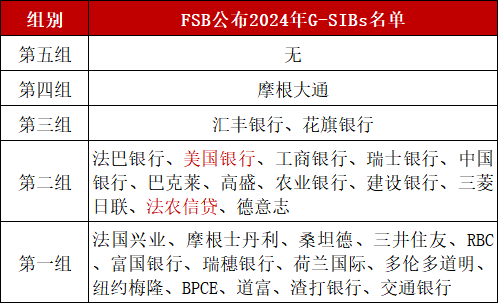
全球系统重要性银行

Search documents
2025年全球系统重要性银行名单出炉!五大国有行入榜,工行组别上升
Guo Ji Jin Rong Bao· 2025-11-28 12:45
Core Points - The Financial Stability Board (FSB) released the 2025 list of Global Systemically Important Banks (G-SIBs) on November 27, 2023, with five major state-owned banks from China consistently included in the list [1] - Industrial and Commercial Bank of China (ICBC) has moved from the second group to the third group, while Agricultural Bank of China, Bank of China, and China Construction Bank remain in the second group, and Bank of Communications stays in the first group [1] Group 1: G-SIBs Classification and Requirements - The G-SIBs rating is based on five dimensions: size, interconnectedness, substitutability, financial institution infrastructure, complexity, and cross-border activities [4] - The 2025 list includes 29 G-SIBs, with the same institutions as in 2024 but with adjusted rankings reflecting changes in banks' core business activities [4] - An increase in group ranking leads to higher loss absorption requirements, effective from January 1, 2027 [4][5] Group 2: Capital Requirements and TLAC - Following the group elevation, ICBC's additional capital requirement will rise from 1.5% to 2.0% [5] - The total loss-absorbing capacity (TLAC) requirements for G-SIBs are aligned with international standards, with external TLAC risk-weighted ratios set to be no less than 16% from January 1, 2025, and 18% from January 1, 2028 [6] - TLAC bonds issued by the five major state-owned banks reached a total of 540 billion yuan, with 30 bonds issued as of November 28, 2025 [7]


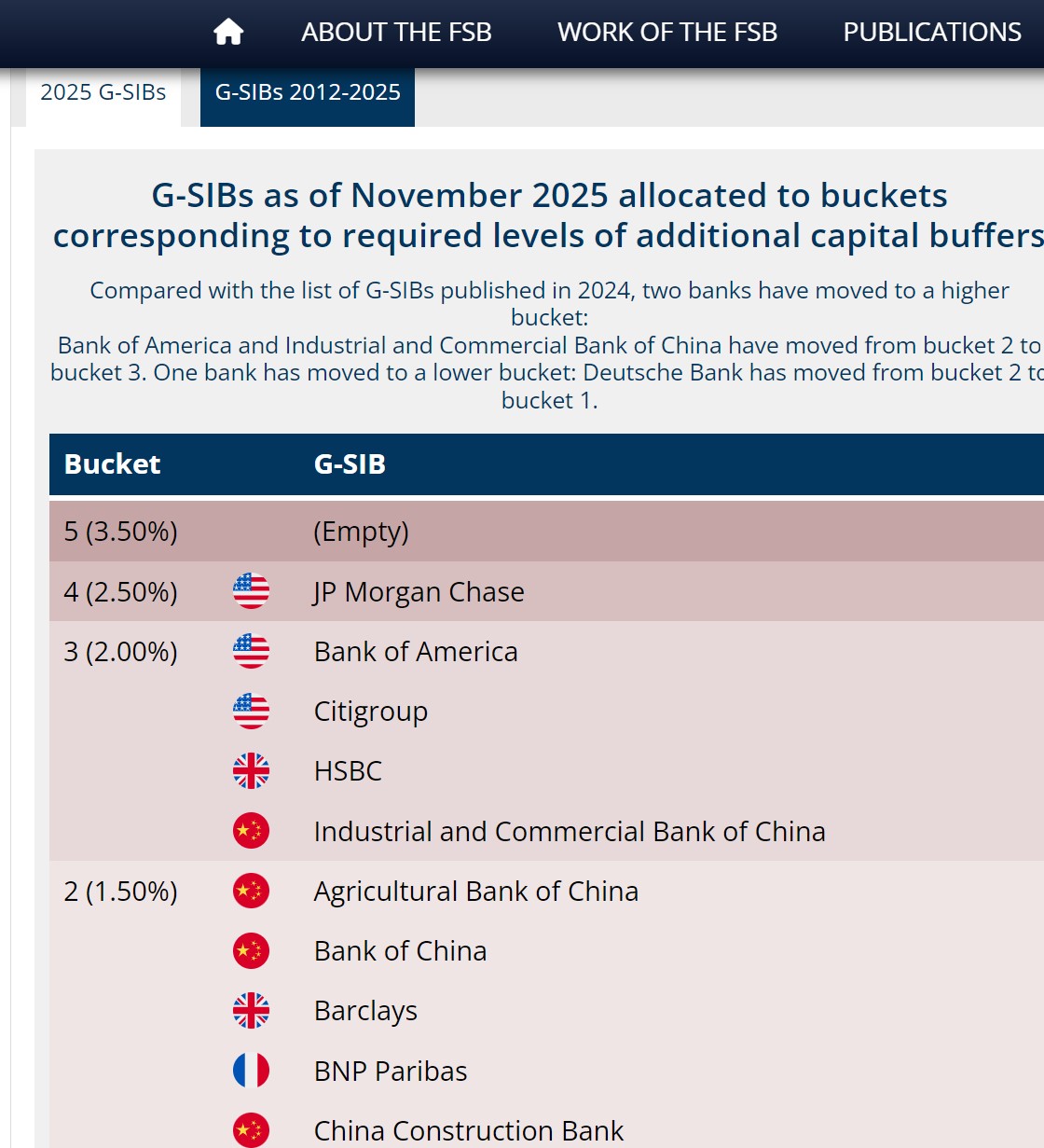
2025年全球系统重要性银行名单出炉!五大国有行入榜 工行组别上升
Guo Ji Jin Rong Bao· 2025-11-28 12:44
Core Points - The Financial Stability Board (FSB) released the 2025 list of Global Systemically Important Banks (G-SIBs) on November 27, 2023, with five major state-owned banks from China consistently included in the list [1] - Industrial and Commercial Bank of China (ICBC) has moved from the second group to the third group, while Agricultural Bank of China, Bank of China, and China Construction Bank remain in the second group, and Bank of Communications stays in the first group [1][2] Group 1: G-SIBs Classification and Capital Requirements - The G-SIBs classification is based on five dimensions: size, interconnectedness, substitutability, financial institution infrastructure, complexity, and cross-border activities [2] - The 2025 list includes 29 G-SIBs, with the same institutions as in 2024 but with adjusted rankings reflecting changes in banks' core business activities [2] - ICBC's additional capital requirement will increase from 1.5% to 2.0% due to its group elevation, effective from January 1, 2027 [2][3] Group 2: Factors Influencing G-SIBs Scores - The increase in scores for ICBC and Bank of China by 33 and 32 points, respectively, is attributed to multiple sub-factors rather than size being the primary driver [3] - Chinese G-SIBs continue to outperform global peers in terms of size and interconnectedness metrics [3] - Currency fluctuations have positively impacted the scores of Chinese G-SIBs, contrasting with historical trends where currency factors typically alleviated score increases [3] Group 3: TLAC Requirements and Bond Issuance - G-SIBs must meet different capital requirements based on their group classification and adhere to Total Loss-Absorbing Capacity (TLAC) requirements [4] - TLAC is designed to ensure that G-SIBs can absorb losses and maintain critical functions during resolution [4] - As of November 28, 2025, the five major state-owned banks have issued a total of 30 TLAC bonds amounting to 540 billion yuan [5] - The issuance of TLAC bonds from 2024 to 2025 is expected to be lower than anticipated, with a projected net supply of around 300 billion yuan in 2026 [5]
全球系统重要性银行名单(G-SIBS)发布
Shang Hai Zheng Quan Bao· 2025-11-28 03:26
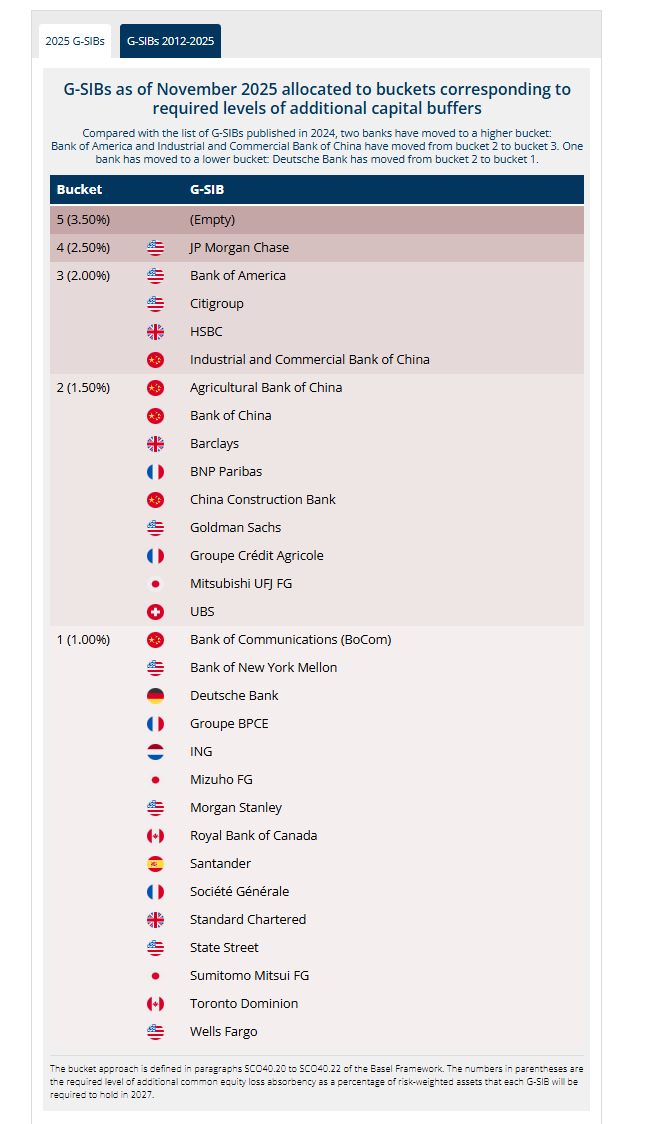
Core Points - The Financial Stability Board (FSB) released the 2025 Global Systemically Important Banks (G-SIBs) list, with the Industrial and Commercial Bank of China (ICBC) moving from bucket 2 to bucket 3, becoming the first Chinese bank in this category [1][3] - The total number of G-SIBs remains at 29, unchanged from the 2024 list, but there have been adjustments in the bucket allocations of some banks [3] - The adjustments in bank classifications are primarily influenced by changes in their business activities, with the "complexity" metric having the most significant impact on scoring changes [3] Bucket Allocations - Bucket 5 (3.50%): Empty - Bucket 4 (2.50%): JP Morgan Chase - Bucket 3 (2.00%): Bank of America, Industrial and Commercial Bank of China, Citigroup, HSBC [2] - Bucket 2 (1.50%): Agricultural Bank of China, Bank of China, China Construction Bank, among others [2] - Bucket 1 (1.0096%): Bank of Communications, Deutsche Bank, and others [2] Future Implications - Higher capital buffer requirements for banks that move up in classification will take effect starting January 1, 2027 [3] - Fitch Ratings had predicted the rise of ICBC to bucket 3, while other Chinese banks are expected to remain on the G-SIBs list [3]


全球系统重要性银行的机遇与挑战
Sou Hu Cai Jing· 2025-10-10 02:31
Core Insights - Global systemically important banks (G-SIBs) are undergoing a critical transformation, driven by industrialization and middle-class expansion in emerging markets, which present new opportunities in retail, corporate, and cross-border businesses. Financial technology is enhancing digital risk control and customer acquisition. However, challenges such as stagflation risks, geopolitical conflicts, and interest rate differentiation are intensifying pressure on interest margins and asset quality. The application of artificial intelligence also brings challenges related to model interpretability and compliance. Capturing the emerging market dividend and completing digital upgrades will be key to determining the future competitive advantage of G-SIBs [1]. Background - The 2008 global financial crisis highlighted the "too big to fail" issue of large international financial institutions. In 2011, the Financial Stability Board (FSB) released regulatory measures for G-SIBs, publishing the first list of G-SIBs, which included most global systemically important banks. According to the FSB's 2024 G-SIBs list, there are 29 banks globally [2][3]. Current Operations - In the current interest rate cut cycle, financial services have become the main revenue driver for banks. Since the Federal Reserve began lowering rates, traditional lending has faced pressure, leading to significant revenue growth in investment banking, financial markets, and wealth management. In Q1 2025, revenues from financial services for JPMorgan, Citigroup, and Bank of America grew by 12.0%, 10.0%, and 7.1%, respectively, with contributions exceeding 50% of total revenues, an increase of 3-6 percentage points from pre-rate cut levels [5]. - Investment banking has cooled down, with uncertainty in the market due to aggressive policy changes under the Trump administration. In Q1 2025, the growth rate of investment banking revenues for the four major U.S. banks dropped from an average of around 40% to less than 10%. Bank of America saw a year-on-year decline of -0.35% in investment banking revenue, while JPMorgan's growth slowed to 2.4% [5]. - Trading business has emerged as a new revenue driver, with significant increases in trading revenues for major U.S. banks in Q1 2025, attributed to heightened market volatility and geopolitical tensions. Trading revenues for JPMorgan, Citigroup, and Bank of America grew by 21%, 12%, and 11%, respectively, with stock trading revenues increasing by 48%, 23%, and 17% [6]. - Payment and settlement services have shown weak performance, with revenues for JPMorgan, Citigroup, Bank of America, and Wells Fargo growing by only 2.2%, 3.6%, 0.5%, and -10.9%, respectively, contrasting sharply with the growth in investment banking and trading revenues [6]. Opportunities - Expansion in emerging markets presents significant opportunities, particularly in retail banking, as the growing middle class demands diverse financial services. G-SIBs can meet these needs by offering various savings products and consumer loans. Additionally, the rising high-net-worth population increases demand for wealth management services [7]. - The demand for cross-border financial services is increasing, driven by globalization. G-SIBs can provide efficient cross-border payment solutions, financing, and risk management services to support businesses in their international activities [7]. - Regulatory changes may create potential opportunities, as the new U.S. administration's policies could support the cryptocurrency and digital asset markets, allowing G-SIBs to explore new business areas [8]. - Financial technology is enabling digital transformation, allowing G-SIBs to innovate in cross-border services and enhance customer experiences through personalized financial products [8]. Challenges - The uncertain macroeconomic environment in 2025 poses risks, with geopolitical tensions and trade protectionism affecting global economic activity. The U.S. government's tariff policies may lead to a new round of global trade disputes, increasing external risks for G-SIBs [9]. - The potential return of laissez-faire financial policies under the Trump administration could elevate systemic financial risks, as regulatory changes may reduce banks' liquidity requirements, impacting their ability to absorb potential losses [10]. - The application of AI in banking faces challenges, including the reliability and accuracy of AI outputs, which may conflict with the low tolerance for error in banking services [11]. Strategies and Recommendations - To address the challenges posed by low interest rates and regulatory costs, G-SIBs should build a multi-layered governance framework. This includes meeting total loss-absorbing capacity (TLAC) requirements and optimizing capital structures through asset securitization and diversifying capital tools [15][16]. - Business transformation and revenue diversification are crucial for balancing regulatory costs and profitability. G-SIBs should focus on expanding light-capital businesses and enhancing non-interest income through wealth management and advisory services [16]. - Governance and technology should work in tandem to improve risk management and operational resilience, including the implementation of real-time monitoring platforms for cross-border risks [16][17].