全球系统重要性银行

Search documents
中国金融市场的整体实力 和影响力不断增强
Jin Rong Shi Bao· 2025-12-10 02:05
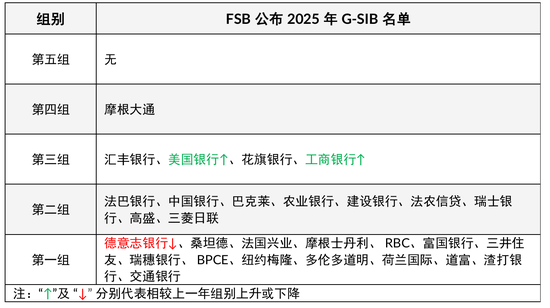
Core Viewpoint - The Financial Stability Board (FSB) has released the 2025 Global Systemically Important Banks (G-SIB) list, highlighting the increasing significance of Chinese banks in the global financial system [1][2]. Group 1: G-SIB List Overview - Five Chinese banks, including Industrial and Commercial Bank of China (ICBC), Agricultural Bank of China, Bank of China, China Construction Bank, and Bank of Communications, are included in the G-SIB list for 2025, consistent with 2024 [1]. - ICBC has moved into the third group for the first time, while Agricultural Bank, Bank of China, and China Construction Bank remain in the second group, and Bank of Communications stays in the first group [1]. - The G-SIB list consists of five groups, with no banks in the highest fifth group, only JPMorgan in the fourth group, and a total of 29 banks listed, unchanged from 2024 [1][2]. Group 2: Performance Metrics - The total scores for the Chinese banks have increased compared to the previous year, with ICBC up by 33 points, Agricultural Bank by 15 points, Bank of China by 32 points, China Construction Bank by 10 points, and Bank of Communications by 9 points [2]. - The increase in scores indicates that factors beyond size are now more significant in determining the rankings of these banks [2]. Group 3: Implications and Requirements - The adjustments in the G-SIB list reflect the evolving business activities of banks, emphasizing quality over size, aligning with the goals of building a stronger financial nation [2]. - Banks on the G-SIB list face higher capital regulatory requirements, including additional capital and Total Loss-Absorbing Capacity (TLAC) requirements, with varying standards from 1% to 3.5% across the groups [2]. - ICBC, having moved up a group, will now encounter higher capital buffer requirements, which signifies both recognition of its strength and a challenge for future development [3].





金融行业双周报(2025、11、21-2025、12、4)-20251205
Dongguan Securities· 2025-12-05 08:49
Investment Ratings - Banking: Overweight (Maintain) [1] - Securities: Market Weight (Maintain) [1] - Insurance: Overweight (Maintain) [1] Core Insights - The Financial Stability Board (FSB) released the 2025 Global Systemically Important Banks (G-SIBs) list, with the Industrial and Commercial Bank of China (ICBC) moving from the second group to the third group, marking a historic breakthrough for Chinese banks in global importance assessments [1][44] - The upward adjustment in ranking will subject ICBC to stricter capital regulatory requirements, with additional capital requirements increasing from 1.5% to 2% effective from 2027 [1][44] - The banking sector is expected to attract funds due to the ongoing low-interest-rate environment and the "asset shortage" issue, leading to sustained demand for high-dividend, low-valuation bank stocks [1][44] - The insurance sector is transitioning from reliance on sales expenses to refined management and cost control, with policies encouraging a return to the core of insurance protection and supporting increased equity investment by insurance funds [1][49] Summary by Sections Market Review - As of December 4, 2025, the banking, securities, and insurance indices experienced declines of -2.18%, -4.12%, and -2.74% respectively, while the CSI 300 index fell by -0.40% [10] - Xiamen Bank (+4.94%), CITIC Securities (+1.15%), and China Pacific Insurance (-0.96%) were the best performers among sub-sectors [10] Valuation Situation - As of December 4, 2025, the PB ratio for the banking sector was 0.77, with state-owned banks, joint-stock banks, city commercial banks, and rural commercial banks having PB ratios of 0.83, 0.62, 0.73, and 0.65 respectively [19] - The securities sector's PB ratio was 1.44, indicating potential for valuation recovery [22] Recent Market Indicators - The one-year Medium-term Lending Facility (MLF) rate was 2.0%, with the one-year and five-year Loan Prime Rates (LPR) at 3.0% and 3.50% respectively [27] - The average daily trading volume of A-shares was 17142.93 billion, showing a slight decrease of 0.65% [33] Industry News - The China Actuarial Society issued guidelines on the allocation of costs for life insurance products, aiming to clarify cost definitions and management [40][47] - The number of new A-share accounts opened in November 2025 was 2.38 million, a 3% increase from October, indicating a recovery in market sentiment [46] Company Announcements - New China Life announced a cash dividend of 0.67 yuan per share for the first half of 2025, totaling approximately 2.09 billion yuan [42] - Changsha Bank issued 60 billion yuan in secondary capital bonds, while Industrial Bank successfully issued 20 billion yuan in financial bonds [42]
【光大研究每日速递】20251202
光大证券研究· 2025-12-01 23:04
Group 1: Banking Sector - The Financial Stability Board (FSB) released the 2025 Global Systemically Important Banks (G-SIBs) list, with adjustments in group rankings. Industrial and Commercial Bank of China (ICBC) moved from Group 2 to Group 3, while Deutsche Bank dropped from Group 2 to Group 1 [4] - ICBC's capital strength remains adequate to meet G-SIBs regulatory requirements, especially considering factors like special government bond capital supplements and TLAC non-capital bond issuances [4] Group 2: Steel Industry - The Ministry of Industry and Information Technology (MIIT) issued the "Steel Industry Normative Conditions (2025 Edition)" on February 8, 2025, and reiterated the need to promote the orderly exit of outdated production capacity on July 18, 2025. This suggests a potential recovery in steel sector profitability to historical average levels [4] - Steel stocks' price-to-book (PB) ratios are expected to recover alongside profitability improvements, although caution is advised regarding significant fluctuations in futures prices [4] Group 3: Copper Industry - The China Copper Raw Material Negotiation Group (CSPT) has mandated member companies to reduce copper production capacity by over 10% in 2026, indicating a tightening supply chain that may lead to higher copper prices [5][6] - The processing fees and pricing terms for copper concentrate have deviated significantly from market norms, prompting CSPT to enforce stricter compliance among its members [6] Group 4: Renewable Energy and Utilities - The National Development and Reform Commission (NDRC) acknowledged the achievements in the development of energy storage and hydrogen energy, emphasizing the importance of market mechanisms for reasonable returns in the energy storage sector [7] - Recent policies aim to enhance the consumption of green electricity, with expectations for valuation recovery in the green electricity sector due to accelerated subsidy disbursements [7] Group 5: Jewelry Sector - Chow Tai Fook reported a 1.1% year-on-year decrease in revenue for the first half of FY2026, totaling HKD 38.986 billion, while net profit increased by 0.2% to HKD 2.534 billion. The company proposed an interim cash dividend of HKD 0.22 per share, reflecting a payout ratio of 85.7% [8]


我国5家银行入选2025年G-SIB名单 分析称未来继续看好银行板块
Zhong Guo Jing Ying Bao· 2025-12-01 09:21
Group 1 - The Financial Stability Board (FSB) announced the 2025 list of Global Systemically Important Banks (G-SIBs), with five Chinese banks included, maintaining the same number as the previous year [1] - Industrial and Commercial Bank of China (ICBC) has been upgraded to the third group with an additional capital requirement of 2.0%, while Bank of China, Agricultural Bank of China, and China Construction Bank remain in the second group with a requirement of 1.5%, and Bank of Communications stays in the first group with a requirement of 1% [1] - Following the upgrade, ICBC's core Tier 1 capital adequacy ratio regulatory requirement increases from 9% to 9.5%, with a current ratio of 13.6%, providing a buffer of 4.6 percentage points [1] Group 2 - Fitch Ratings noted that the scoring changes for Chinese G-SIBs in 2025 show that scale is no longer the primary driver for score increases, and exchange rate effects have positively influenced scores [2] - The Basel Committee plans to adjust the framework for identifying G-SIBs from year-end static data to annual average calculations, which may reduce data volatility and limit the impact on most banks, although institutions near threshold levels may experience changes [2] - The increase in global systemic importance reflects the fundamental strength of large banks, with scores for the five major banks rising between 9 to 33 points, and Bank of China is likely to be upgraded soon [2] Group 3 - The banking sector is viewed positively for long-term investment, with a high dividend strategy still having room for growth amid an "asset shortage" environment, suggesting a continuation of structural market trends [3]
金融行业周报:全球重要性银行名单公布,资本市场投融资改革持续推进-20251201
Ping An Securities· 2025-12-01 05:35
Investment Rating - The industry investment rating is "Outperform the Market," indicating an expected performance that exceeds the CSI 300 index by more than 5% within the next six months [34]. Core Insights - The Financial Stability Board (FSB) has released the 2025 list of Global Systemically Important Banks (G-SIBs), with five Chinese state-owned banks included. Notably, the Industrial and Commercial Bank of China (ICBC) has moved to the third group, requiring an additional capital requirement increase from 1.5% to 2.0% [4][12]. - The China Securities Regulatory Commission (CSRC) has issued a draft announcement for the pilot of Commercial Real Estate Investment Trusts (REITs), aimed at revitalizing the commercial real estate market and filling the gap for quality investment targets [5][13]. - A joint announcement from six departments outlines a plan to enhance the adaptability of supply and demand for consumer goods, targeting significant improvements in the supply structure by 2027 and fostering a high-quality development pattern by 2030 [6][19]. Summary by Sections Global Systemically Important Banks - The FSB has categorized Chinese banks into different groups, with ICBC in the third group, Agricultural Bank of China, Bank of China, and China Construction Bank in the second group, and China Communications Bank in the first group. This classification reflects the banks' systemic importance and associated capital requirements [4][12]. Commercial Real Estate Investment Trusts - The CSRC's draft announcement outlines the framework for establishing Commercial REITs, which will allow investment in commercial real estate assets to generate stable cash flows. This initiative is expected to address challenges in the commercial real estate sector and enhance financing channels [5][13]. Consumer Goods Supply and Demand - The joint plan from six government departments aims to optimize the supply structure of consumer goods, with specific targets for 2027 and 2030. The focus is on creating significant consumer sectors and enhancing the quality of products available in the market [6][19]. Industry Data - The banking sector saw a net injection of 15,118 billion yuan through open market operations, while the SHIBOR rates showed mixed performance. The average daily trading volume in the stock market was 21,585 billion yuan, reflecting a decrease of 7.4% from the previous week [21][27][29]. - The insurance sector's ten-year government bond yield increased by 2.46 basis points, indicating a slight upward trend in interest rates [32].
光大证券晨会速递-20251201
EBSCN· 2025-12-01 03:44
Macro Analysis - The manufacturing PMI showed signs of stabilization in November, indicating a weak recovery driven by improved exports due to the easing of trade tensions between China and the US, with new export orders and small enterprise PMI significantly rebounding [2] - Seasonal disruptions from the October holiday have ended, leading to a rise in production and procurement indices [2] - Both raw material and finished product price indices have increased, suggesting an ongoing improvement in the supply-demand relationship for industrial goods [2] Strategy Insights - The market is expected to remain in a wide fluctuation phase, with a potential bull market direction, although short-term catalysts may be lacking [4] - The A-share and Hong Kong stock monthly stock picks for December include companies like Tencent Holdings, China Petroleum, and Haier Smart Home, indicating a focus on sectors with growth potential [3] Bond Market Overview - The total bond custody volume increased significantly in October, with a net increase in interest rate bonds and credit bonds, while financial bonds saw a net decrease [5] - The convertible bond market experienced slight adjustments, with high-priced and high-valuation convertible bonds facing pressure [6] - Credit bond issuance rose to 5,890.11 million yuan, reflecting a 1.34% increase week-on-week, with overall credit spreads trending upwards [7] Chemical Industry Insights - The signing of a major potash fertilizer contract at $348 per ton indicates a tight supply-demand situation, supporting the industry's positive outlook [11] - Oil prices are experiencing low-level fluctuations due to geopolitical tensions and OPEC+ production policies, with Brent and WTI prices reported at $62.32 and $58.48 per barrel respectively [12] Energy Sector Developments - The storage and hydrogen energy sectors are expected to see continued growth, with government support for market-driven adjustments and the promotion of hydrogen ammonia construction [13] Copper Industry Analysis - The China Copper Raw Material Negotiation Group has requested a 10% reduction in copper production capacity for 2026, indicating a tightening supply situation [14] Utility Sector Updates - The National Development and Reform Commission has released new pricing policies for electricity distribution, which may lead to a valuation recovery in the green electricity sector [15] Automotive Sector Performance - Pony.ai reported significant revenue growth in its Robotaxi segment, with expectations for continued expansion and improved profitability [16] - Li Auto's third-quarter performance was under pressure, leading to a downward revision of profit forecasts, but the company remains optimistic about its market positioning [17] Apparel Industry Trends - Chow Tai Fook's sales growth turned positive in Q2, with a notable increase in revenue from priced jewelry, prompting an upward revision of profit forecasts [18] - Bosideng's revenue grew by 1.4% in the first half of the fiscal year, supported by stable growth in its branded down jacket business [19]
2025年全球系统重要性银行名单出炉
Zheng Quan Ri Bao Zhi Sheng· 2025-11-30 16:06
Core Insights - The Financial Stability Board (FSB) has released the 2025 list of Global Systemically Important Banks (G-SIBs), maintaining the number of banks at 29, with five Chinese state-owned banks included [1][2] - The grouping of banks has changed, reflecting shifts in their core business activities, with the Industrial and Commercial Bank of China (ICBC) moving from the second to the third group, marking it as the first Chinese bank in that category [1][2] Group Changes - The highest group (fifth group) remains vacant, while the fourth group includes only JPMorgan Chase [1] - The Agricultural Bank of China, Bank of China, and China Construction Bank remain in the second group, while the Bank of Communications is in the first group [1] Score Changes - The scores of Chinese G-SIBs have changed significantly, with ICBC and Bank of China increasing by 33 and 32 points respectively, driven by multiple factors rather than just size [2] - Currency effects have also positively influenced the scores of Chinese G-SIBs [2] Capital Requirements - Following the group adjustment, ICBC's additional capital requirement will increase from 1.5% to 2.0%, necessitating compliance with Total Loss-Absorbing Capacity (TLAC) requirements within a specified timeframe [2] Importance in Global Financial System - The adjustment confirms ICBC's significant position in the global financial system, raising expectations for its compliance and risk management [2] - The five Chinese banks are encouraged to enhance their ESG management and global strategy, leveraging financial technology for new service models [3] Recommendations for Future Strategy - The banks should improve their compliance and risk management systems by learning from global experiences and actively participating in discussions on international financial management standards [3] - They are advised to innovate in business practices to enhance their narrative in the global financial system and increase their influence [3]
工行、农行、中行、交行、交行入选!工行迎重要突破!
Jin Rong Shi Bao· 2025-11-30 03:13
Core Insights - The Financial Stability Board (FSB) has released the list of Global Systemically Important Banks (G-SIBs) for 2025, maintaining the number of banks at 29, consistent with 2024 [1] - Among Chinese banks, five state-owned banks remain on the list: Industrial and Commercial Bank of China (ICBC), Agricultural Bank of China, Bank of China, China Construction Bank, and Bank of Communications [1] - ICBC has been upgraded to the third group, marking it as the first Chinese bank to enter this category, which increases its additional capital requirement from 1.5% to 2.0% [1] Group Analysis - The inclusion of the five major state-owned banks in the G-SIB list underscores their stable and significant position in the global financial landscape [2] - According to Fitch Ratings, the scoring for Chinese banks in this year's G-SIB list is driven by multiple sub-factors rather than just size, with ICBC and Bank of China seeing significant score increases of 33 and 32 points respectively [2] - Changes in the grouping of foreign banks, such as Bank of America moving from the second to the third group and Deutsche Bank dropping from the second to the first group, reflect the evolving competitive landscape of the global banking industry [2]
工行晋级全球系统重要性银行第三组 中国金融业全球话语权再进阶
Shang Hai Zheng Quan Bao· 2025-11-28 18:40
Core Insights - The Financial Stability Board (FSB) has updated the list of Global Systemically Important Banks (G-SIBs) for 2025, highlighting the advancement of Chinese banks in the global financial system [1][2] - Five major state-owned banks from China have been recognized, with Industrial and Commercial Bank of China (ICBC) moving from the second group to the third group, marking it as the first Chinese bank to achieve this status [1][2] Group 1: ICBC's Advancement - ICBC's elevation to the third group reflects its ongoing efforts in smart risk control, modern layout, digital empowerment, comprehensive services, and ecological systems [2] - External factors such as changes in international competition and currency fluctuations contributed to ICBC's rise, with the appreciation of the Renminbi against the Euro positively impacting its score [2] Group 2: Implications for Chinese Banking Sector - The elevation of ICBC signifies a notable increase in the systemic importance of Chinese banks within the global financial framework [3] - This event sends three key signals: the enhanced global significance of Chinese banks, a shift in competitive focus towards emerging markets, and the potential reshaping of the global banking landscape [3] - ICBC's advancement is expected to have a demonstration effect on other large domestic banks, promoting adherence to global regulatory standards and encouraging a transition from "scale expansion" to "quality expansion" in the Chinese banking sector [3]
工行晋升全球系统重要性银行第三组,为中资银行首家
2 1 Shi Ji Jing Ji Bao Dao· 2025-11-28 13:18
Core Insights - The Financial Stability Board (FSB) announced the 2025 Global Systemically Important Banks (G-SIB) list, with five Chinese commercial banks included, marking a significant recognition of their importance in the global financial system [1][2] Group Summaries Group Adjustments - Industrial and Commercial Bank of China (ICBC) has moved from the second group to the third group, becoming the first Chinese bank to enter the G-SIB third group, which indicates an increase in its global significance [1][2] - The additional capital requirement for ICBC will increase from 1.5% to 2.0% due to this group adjustment [1] Other Chinese Banks - The other four Chinese banks maintain their group positions: Bank of China, Agricultural Bank of China, and China Construction Bank remain in the second group, while Bank of Communications stays in the first group [1][2] G-SIB Evaluation Framework - The G-SIB evaluation framework, established post-2007 financial crisis, aims to enhance capital requirements for large banks to mitigate systemic risks [2][3] - The additional capital requirements for each group range from 1% for the first group to 3.5% for the fifth group, with higher groups facing stricter regulatory demands [3] Rating Changes and Factors - Fitch Ratings noted that the scoring changes for Chinese G-SIBs this year were driven by multiple factors rather than just size, with ICBC and Bank of China seeing significant score increases of 33 and 32 points, respectively [3] - Currency fluctuations positively impacted the scores of Chinese banks this year, although this effect may reverse in 2026 due to recent currency changes [3] Basel Committee Adjustments - The Basel Committee is considering changing the G-SIB identification framework from year-end static data to average values over the year, with a preference for quarterly averages among feedback [4] - If quarterly averages are adopted, the impact on most banks' final scores may be limited, but institutions near group thresholds could still experience changes [4] Capital Adequacy of ICBC - Standard & Poor's Global Ratings indicated that ICBC is capable of meeting the higher capital requirements, with a total loss-absorbing capacity capital ratio of 21.52% as of September 30, 2025, exceeding the minimum requirement for the third group [4] - ICBC's conservative growth strategy is expected to support capital retention and manage capital buffer pressures, with projected asset growth remaining controlled in the coming years [4]