历史文化名城保护

Search documents
陈刚到八路军驻湘通讯处旧址调研历史文化名城保护工作
Chang Sha Wan Bao· 2025-09-02 03:19
Core Viewpoint - The restoration and reopening of the Eighth Route Army's communication station in Hunan is aimed at enhancing cultural heritage and commemorating the 80th anniversary of the victory in the Anti-Japanese War and the World Anti-Fascist War [1][2] Group 1: Restoration and Cultural Events - The restoration project of the Eighth Route Army's communication station was completed on August 30 and opened for trial operation on September 3 [1] - A cultural performance titled "Memories of Xiang Soil, Illuminating the Journey" was held on September 1, featuring various anti-war themed programs to engage the public and promote historical awareness [1] - The event included performances such as the chorus "Never Forget National Humiliation, Strengthen China" and the dance "Yellow River Ode," aimed at inspiring collective spirit and historical remembrance [1] Group 2: Community Engagement Activities - The reopening of the communication station serves as an opportunity to enhance community cultural life, with film screenings of anti-war themed movies scheduled for September 1 and 2 [2] - On September 3, a commemorative activity titled "A Victory Flower, Thousands of Hearts in Changsha" is planned to involve citizens in the celebration [2]
(活力中国调研行)湖北随州产城深度融合 注入发展新动能
Zhong Guo Xin Wen Wang· 2025-08-30 09:01
Group 1: Industry Development - Suizhou is recognized as the "Capital of Special Vehicles in China," producing one out of every ten special vehicles in the country, with a projected output of 164,000 special vehicles in 2024 and an emergency industry output value exceeding 60 billion yuan [3][4] - The local industry has evolved to include a safety emergency industry chain, focusing on emergency rescue training and technology transfer, with the establishment of the Suizhou Safety Emergency Base [3] - Suizhou has transformed its traditional mushroom farming into a thriving industry, becoming the largest trading hub for mushrooms in China, exporting products to over 60 countries and regions [3][4] Group 2: Urban and Rural Integration - Suizhou has revitalized its historical and cultural sites, enhancing the urban night economy through the renovation of historical districts like Caodianzi Street, which showcases the city's cultural heritage [5][7] - The city has implemented a "beautiful countryside" construction model, promoting rural development and attracting tourism through local initiatives, such as the establishment of popular homestays [7][8] Group 3: Cultural Heritage and Tourism - The cultural significance of Suizhou is highlighted by the legend of Emperor Yan and the ancient Zenghouyi Bell, which represents the pinnacle of Chinese pre-Qin civilization [8][10] - The Suizhou Yan Emperor Cultural Park has successfully attracted tens of thousands of visitors through seasonal events, emphasizing the importance of cultural tourism in the region [8][10] - The Zenghouyi Bell, recognized as the largest ancient musical instrument, was included in the "World Memory Register," further enhancing Suizhou's cultural profile [10]

建体系、强协调,广州历史文化名城保护最新规划“新”在哪?
Nan Fang Du Shi Bao· 2025-08-13 15:59
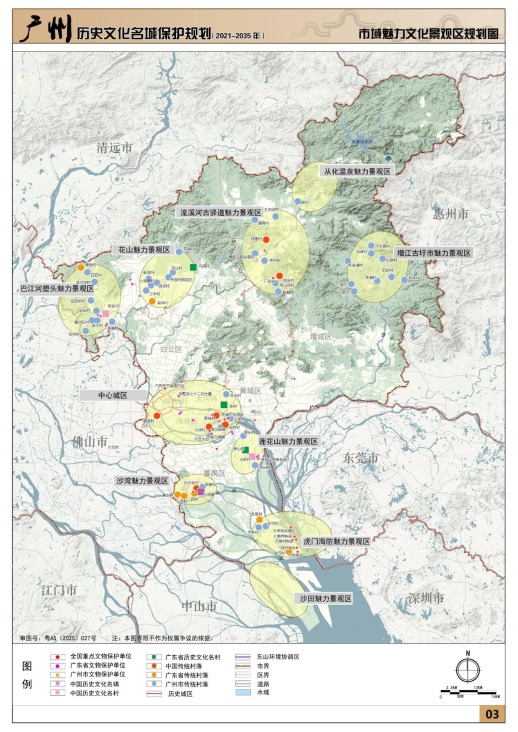
Core Points - Guangzhou has officially issued the "Historical and Cultural City Protection Plan (2021-2035)" which serves as a top-level design and guiding document for the protection and inheritance of its historical culture [1] - The plan integrates national and regional development strategies, optimizing the five major historical cultural values and six major city characteristics, while enhancing the historical and cultural protection system [1][3] - The plan aims to incorporate historical and cultural heritage protection into urban and rural construction, creating a world-class city with classic charm and contemporary vitality by 2035 [1] Summary by Sections Historical and Cultural Values and City Characteristics - The five major historical cultural values identified include: 1. Political and military center of the Lingnan region and a gateway for foreign exchanges 2. A thousand-year-old commercial hub and an important birthplace of the Maritime Silk Road 3. A cultural center reflecting the diverse and unified characteristics of Chinese civilization 4. A frontline for anti-imperialism and anti-feudalism, and a source of democratic revolution 5. A pioneering city in modern development and a leader in reform and opening up [3][2] - The six major city characteristics include: 1. A town pattern interwoven with mountains, fields, and seas 2. An urban environment characterized by clouds, mountains, and rivers 3. An ancient city layout with a thousand-year continuity and layered culture 4. A commercial hub with distinctive architectural styles 5. A blend of Lingnan charm and Western architectural styles 6. An open and inclusive city with vibrant cultural heritage [2][3] Overall Structure and Protection Framework - The plan proposes a new spatial structure for cultural and ecological integration, termed "One River, One River, One City, Nine Districts," which includes the Pearl River cultural belt and the Liuxi River cultural belt [5][4] - The "One City, Nine Districts" concept integrates historical culture and natural ecological resources, forming a central urban area and nine scenic areas rich in resources [5][4] Heritage Protection and Expansion - The plan expands the scope of heritage protection to include agricultural, industrial, and water heritage, such as the Guangdong Lingnan lychee planting system and historical sites like Guanggang and Guangchuan [9][8] - It emphasizes the protection of 9,961 ancient trees and various historical sites, enhancing resource identification and protection efforts [9][8] Historical Urban Area Protection - The historical urban area covers 20.39 square kilometers, with specific protection requirements for historical docks and water systems [11][12] - The plan maintains the traditional urban structure of "One Ring, Two Axes, Multiple Veins, and Multiple Points," emphasizing the preservation of historical features [12][14] Cultural Network and Regional Cooperation - The plan establishes a cultural network system for the Guangdong-Hong Kong-Macao Greater Bay Area, highlighting Guangzhou's role as a cultural center [18][17] - It encourages cultural innovation and the development of creative industries, integrating modern creative sectors with historical cultural promotion [18][17]