
历史正义

Search documents
历史的道与义(文思)
Ren Min Ri Bao· 2025-09-05 22:22
Core Viewpoint - The event commemorates the victory of the Chinese people in the War of Resistance against Japan and the global anti-fascist struggle, emphasizing the importance of historical justice and collective memory [3][4]. Group 1: Historical Significance - The event serves as a powerful reminder of the sacrifices made by heroes throughout Chinese history, encapsulated in the inscription on the Monument to the People's Heroes [1]. - The commemoration highlights the transformation of World War II into a global anti-fascist war, leading to significant political changes and the establishment of a more just world order [3]. Group 2: Cultural and Soft Power - The importance of cultural memory and the role of art in shaping global narratives is emphasized, with a call for active participation in global cultural competition [4]. - The need for a robust public cultural service system and high-quality cultural products is identified as essential for building a culturally strong nation [4]. Group 3: Future Aspirations - The event reflects a collective aspiration for a peaceful and stable international order, with a focus on the contributions of new art forms that engage with contemporary social processes [5]. - The commitment to enhancing cross-cultural dialogue and international communication capabilities is highlighted as a means to assert China's cultural narrative on the global stage [4].
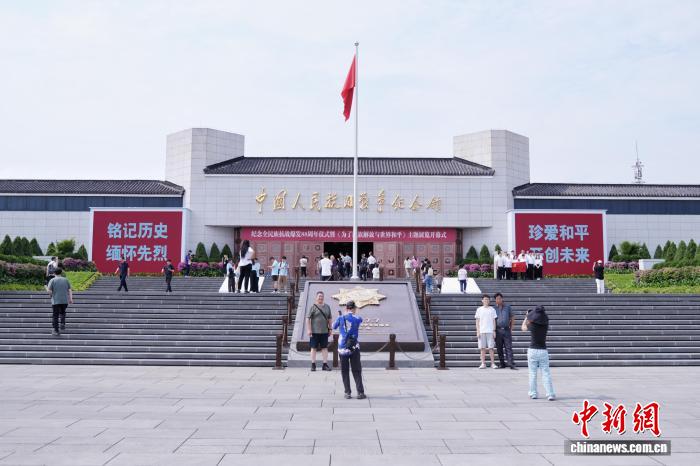
(抗战胜利80周年)抗战馆让历史“活”起来 诠释胜利传承精神
Zhong Guo Xin Wen Wang· 2025-09-02 23:25
Core Viewpoint - The upgraded China People's Anti-Japanese War Memorial Museum (Anti-War Museum) commemorates the 80th anniversary of the victory in the Anti-Japanese War, emphasizing the importance of historical memory and peace through a new exhibition titled "For National Liberation and World Peace" [1][13]. Group 1: Exhibition Overview - The exhibition opened on July 7 and has attracted over 600,000 visitors to date [1]. - The exhibition area has expanded from 6,700 square meters to 12,200 square meters, nearly doubling the space for historical narrative [4]. - A total of 3,237 artifacts and 1,525 photographs are displayed, with nearly one-third of the items being shown for the first time [4][13]. Group 2: Historical Narrative and Content - The exhibition features a variety of historical materials, including documents and artifacts that provide deeper insights into the Anti-Japanese War [6]. - A section dedicated to the history of the Anti-Japanese War from Hong Kong, Macau, and Taiwan showcases contributions from overseas Chinese [6]. - A dynamic lightbox matrix composed of 5,098 photos narrates the 14-year struggle from September 18, 1931, to September 2, 1945 [6]. Group 3: Technological Integration - The museum employs advanced technology to enhance visitor engagement, such as interactive displays and immersive experiences [10][11]. - AI technology has been used to animate images of heroes, making their stories more relatable to visitors [11]. - The use of 5K ultra-high-definition displays creates an immersive environment that allows visitors to experience historical moments vividly [11]. Group 4: Spiritual and Educational Mission - The museum emphasizes the importance of passing on the spirit of resistance and patriotism through interactive installations that honor heroes [14]. - The commitment to historical justice is reflected in the exhibition's content, which exposes the atrocities committed by Japanese militarism [15][16]. - The museum aims to educate visitors about the significance of the Anti-Japanese War in the context of global anti-fascist efforts [9][16]. Group 5: Future Directions - The museum's expansion and technological advancements aim to make history more accessible and engaging for future generations [17]. - The integration of history, technology, and art is designed to foster a deeper understanding of national spirit and historical context among visitors [17].

纪念抗战胜利80周年研讨会在土耳其伊斯坦布尔举行
Xin Hua She· 2025-08-27 16:14
Core Points - The seminar commemorating the 80th anniversary of the victory in the Chinese People's Anti-Japanese War and the World Anti-Fascist War was held in Istanbul, emphasizing the theme "Cherish Peace, Create the Future" [1] - Over a hundred representatives from think tanks, media, and scholars from China and Turkey, as well as consuls from Uzbekistan, Azerbaijan, Argentina, and Poland, attended the event [1] - The Chinese Consul General in Istanbul, Wei Xiaodong, highlighted China's significant sacrifices and contributions to the victory in the World Anti-Fascist War, noting that the Chinese Anti-Japanese War began the earliest and lasted the longest [1] - Turkish academic Hasan Yunar stressed the importance of remembering the sacrifices made by countries like China and the Soviet Union during World War II, advocating for multilateral cooperation to address global challenges [1] - Historian İbrahim Ortaylı emphasized the need for mutual trust and respect among nations to achieve stability and development in a complex international environment [1] Additional Activities - The Chinese Consulate in Istanbul also organized a photo exhibition featuring 60 historical images provided exclusively by Xinhua News Agency, which attendees found to be a valuable reminder of the importance of peace [2]
强烈不满!中方已提出严正交涉
中国基金报· 2025-08-16 11:53
Core Viewpoint - The Chinese government expresses strong dissatisfaction with Japanese officials' visits to the Yasukuni Shrine, viewing it as a challenge to historical justice and human conscience, and has lodged formal protests against Japan's actions [1][3]. Group 1 - The Yasukuni Shrine is described as a spiritual tool and symbol of Japanese militarism, housing 14 Class A war criminals responsible for serious crimes during the invasion wars [1][3]. - This year marks the 80th anniversary of the victory of the Chinese people in the Anti-Japanese War and the World Anti-Fascist War, emphasizing the importance of correctly understanding and addressing history for Japan's reintegration into the international community [1][3]. - The Chinese government urges Japan to reflect on its history of aggression, exercise caution regarding historical issues like the Yasukuni Shrine, and completely sever ties with militarism while committing to a path of peaceful development [1][3].
坚持正确二战史观 坚定捍卫历史正义(深入学习贯彻习近平新时代中国特色社会主义思想)
Ren Min Wang· 2025-05-20 21:58
Core Viewpoint - The visit of President Xi Jinping to Russia commemorates the 80th anniversary of the victory in World War II, emphasizing the importance of historical memory and the need to uphold the achievements of the war against fascism [1][3][10] Group 1: Historical Significance - The visit serves as a solemn commemoration of the joint efforts of China and Russia in achieving victory during World War II, reinforcing the need to maintain a correct historical perspective on the war [1][3] - Xi Jinping's article highlights the importance of learning from the lessons of World War II to oppose all forms of hegemony and to create a better future for humanity [1][5] Group 2: Contributions of China and Russia - China and the Soviet Union played crucial roles in defeating Japanese militarism and German fascism, which were essential for maintaining national independence and sovereignty [3][8] - The sacrifices made by the Chinese people during the Anti-Japanese War, with over 35 million casualties, significantly supported the Allied forces and contributed to the overall victory in World War II [8][10] Group 3: Defense of Historical Justice - Upholding historical justice requires acknowledging the achievements of World War II and remembering the shared historical memories of China and Russia [4][11] - Xi Jinping emphasizes that any attempts to distort the truth of World War II or deny its outcomes will not succeed, highlighting the importance of preserving historical facts [11][12] Group 4: International Order and Cooperation - The establishment of the United Nations and the return of Taiwan to China are seen as significant outcomes of World War II, which are integral to the post-war international order [12][13] - The joint declaration between China and Russia aims to deepen strategic cooperation and promote the correct historical perspective on World War II, including educational and commemorative activities [10][13]