
外债规模

Search documents
国家外汇管理局:我国外债规模及币种结构保持基本稳定 期限结构有所优化
Zheng Quan Shi Bao Wang· 2025-09-30 09:28
Core Viewpoint - The external debt situation of China remains stable as of the second quarter of 2025, with a slight decrease in total external debt and improvements in its structure [1] Group 1: External Debt Scale - As of June 30, 2025, China's total external debt (including both domestic and foreign currencies) stands at 24,368 billion USD, reflecting a minor decrease of 0.6% compared to March 2025 [1] Group 2: External Debt Structure - The currency structure of external debt remains stable, with domestic currency debt accounting for 52.1%, unchanged from March 2025 [1] - The maturity structure shows a marginal improvement, with medium to long-term external debt comprising 42.4%, an increase of 0.2 percentage points from March 2025 [1]
多重因素推动3月末外债规模企稳回升
Jin Rong Shi Bao· 2025-08-08 07:57
Group 1 - The core viewpoint is that China's external debt has shown a slight increase in the first quarter of 2025, with a total external debt balance of $24,514 billion, reflecting a growth of $316 billion or 1.3% compared to the end of 2024 [1] - The currency structure of external debt has improved, with domestic currency debt accounting for 52%, an increase of 2.0 percentage points from the end of 2024 [1] - The maturity structure remains stable, with medium to long-term external debt accounting for 42%, a decrease of 1.7 percentage points from the end of 2024 [1] Group 2 - Multiple factors are contributing to the stabilization and recovery of external debt, including complex changes in the international situation and a positive trend in domestic economic performance [1] - The attractiveness of RMB-denominated bonds has increased, leading to a rise in foreign investment in these assets [1] - It is anticipated that China's external debt scale will remain stable, supported by steady economic growth, resilience in the domestic financial market, and ongoing efforts to enhance cross-border financing [2]
货币市场日报:6月27日
Xin Hua Cai Jing· 2025-06-27 14:09
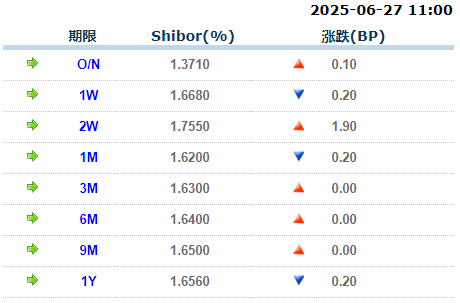
Core Viewpoint - The People's Bank of China (PBOC) conducted a 7-day reverse repurchase operation of 525.9 billion yuan at an interest rate of 1.40%, maintaining the previous rate, resulting in a net injection of 364.7 billion yuan into the market after 161.2 billion yuan of reverse repos matured on the same day [1] Group 1: Monetary Policy Operations - The PBOC executed a total of 20,275 billion yuan in reverse repos and 3,000 billion yuan in Medium-term Lending Facility (MLF) operations during the week, achieving a net injection of 13,672 billion yuan due to 9,603 billion yuan of reverse repos maturing [1] - The Shanghai Interbank Offered Rate (Shibor) showed narrow fluctuations, with the 7-day Shibor slightly declining [1] Group 2: Interbank Repo Market - In the interbank pledged repo market, overnight rates slightly decreased while 7-day and 14-day rates increased. Specifically, the weighted average rate for DR001 fell by 0.2 basis points to 1.3683%, while DR007 and DR014 rose by 1.2 and 1.1 basis points, respectively [4] - The overall funding environment on June 27 was balanced, with significant credit tiering differences observed. The rates for various transactions showed a mix of slight increases and decreases throughout the day [8] Group 3: Interbank Certificates of Deposit - On June 27, 75 interbank certificates of deposit were issued, with a total issuance amount of 135 billion yuan. The trading sentiment for primary certificates was subdued, particularly for 3-month and 6-month maturities [9] - The overall yield for secondary certificates showed a downward trend compared to the previous day's close, with specific yields for different maturities reflecting slight declines [9]

国家外汇局副局长李斌:2025年第一季度 重因素推动外债规模企稳回升
news flash· 2025-06-27 09:11
Core Insights - The Deputy Director of the State Administration of Foreign Exchange, Li Bin, indicated that China's external debt is expected to see a slight increase in the first quarter of 2025, driven by various factors including international changes and domestic economic recovery [1] Group 1 - China's external debt scale is projected to stabilize and slightly increase in Q1 2025 due to multiple influences [1] - The currency structure of external debt is being optimized, while the maturity structure remains stable [1] - Increased foreign investment in RMB-denominated bonds is contributing to the stabilization and growth of external debt [1] Group 2 - The external shocks have intensified since 2025, leading to significant fluctuations in international financial markets [1] - Despite these challenges, China's economy continues to show stable growth, demonstrating resilience and risk management capabilities in its domestic financial markets [1] - The attractiveness of RMB assets has further improved, encouraging foreign investment [1]
国家外汇局:多重因素推动外债规模企稳回升,预计我国外债规模将保持基本稳定
news flash· 2025-06-27 09:06
Core Viewpoint - The external debt of China has shown a slight increase as of the end of March 2025, with a total balance of 24,514 billion USD, reflecting a growth of 316 billion USD or 1.3% compared to the end of 2024 [2][3] Group 1: External Debt Overview - As of March 2025, China's total external debt balance is 24,514 billion USD, which is an increase of 316 billion USD from the end of 2024, marking a growth rate of 1.3% [2] - The currency structure of the external debt has improved, with domestic currency debt accounting for 52%, an increase of 2.0 percentage points from the end of 2024 [2] - The maturity structure remains stable, with medium to long-term external debt accounting for 42%, a decrease of 1.7 percentage points from the end of 2024 [2] Group 2: Factors Influencing External Debt - Multiple factors have contributed to the stabilization and slight increase in external debt, including complex changes in international circumstances and a continued positive trend in domestic economic performance [3] - The attractiveness of RMB-denominated bonds has increased, leading to higher foreign investment in these assets, which supports the stability of external debt levels [3] - China's commitment to innovation-driven development and high-level opening-up, along with improvements in cross-border financing facilitation, are expected to provide strong support for maintaining stable external debt levels [3]