
人民币资产

Search documents
当?油价压住降息,美债还能当“避险锚”吗?
Yin He Zheng Quan· 2026-03-23 08:03
Core Insights - The global asset pricing logic is changing under the backdrop of high oil prices, high inflation, and high interest rates, with U.S. Treasury yields becoming more sensitive to inflation and supply factors [2] - The long-term interest rate is facing upward pressure, while gold retains its allocation value in an inflationary and uncertain environment [2] - The U.S. dollar is supported by safe-haven demand in the short term but faces adjustment pressure in the medium term due to fiscal constraints and reserve diversification [2] - The attractiveness of RMB assets is expected to increase as China distances itself from conflict-prone areas and maintains policy space [2] - A-shares are influenced by external disturbances but still present structural opportunities in sectors like power equipment and high-end manufacturing [2] - Hong Kong stocks are more affected by foreign capital flows and exhibit higher volatility, but their attractiveness for medium to long-term capital is increasing due to low valuations [2] Section Summaries 1. U.S.-Iran Conflict Dynamics - The U.S.-Iran conflict has escalated into a prolonged confrontation, impacting global energy supply and prices, with Brent crude oil prices rising significantly [6][7] - The conflict has led to increased military spending by the U.S., with costs exceeding $10 billion related to Iran, contributing to the rapid expansion of U.S. federal debt [15] 2. U.S. Federal Reserve's Hawkish Shift Amid High Energy Prices - The Federal Reserve has signaled a significant reduction in rate cut expectations, with most officials supporting only one rate cut in 2026 [8][12] - Inflation forecasts have been revised upward, with the core PCE inflation expected to rise to 4.0% [8][12] 3. U.S. Treasury Debt Outlook - U.S. federal debt has surpassed $40 trillion, with rapid growth driven by persistent fiscal deficits and military spending related to geopolitical tensions [15][19] - Interest payments on the debt are projected to exceed $1 trillion, raising concerns about fiscal sustainability [19] 4. Asset Class Changes Under Re-Inflation Narrative - The core logic of global asset pricing is shifting towards a framework of multiple constraints, including high energy costs and inflation persistence [32] - The traditional safe-haven role of U.S. Treasuries is weakening as inflation and supply factors dominate market dynamics [34] - Gold is expected to benefit from its dual role as a hedge against inflation and a currency alternative [34] 5. Structural Changes in Asset Pricing - The current asset pricing system is undergoing a fundamental reconfiguration, with energy costs, fiscal constraints, and credit stability becoming central [41] - Assets with supply security and credit stability characteristics, such as gold and energy, are likely to gain new premium sources [41]

油价大涨的影响和机遇
泽平宏观· 2026-03-22 16:27
Group 1 - The article discusses the impact of rising oil prices due to the US-Iran conflict, highlighting that oil is a critical component of modern industry and daily life, affecting transportation and chemical raw materials, thereby increasing living costs [3] - Oil price increases will lead to higher transportation costs, with crude oil accounting for 70-80% of refined oil production costs; a 10% rise in international oil prices theoretically raises refined oil production costs by 7-8% [6][7] - The article notes that Brent crude oil prices surged from $70 per barrel at the end of February to over $111 per barrel by March 20, leading to significant increases in fuel surcharges by airlines and domestic fuel prices [7][10] Group 2 - The article emphasizes the global focus on energy security, particularly in Europe and Asia, where countries like Japan and South Korea are heavily reliant on Middle Eastern oil, while China has diversified its oil import sources [12][13] - China is positioned to benefit from the energy crisis, with its renewable energy sector expected to see significant growth; it has established a leading position in wind, solar, and battery industries, contributing to global supply chains [13] - The influx of international funds, particularly from the Middle East, into Chinese assets is noted, with Hong Kong becoming a financial safe haven amid geopolitical tensions [14][15] Group 3 - The article outlines the transmission of rising oil prices to agricultural sectors, particularly fertilizers and pesticides, with costs expected to rise due to increased energy and chemical raw material prices [16][18] - Long-term bonds and gold are identified as negatively impacted assets due to rising oil prices, which are expected to increase inflationary pressures and alter interest rate expectations [20][22] - Despite short-term market fluctuations due to the oil crisis, the long-term trends in AI and advanced manufacturing are expected to remain unaffected, driven by technological advancements and policy support [24]


香港离岸人民币市场观察(2026年2月刊):地缘扰动下人民币资产表现出较优稳健性
工银亚洲· 2026-03-22 10:50
Group 1: Currency and Market Trends - As of the end of January 2026, Hong Kong's RMB deposits reached 993.88 billion CNY, a year-on-year increase of 0.7% and a month-on-month increase of 3.5%[5] - The average USD index for February was 97.44, down 0.79% from January, while it rose 0.54% by the end of February[8] - The USDCNY and USDCNH rates at the end of February were 6.8559 and 6.8612, respectively, reflecting increases of 1.33% and 1.40% compared to the end of January[10] Group 2: Interest Rates and Monetary Policy - The average CNH HIBOR for February was 1.37%, 1.65%, and 1.72% for overnight, 1-month, and 3-month rates, respectively, showing declines of 25.7 BP, 16.1 BP, and 10.2 BP from January[18] - The SHIBOR rates for February averaged 1.33%, 1.55%, and 1.58%, with slight decreases of 0.8 BP, 1.0 BP, and 1.7 BP from January[20] - The People's Bank of China announced a reduction in the foreign exchange risk reserve ratio for forward sales from 20% to 0% starting March 2, 2026, supporting the RMB's strength[10] Group 3: Bond Market Activity - In February, the issuance of offshore RMB bonds totaled 943.6 billion CNY, an increase of 48.1% month-on-month and 21.4% year-on-year, despite a decrease in the number of bonds issued[32] - The total custody scale of foreign institutions in the interbank bond market was 3.35 trillion CNY, a decrease of 3.11% from the previous month[36] - The "Northbound Bond Connect" trading volume in January was 9.425 trillion CNY, reflecting a significant increase of 47.4% month-on-month[36]
关于“十五五”资本市场创新与改革的思考|资本市场
清华金融评论· 2026-03-21 09:49
Core Viewpoint - The article emphasizes the importance of capital market reform in China, highlighting its role in enhancing the service capabilities for new productive forces and resident wealth, as well as seizing opportunities for international financial competitiveness [3][4]. Domestic Level - The capital market serves as a crucial financing engine for new productive forces, transitioning from a reliance on real estate to a focus on technological innovation, which is essential for high-quality economic development [6]. - The direct financing methods of the capital market are better suited for the development of new productive forces compared to the traditional indirect financing model [7]. - In 2025, 116 companies are expected to be listed on the A-share market, raising a total of 131.77 billion yuan, with the Sci-Tech Innovation Board and the Growth Enterprise Market accounting for approximately 48.1% of the total IPO fundraising [7]. Resident Level - There is a pressing need for the capital market to better serve as a "reservoir" for resident wealth, especially as the investment appeal of real estate declines [8]. - The low returns on "safe" assets and the increasing excess savings among residents highlight the necessity for these funds to be activated and allocated to equity markets [8]. - By 2025, the Shanghai Composite Index, Shenzhen Component Index, and CSI 300 Index are projected to increase by 18.4%, 29.9%, and 17.7% respectively, indicating that financial assets like stocks, funds, and wealth management products could become key directions for resident asset allocation [8]. International Level - Since the initiation of capital market opening in 1992, significant progress has been made, including the integration of QFII and RQFII systems and the deepening of cooperation with Hong Kong markets [9]. - As of now, 900 foreign institutions have obtained QFII qualifications, with a total holding value of 143.46 billion yuan, and foreign investments in domestic stocks and bonds have reached 3.5 trillion and 3.8 trillion yuan respectively [9]. - The global asset allocation is entering a critical adjustment period, with China's capital market poised for high-level opening, supported by its status as the second-largest bond and stock market globally [10]. Key Focus Areas for Capital Market Innovation and Reform - The reform will focus on enhancing the coordination between investment and financing functions, optimizing the stock issuance and listing system to better support technology enterprises [12]. - Improving the delisting system and corporate governance is essential to ensure the quality of listed companies and enhance investor confidence [12]. - The establishment of a "technology board" for bonds and the introduction of long-term technology bonds will improve financing accessibility for tech companies [13]. - The cultivation of patient capital and the optimization of investment policies for long-term funds are crucial for enhancing market attractiveness [14]. - Diversifying exit mechanisms for venture capital and promoting mergers and acquisitions will facilitate a healthy investment cycle [15].

观点全追踪(3月第6期):晨会精选-20260317
GF SECURITIES· 2026-03-16 23:30
Group 1 - The report highlights a short-term disturbance in cross-border liquidity outlook due to a strong US dollar, which may temporarily suppress capital inflow [3] - It notes that the appreciation pace of the RMB is expected to moderate, influenced by changes in market risk appetite and rising oil prices [3] - The report anticipates that the US-China interest rate differential will maintain a volatile pattern due to the dual constraints of rising energy prices on the monetary policy space of both central banks [3] Group 2 - The report indicates that domestic credit demand is on a recovery trend, supported by fiscal policies from the Two Sessions, which are expected to bolster domestic demand and export-driven external demand [3] - It suggests that long-term capital flows will be driven by safety considerations, with instability in the US dollar monetary system potentially leading to increased capital inflow into RMB assets [3] - The report emphasizes that the speed of financial infrastructure opening will be crucial in determining the pace of this capital inflow [3]
今天V型反弹的几个原因
表舅是养基大户· 2026-03-16 13:37
Core Viewpoint - The article discusses the strong performance of Hong Kong stocks, particularly the Hang Seng Technology Index, amidst rising oil prices and highlights the potential investment opportunities in the Chinese market driven by various factors [1][4]. Group 1: Market Performance and Influences - The Hang Seng Technology Index has outperformed globally, with significant gains noted in the context of rising oil prices [1]. - Michael Burry's bullish stance on the Hang Seng Technology Index has been validated by recent market movements, indicating a positive sentiment among investors [3]. - The strong performance of Hong Kong stocks has contributed to a V-shaped rebound in A-shares, driven by several key factors [4]. Group 2: Capital Inflows and Sector Performance - There are rumors of increased capital inflows from the Middle East into Hong Kong stocks, driven by a demand for safe-haven assets [5]. - Specific stocks like CATL and BYD have shown strong performance in both A-shares and H-shares, with H-shares outperforming [7]. - CATL's H-shares have surged over 35% since the onset of the Iran conflict, indicating a significant premium over its A-shares [9]. Group 3: Semiconductor Sector and Economic Data - The semiconductor sector has been a key driver of the market's V-shaped rebound, particularly following breakthroughs by Huahong in 7nm chip technology [12][13]. - Positive macroeconomic data for January-February has exceeded expectations, with notable growth in consumer spending, particularly in the food and beverage sector [16][18]. - The retail sales data for January-February shows a total of 86,079 million yuan, with a year-on-year growth of 2.8%, indicating a recovery in consumer confidence [21]. Group 4: Real Estate Market Trends - The real estate market in first-tier cities appears to be stabilizing, with a reduction in the rate of price declines [23]. - Recent data indicates that the decline in real estate prices is narrowing, which is crucial for maintaining consumer confidence and supporting the stock market [24]. - The trend suggests that high-quality properties in prime locations will be the future focus of the real estate sector, rather than a broad market recovery [28]. Group 5: Geopolitical and Economic Risks - The ongoing geopolitical tensions in the Middle East continue to pose uncertainties for the market, particularly with rising oil prices impacting economic stability [34][39]. - Institutional investors are currently exhibiting cautious behavior, with significant fund redemptions observed, indicating a risk-averse sentiment [40][42]. - The potential for price increases in consumer electronics due to rising storage chip costs could impact market dynamics, particularly for lower-end brands [44].

周末好几个很炸裂的消息
表舅是养基大户· 2026-03-15 13:33
Core Viewpoint - The article emphasizes the increasing chaos in the Middle East and its implications for global oil prices, suggesting that investors should prepare for a prolonged period of high oil prices and the associated impacts on the market [2]. Group 1: Key Events and Developments - The U.S. military launched an attack on Iran's critical oil export location, Halke Island, which is vital for Iran's economy as over 90% of its oil exports pass through this area [7][10]. - The attack on Halke Island could lead to a significant short-term oil supply shortage globally, as Iran lacks alternative export routes due to geographical constraints [10][11]. - The U.S. is attempting to pressure Iran into negotiations by targeting its economic lifeline, but this could escalate tensions further if not managed carefully [12][13]. Group 2: Global Economic Implications - Many countries, including Vietnam, Thailand, and Pakistan, are implementing measures to reduce oil consumption, indicating a broader concern over energy supply amid rising oil prices [19][20][25]. - The article notes that the upcoming financial reports from major companies like Tencent and Alibaba are crucial, especially in the context of the current economic climate influenced by geopolitical tensions [5]. - The global central banks, including the Federal Reserve and the Bank of Japan, are expected to make critical announcements regarding interest rates, which could be complicated by the ongoing Middle East situation [5][6]. Group 3: Currency and Market Reactions - There are rumors regarding the use of the Chinese yuan for oil transactions, although the credibility of these claims is questioned due to a lack of reliable sources [27][30]. - Despite the strengthening of the U.S. dollar, the Chinese yuan has remained relatively stable, suggesting resilience in the face of global economic pressures [38][39]. - The article highlights a shift in market sentiment, with some investors turning bullish on the Hang Seng Tech Index, indicating a potential opportunity in the tech sector despite broader market volatility [40].

连续7个月增长,2月外储规模环比上升0.85%
第一财经· 2026-03-07 08:17
Core Viewpoint - China's foreign exchange reserves continue to increase, reaching $34,278 billion by the end of February 2026, marking a rise of $287 billion or 0.85% from the end of January 2026 [3]. Group 1: Foreign Exchange Reserves - The foreign exchange reserves have increased for the seventh consecutive month, influenced by monetary policies and macroeconomic data from major economies, leading to positive valuation effects from exchange rate adjustments and asset price changes [3]. - The rise in reserves is attributed to heightened risk aversion among global investors due to escalating geopolitical tensions, particularly between the US and Iran, prompting a shift of funds from risk assets to US Treasury bonds and the US dollar [3]. Group 2: Economic Outlook - The 2026 Government Work Report emphasizes the commitment to "further expand high-level opening up," reflecting confidence in using openness to promote reform [3]. - China's chief economist at China Minsheng Bank, Wen Bin, believes that under strong national strategic support, exports will continue to play a stabilizing role in cross-border capital flows, aided by diversified trade partnerships and optimized export structures [4]. - The long-term investment willingness of foreign investors in RMB assets is expected to continue increasing, with stable net inflows in securities investment and foreign direct investment [4].

离岸人民币,升破6.84!未来怎么看?
Sou Hu Cai Jing· 2026-02-26 05:21
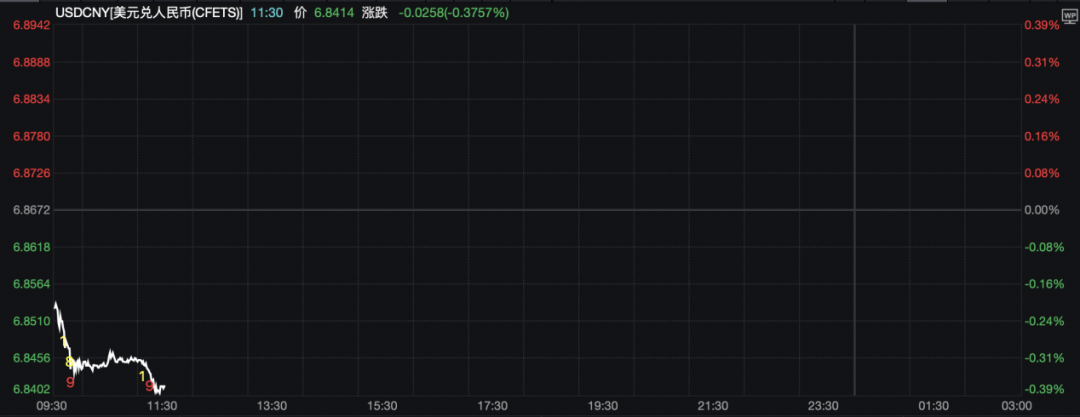
Core Viewpoint - The Chinese yuan has appreciated against the US dollar, reaching new highs since May 2023, driven by multiple factors including improved export structures and increased competitiveness in manufacturing [1][4]. Group 1: Exchange Rate Performance - On February 26, the onshore and offshore yuan broke through the 6.85 and 6.84 thresholds against the dollar, respectively, with the onshore rate at 6.8414, up 258 basis points from the previous close [1]. - Since the beginning of 2023, the onshore and offshore yuan have appreciated by 2.11% and 1.98%, respectively [4]. Group 2: Contributing Factors - The appreciation of the yuan is attributed to a combination of factors, including an upgrade in export structure, enhanced manufacturing competitiveness, and a high current account surplus, leading to a relatively abundant foreign exchange supply [4]. - Improvements in cross-border capital flows and increased attractiveness of the bond market have also contributed to a rise in foreign institutions' willingness to hold yuan-denominated assets [4]. Group 3: Future Outlook - Future yuan exchange rate trends will be influenced by the direction of the US dollar, domestic fundamentals, and asset value reassessment [5]. - Analysts suggest that while the yuan is likely to continue showing two-way fluctuations and moderate appreciation, caution is advised regarding any strong upward trends [6].
陶冬:人民币资产的机会已经到来,科技自主创新领域牛市已显现
Xin Lang Cai Jing· 2026-02-15 13:49
Group 1 - The president and chief economist of Freshwater Capital (Hong Kong), Tao Dong, expresses the highest optimism for RMB assets in the past seven to eight years, indicating that opportunities have arrived [1] - The Chinese economy has transitioned from relying on "cement dividends" to "data dividends," suggesting a shift in growth drivers [1] - A bull market in the field of technological self-innovation has begun to emerge [1]