建筑信息模型(BIM)

Search documents
预计年底基本建成,是亚洲最大地下综合交通枢纽 北京城市副中心站即将亮相(新视点)
Ren Min Ri Bao· 2025-06-03 21:28
Core Points - The Beijing Urban Sub-center Station Comprehensive Transportation Hub is the largest underground transportation hub in Asia, with a total construction area of 1.28 million square meters, exceeding the size of seven Beijing South Railway Stations [1][4] - The hub integrates two intercity railways, four urban subways, one suburban railway, and 15 bus lines, with a reserved space for a future dock [1] - The construction method used is called "cover-excavation reverse construction," where the roof is built first before excavating downwards, resulting in an earth excavation volume of approximately 14 million cubic meters [1][2] Construction Technology - Advanced technologies such as BIM (Building Information Modeling) and robotic equipment are employed to enhance construction quality and efficiency, achieving precision and increasing productivity by 6 to 7 times compared to traditional methods [2] - The hub's steel structure requires 35,000 tons of steel, with a welding task involving up to 35,000 weld seams, and welding robots are utilized to ensure "zero defect" quality [2] - The "Jingfan" roof design features a special ETFE membrane that allows light while preventing direct sunlight, contributing to a comfortable underground lighting environment [2][3] Energy Efficiency - The "Jingfan" roof includes perforated shading panels to balance thermal loads and control light transmission, reducing annual thermal load by 5.2 million kilowatt-hours, equivalent to the cooling capacity of 3,200 household air conditioners [3] - The hub is expected to reduce lighting electricity consumption by approximately 486,000 kilowatt-hours annually [3] Accessibility - The transportation hub is located in Tongzhou District, Beijing, and is expected to be completed by the end of the year, featuring over 150 entrances, with 60 directly connected to surface buildings for seamless access [3]
智能拼装,建设跨江巨“弓”(工匠绝活·我在重大工程一线)
Ren Min Ri Bao· 2025-05-07 22:27
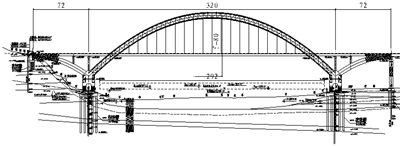
Core Viewpoint - The construction of the Jianyang Tuojiang Grand Bridge is a key project in the Chengdu-Chongqing high-speed railway, which will significantly reduce travel time between Chengdu and Chongqing to 50 minutes upon completion [7][8]. Design and Engineering - The bridge features a main arch span of 320 meters and side arches of 72 meters, designed as a thrust-free composite arch bridge to accommodate geological conditions and navigation needs [8][9]. - The design process began in 2020, with the team opting for a thrust-free composite arch bridge over a cable-stayed bridge due to lower excavation volume, shorter construction time, and reduced costs [10][11]. Construction Techniques - The construction employs Building Information Modeling (BIM) and virtual assembly technology to enhance the efficiency of assembling the massive arch components [11][14]. - Each arch rib is composed of four steel pipes filled with concrete, with a length of 12 meters per rib, and the construction team utilizes digital scanning to ensure precision in assembly [11][12]. Quality Control - The project incorporates an intelligent bolt tightening system to ensure the correct torque is applied to approximately 72,000 high-strength bolts, preventing issues such as under-tightening or over-tightening [17][18]. - An intelligent temperature control system is also implemented to monitor and adjust the cooling of concrete during pouring, mitigating the risk of cracking due to temperature differentials [19]. Project Timeline - The Jianyang Tuojiang Grand Bridge is expected to be completed and ready for the first high-speed train service by the second half of this year [19].