房地产小阳春

Search documents
2月百城二手房价格跌幅继续收窄,房价结束急跌阶段?
中指研究院· 2026-03-15 02:09
Investment Rating - The report indicates a cautious outlook on the real estate market, suggesting that 2026 is a critical year for stabilization after a period of decline [3][12]. Core Insights - In February 2026, the average price of second-hand residential properties in 100 cities decreased by 0.54% month-on-month, with the decline narrowing by 0.31 percentage points compared to the previous month. Year-on-year, the price fell by 8.78% [3][4]. - The average price of new residential properties in February 2026 was 17,107 RMB per square meter, showing a slight month-on-month decrease of 0.04% but a year-on-year increase of 2.37% [3][4]. - The rental market saw a slight decline, with the average rent in 50 cities at 33.96 RMB per square meter per month, down 0.11% month-on-month and 3.79% year-on-year [3][4]. Summary by Sections Second-hand Residential Market - The month-on-month decline in second-hand residential prices across first, second, and third/fourth-tier cities was 0.42%, 0.57%, and 0.54%, respectively, with year-on-year declines of 7.85%, 9.44%, and 8.51% [8]. - A total of 5 cities experienced price increases, while 95 cities saw declines [8]. New Residential Market - In February, first-tier cities saw a 0.07% month-on-month decrease in new residential prices, while second-tier cities experienced a 0.08% increase. Year-on-year, first-tier cities rose by 6.51% and second-tier cities by 1.70% [8]. - 15 cities reported price increases, while 84 cities saw declines, with one city remaining stable [8]. Rental Market - The rental market showed a month-on-month decline of 0.11% in February, with a year-on-year decrease of 3.79% [3][4]. - The report highlights that short-term rental demand increased in some cities due to the Spring Festival, impacting rental prices [3][4]. Policy and Market Outlook - The report emphasizes that February's performance is crucial for the real estate market's trajectory in 2026, with March expected to be a key observation point for market trends [4][12]. - The government is expected to continue focusing on policies aimed at controlling supply and improving housing quality, with a gradual approach to real estate development [10][12].
交银国际每日晨报-20260312
BOCOM International· 2026-03-12 02:31
Group 1: NIO Inc. (蔚来汽车) - NIO's 4Q25 performance exceeded expectations with revenue of 34.7 billion HKD, a year-on-year increase of 75.9%, and vehicle deliveries of 124,800 units, achieving a gross margin of 18.1% [1] - The company reported its first quarterly GAAP and Non-GAAP operating profit, with cash reserves increasing to 45.9 billion HKD [1] - For 1Q26, despite being a seasonal low period, NIO guided for deliveries of 80,000 to 83,000 units and expects to maintain high gross margins, with a target of 40%-50% sales growth for 2026 [1][2] Group 2: New World Development (新世界发展) - New World Development's first half of the fiscal year 2026 met expectations, with revenue declining by 50% year-on-year to 8.391 billion HKD due to reduced construction income and property delivery volumes [3] - The company reported a narrowed loss attributable to shareholders of 3.73 billion HKD, reflecting a 43.8% decrease, while core operating profit fell by 17.7% to 3.636 billion HKD [3] - The company completed 13.8 billion HKD in attributable contract sales in the first half, exceeding half of the annual target, with strong performance in Hong Kong property sales [4] Group 3: Real Estate Industry Insights - The real estate sector experienced a traditional sales lull in February, with total sales for the top 100 developers dropping by 31.3% month-on-month to 125.2 billion HKD [7] - The average price index for new residential properties in 70 major cities fell by 3.3% year-on-year in January, while second-hand residential prices dropped by 6.2% [7] - The government emphasized stabilizing the real estate market in the 2026 work report, indicating potential for demand recovery in the secondary market [7]

TOP100 房企 2026 年 2 月销售数据点评:春节月进入淡季修整,关注 3 月小阳春成色
GUOTAI HAITONG SECURITIES· 2026-03-03 02:35
Investment Rating - The report maintains an "Accumulate" rating for the real estate sector [5][23]. Core Insights - The report highlights that February, being a month of the Spring Festival, saw a seasonal decline in sales for new homes, second-hand homes, and land markets, with a focus on the upcoming "small spring" in March [2][5]. - The top 100 real estate companies reported a significant year-on-year sales decline of 30.5% in February 2026, with total sales amounting to 288.81 billion CNY [7][11]. - The report emphasizes the ongoing efforts in various cities to relax restrictive policies, promote urban renewal, and acquire second-hand homes, indicating potential market recovery [2][5]. Summary by Sections Sales Performance - In February 2026, the top 100 real estate companies achieved a sales amount of 123.29 billion CNY, reflecting a month-on-month decline of 25.5% and a year-on-year decline of 34.5% [7][11]. - The top 50 companies recorded a sales amount of 253.42 billion CNY, down 28.9% year-on-year [7][11]. - The report notes that the sales threshold for the top 21-30 companies decreased by 17.1% year-on-year, while the threshold for the top 31-50 companies saw a more significant drop of 41.4% [13][12]. Company Recommendations - Recommended companies for investment include: 1. Development: Vanke A, Poly Development, China Overseas Development, and others [5][23]. 2. Commercial and Residential: China Resources Land, Longfor Group [5][23]. 3. Property Management: Wanwu Cloud, China Resources Vientiane Life, and others [5][23]. 4. Cultural Tourism: Overseas Chinese Town A [5][23]. Market Outlook - The report anticipates a recovery in the market driven by stronger policy interventions aimed at rebalancing supply and demand [4][5]. - The report suggests that the current market has the capacity to absorb the 8 trillion CNY new housing market sales, with a focus on the timing of fiscal stimulus and the emergence of blue-chip competitive dynamics [23].





房地产开发与服务26年第9周:小阳春复苏强劲,行情持续有支撑
GF SECURITIES· 2026-03-01 23:30
Core Insights - The report indicates a strong recovery in the real estate market, supported by recent policy changes and seasonal demand, particularly in Shanghai [5][16][17] - The report maintains a "Buy" rating for the real estate sector, reflecting confidence in the long-term growth potential despite short-term fluctuations [2][5] Policy Developments - Shanghai has implemented significant policy changes, including reducing the social security requirement for home purchases from three years to one year, which is expected to stimulate demand [5][17][18] - The new policies also increase the public housing loan limit from 1.6 million to 3.24 million RMB, providing substantial support for first-time homebuyers [5][17] Market Performance - New home transactions in 50 cities increased by 31.8% week-on-week, with a year-on-year growth of 14.6% post-Spring Festival [5][9] - The second-hand housing market showed a remarkable recovery, with transaction volumes in 11 cities rising by 82.4% week-on-week and 39% year-on-year [5][9] Supply and Demand Dynamics - New housing supply remains low, with a 21% decrease in new home launches week-on-week, indicating a potential supply peak in the coming weeks [5][9] - The inventory of second-hand homes in 140 cities remained stable, with a slight decrease of 0.1% in key cities, suggesting a balanced market [5][9] Land Market Activity - The land auction market saw a significant increase in transaction value, with 260 billion RMB in land sales across 300 cities, marking a substantial rise compared to previous weeks [5][9] - Notably, a land parcel in Guangzhou achieved the second-highest total price in the city's history, indicating renewed interest in prime locations [5][9] Company Performance - The report highlights strong performances from major real estate companies, with notable gains from China Overseas Land, China Overseas Grand Oceans, and China Resources Land [5][9] - The overall performance of the real estate sector was slightly below the broader market, with a 0.6% increase compared to a 0.5% underperformance against the CSI 300 index [5][9] C-REITs Overview - The C-REITs sector experienced a decline of 0.85% in the comprehensive return index, with 17 out of 78 REITs showing gains [5][9] - The report notes ongoing progress in the commercial real estate REITs, with two new applications submitted this week, bringing the total to 14 [5][9]


多地项目“春节不打烊”,专家预计3月会是一个小高潮
Mei Ri Jing Ji Xin Wen· 2026-02-26 01:03
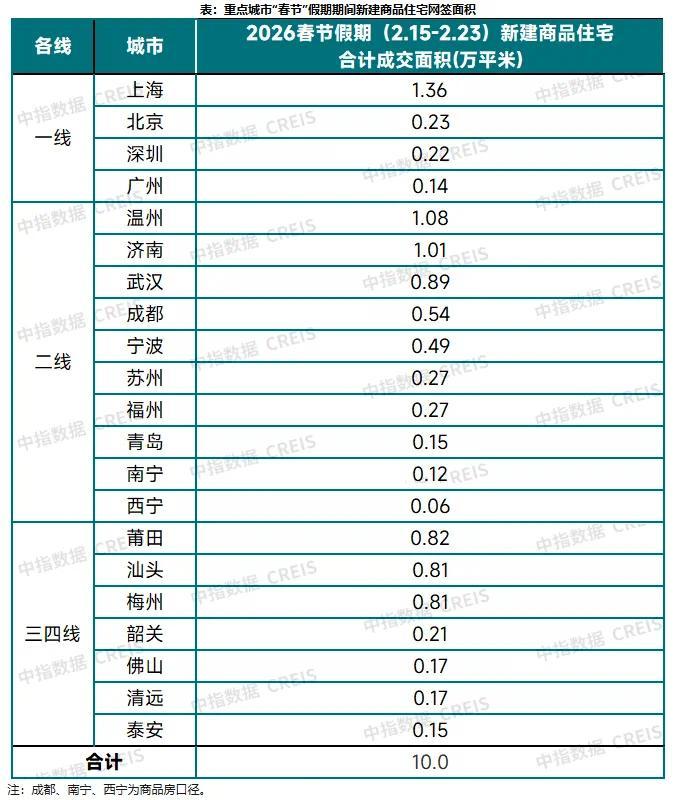
Core Insights - The overall real estate market during the Spring Festival (February 15-23) exhibited a typical "holiday mode," with both new and second-hand housing transaction volumes in key cities at seasonal lows due to factors like holiday travel and temporary suspension of online signing in some cities [1][4] - A total of 100,000 square meters of new residential properties were signed in 21 key cities during the Spring Festival, showing a year-on-year stability in daily transaction volume [1][2] - Major cities like Shanghai, Wenzhou, and Jinan led in transaction volumes, while cities like Nanning and Qingdao experienced significant year-on-year growth due to low base effects [1][2] New Housing Market Performance - Shanghai recorded a transaction volume of 13,600 square meters, followed by Wenzhou at 10,800 square meters and Jinan at 10,100 square meters [2] - The overall new housing sales in Chengdu remained flat year-on-year at 5,400 square meters, with promotional activities driving some sales [3][4] - Developers engaged in various promotional activities, including discounts and community events, to stimulate demand during the holiday period [3][4] Market Outlook - Analysts predict a "small spring" recovery in the core city real estate market as pent-up demand is expected to be gradually released post-holiday [3][4] - The upcoming March is anticipated to see a surge in sales as developers aim to meet their annual performance targets, with expectations for various promotional policies to be introduced [5] - The year 2026 is viewed as a critical year for the real estate market to stabilize, with a focus on controlling inventory and improving supply quality [5]



未知机构:专家上海热点片区二手房成交分析20260203东吴地产-20260210
未知机构· 2026-02-10 01:35
Summary of Conference Call on Shanghai Real Estate Market Industry Overview - The Shanghai real estate market is experiencing an early "small spring" phenomenon, with significant increases in transaction volume in January 2026 compared to previous years. This is attributed to multiple factors, including the early release of demand for school district properties and a positive market response following price corrections in Q4 of the previous year [1][2][3]. Key Insights - **Transaction Volume and Pricing**: - In January 2026, the number of online signed contracts reached 22,283, while real-time transaction volume hit 24,350, indicating high market activity [15][21]. - The "iceberg index" shows a rebound in Shanghai housing prices, primarily due to the late timing of the Spring Festival, which led to an early release of demand for school district properties [15][11]. - The average transaction price in the Yangdong area was reported at 71,500 CNY per square meter, reflecting a 10% decrease from the previous month [5][20]. - **Market Dynamics**: - A reduction in the number of listings has intensified the supply-demand imbalance for high-value properties, leading to an increase in listing prices, while actual transaction prices remain stable [11][12]. - The market is characterized by a seller's market, particularly influenced by school district policies, which are expected to keep prices stable despite fluctuations in transaction volume [16][22]. - **Future Predictions**: - The transaction volume in the front beach area is expected to maintain around 15 transactions per month in 2026, totaling approximately 180 for the year, despite a slight decline compared to previous years [16][22]. - The market is anticipated to face challenges in price stability from May to August 2026, with expected fluctuations within a 1%-2% range [13]. Additional Important Points - **School District Properties**: The demand for school district properties is a significant driver of market activity, with prices for these properties showing resilience even in a generally declining market [10][12]. - **Investment Considerations**: Investors are advised to focus on the cost-performance ratio when considering property purchases, as the current market favors high-value second-hand properties over new builds [14][26]. - **Market Sentiment**: There is a prevailing cautious sentiment among buyers, with many waiting for more favorable conditions before making purchases, particularly in light of the reduced supply of listings [12][18]. Conclusion - The Shanghai real estate market is currently marked by increased activity and stable pricing, driven by specific demand factors and a tightening supply of listings. Investors should remain vigilant and consider the cost-performance ratio when making decisions in this evolving market landscape.
地产专题分析报告:上海收储二手房的积极信号
SINOLINK SECURITIES· 2026-02-08 11:58
Policy Insights - The implementation of the second-hand housing acquisition policy in Shanghai indicates a shift in local government strategies, signaling a bottoming out of prices for older properties in core areas[2]. - The model of acquiring second-hand homes in Shanghai is expected to be promoted in other key cities, laying the foundation for price stabilization of older properties in core urban areas[2]. Market Trends - In the new housing market, the overall transaction volume in 47 cities remains stable, with a year-on-year decline of 20.6% compared to the same period last year, indicating a seasonal downturn[5]. - For second-hand homes, transaction volumes in 22 cities showed a seasonal decline of 2.7% week-on-week, with an 11.3% decrease compared to the same period last year, although the decline is narrowing[7]. Risk Factors - Potential risks include a greater-than-expected decline in housing prices, exceeding anticipated debt risks for real estate companies, and a macroeconomic downturn that could be more severe than expected[3][13].
丁祖昱:淡季不冷场,小阳春可期,年初压力大,全年会不错
Xin Lang Cai Jing· 2026-02-05 23:24
Core Viewpoint - The real estate market in major cities has entered a traditional seasonal downturn, characterized by overall cooling, increasing differentiation, and some bright spots. Supply and demand are contracting simultaneously, with developers showing low enthusiasm for sales and buyers exhibiting strong wait-and-see sentiment, leading to a prominent "look but don't buy" phenomenon [3][4]. Supply and Demand Dynamics - The real estate market is experiencing a cyclical downturn, with new home supply and demand both decreasing significantly. In many cities, new home transaction areas have dropped by 30% to 60% month-on-month, and year-on-year figures show a 20% decline, marking the lowest monthly figure in nearly a year [4]. - Developers are entering a rest period, significantly reducing the scale of new launches, with cities like Shenzhen and Nanjing experiencing supply gaps. The average absorption rate for new projects in Shanghai was only 16% in January [4]. Market Differentiation - Differentiation is evident across various dimensions: - Between cities and within city districts, core first-tier and strong second-tier cities (like Shenzhen and Hangzhou) show slightly higher visitor and subscription activity, while weaker second-tier and suburban areas are experiencing significant cooling [3]. - Product differentiation is notable, with affordable housing and high-end projects performing well, while ordinary improvement and suburban affordable housing continue to struggle [3]. - The second-hand housing market is becoming increasingly dominant, with transaction activity significantly outpacing new homes [3]. Land Market Trends - The land market is characterized by slowed supply, bottom-price transactions, and dominance by state-owned enterprises. Most cities are seeing a decline in transaction volume, with only a few core plots attracting interest, primarily from state-owned and central enterprises [5]. High-End Project Performance - High-end improvement projects in core locations are achieving high absorption rates, with cities like Hangzhou and Tianjin reporting rates of 62% and 68%, respectively. Notable projects include Shanghai's Taikoo Li, which sold 50 out of 60 units on the first day, achieving an 83% absorption rate [7]. Second-Hand Market Activity - In January, the transaction area for second-hand homes in 20 major cities reached approximately 1,483 million square meters, a month-on-month increase of 10% and a year-on-year increase of 25%, marking the second-highest level in 13 months [15]. - The second-hand market is showing a trend of stable volume and weak prices, with many cities experiencing price declines, particularly in lower-priced segments [17][20]. Future Outlook - The market is expected to continue its seasonal downturn in February due to the impact of the Spring Festival, with both new and second-hand home transactions likely to decline. However, a recovery is anticipated in March, with the potential for a "small spring" in the market as quality projects are launched [22].

北上深杭二手房成交集体回暖
21世纪经济报道· 2026-02-03 10:05
Core Viewpoint - The second-hand housing market in key cities in China showed signs of recovery in January, with significant year-on-year increases in transaction volumes, while the new housing market remained relatively subdued [1][4][6]. Group 1: Second-hand Housing Market Performance - In January, Beijing's second-hand housing transactions reached 15,082 units, a year-on-year increase of nearly 21%, despite being lower than December's over 17,000 units [5]. - Shanghai's second-hand housing transactions were 23,000 units, with a month-on-month increase of 1% and a year-on-year increase of 26% [6]. - Shenzhen recorded 5,000 second-hand housing transactions, with a month-on-month increase of 16% and a year-on-year increase of 7% [6]. - Hangzhou's second-hand housing transactions also saw growth, with 6,987 units sold, reflecting a month-on-month increase of 1.8% and a year-on-year increase of 15% [5][6]. Group 2: Factors Influencing Market Recovery - The recovery in the second-hand housing market is attributed to three main factors: a local market bottoming out, a significant drop in the number of listings, and families with educational needs advancing their purchasing plans due to the later timing of the Spring Festival [5][6]. - The number of second-hand listings in Beijing decreased to approximately 130,000, down from 150,000 last year, contributing to a more balanced supply-demand relationship [5]. - The confidence index among real estate agents rose by 12.39% in January, driven by the recovery in transaction volumes and clearer policy signals [6]. Group 3: New Housing Market Performance - The new housing market showed a decline, with Beijing's new housing transactions at 310,000 square meters, down 29% month-on-month and 20% year-on-year [7]. - In January, new housing transactions in Hangzhou fell by 64% month-on-month, with only 1,346 units sold [7]. - The new housing market is characterized by a lag in performance compared to the second-hand market, primarily driven by a more limited buyer demographic focused on improvement needs [7]. Group 4: Price Trends - The average price of new residential properties in 100 cities was 17,114 yuan per square meter, reflecting a month-on-month increase of 0.18% and a year-on-year increase of 2.52% [8]. - The average price of second-hand residential properties was 12,905 yuan per square meter, showing a month-on-month decrease of 0.85% but a narrowing decline compared to the previous month [8]. Group 5: Policy Impact and Future Outlook - The introduction of favorable real estate policies in January, including tax incentives and loan extensions, is expected to stabilize market expectations and boost buyer confidence [10][11]. - Despite a potential slowdown in transactions during February due to the Spring Festival, the market is anticipated to see a "small spring" recovery in March, driven by increased promotional activities from developers and the release of quality land parcels [11][12]. - The demand for high-end new housing is expected to remain strong, particularly in first and second-tier cities, as these properties are less affected by policy changes and have better value retention [11][12].
一线城市二手房成交集体回暖
第一财经· 2026-02-03 09:50
Core Viewpoint - The second-hand housing market in first-tier cities is showing resilience during the traditional off-season, indicating a potential recovery phase after a prolonged adjustment period [2][3]. Group 1: Market Performance - In January, Beijing's second-hand housing transaction volume exceeded 15,000 units, remaining stable above 14,000 units for three consecutive months [5]. - Shanghai's second-hand housing transactions reached 22,834 units in January, marking a five-year high and also maintaining over 22,000 units for three months [7]. - Shenzhen recorded 6,802 second-hand housing transactions in January, a 45.5% year-on-year increase, reaching a ten-month high [10]. - Guangzhou's second-hand housing transactions totaled 8,881 units in January, showing a slight month-on-month increase of 1.07% [10]. Group 2: Market Dynamics - The increase in transactions in Beijing and Shanghai is accompanied by a decrease in listings, indicating a tightening supply and a shift in seller sentiment [5][8]. - In Beijing, the number of listings dropped to 125,600 units, a 4.7% decrease from the end of 2025, reflecting reduced supply pressure [6]. - In Shanghai, the number of listings fell from approximately 120,000 units in April 2025 to 89,000 units in January 2026, a cumulative decline of 26% over five months [8]. Group 3: Buyer Sentiment and Trends - The market is experiencing a shift in seller attitudes, with many opting to withdraw listings or convert properties to rentals rather than engage in price competition [8]. - The demand for school district properties is driving transactions, as parents prefer to secure homes before the school admission season [12]. - A survey indicated that 43% of respondents believe prices will stabilize, while 30% are optimistic about price increases in the Shenzhen market [11]. Group 4: Future Outlook - Experts predict that the current trends suggest an early emergence of a "small spring" in the market, with expectations of strong transaction volumes in March and April [9]. - The overall sentiment is that the second-hand housing market is entering a bottoming phase, with price adjustments making housing more accessible [12].