
数字人才

Search documents
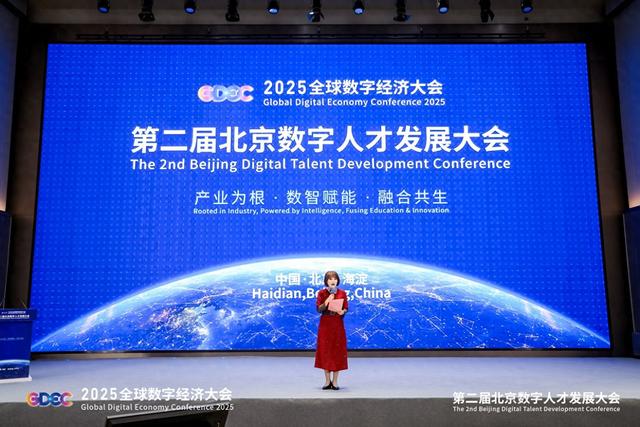
北京数字人才发展大会开幕,研究显示数字经济这些岗位需求高
Bei Jing Ri Bao Ke Hu Duan· 2025-09-29 10:17
Group 1 - The "2025 Global Digital Economy Conference and the Second Beijing Digital Talent Development Conference" was held in Haidian District, showcasing the importance of digital talent cultivation in the context of the digital economy [1][15] - The conference theme was "Industry as the Root · Intelligent Empowerment · Integrated Coexistence," highlighting the focus on digital talent development and the integration of AI in various sectors [3][5] - A report on the cultivation and development direction of digital talent in Beijing was released, analyzing the demand for talent in ten high-tech industries, indicating a high demand for application market product realization talent [7][11] Group 2 - The demand for digital talent in Beijing is concentrated in Haidian, Daxing, and Chaoyang districts, with Haidian accounting for nearly half of the total demand at 48.19%, reflecting its status as a technology and education hub [9] - The report outlines the current status of digital talent cultivation in Beijing, emphasizing the establishment of multi-level training platforms and the goal of training 10,000 digital technology skilled personnel annually [11] - A collaborative initiative called the "Smart Talent Cultivation Plan" was launched, involving government, universities, and enterprises to create a comprehensive talent cultivation ecosystem [13]


杭州成数字人才“富集地区”
Mei Ri Shang Bao· 2025-09-18 22:17
Core Insights - The report highlights that Hangzhou ranks first in net talent inflow index at 2.87% among 27 cities in the Yangtze River Delta, and second in digital talent attraction, following Shanghai [1][2] Group 1: Digital Talent Attraction - Hangzhou's digital talent comprehensive attraction index is 67.23, placing it second in the Yangtze River Delta [2] - The evaluation is based on four dimensions: industrial foundation, innovation ecosystem, development opportunities, and living services [2] - Key indicators include the scale of core digital economy industries, number of unicorn companies, enterprise density, international conference influence, academic strength, and patent conversion rates [2][3] Group 2: Industrial and Innovation Ecosystem - Hangzhou has developed a differentiated path characterized by a "technology-led, application-oriented" approach, driven by "e-commerce + cloud computing" [3] - The core industry revenue in Hangzhou reached 256.38 billion yuan, with Binjiang and Yuhang districts emerging as hubs for new digital jobs [3] - Zhejiang University ranks in the top 30 globally for computer science, supporting robust research, with an annual patent conversion rate of 28% [3] Group 3: Development Opportunities and Living Services - The average monthly salary for digital economy positions in Hangzhou is 14,837 yuan, ranking second among 27 cities [4] - The demand for emerging digital positions accounts for 12.14% of total demand, with high-end core talent demand at 14.64%, both ranking in the top three [4] - Hangzhou offers favorable living conditions, including good housing accessibility, high-quality education and healthcare resources, and convenient intercity commuting [4] Group 4: Future Outlook - Hangzhou aims to strengthen its digital economy foundation while creating a more supportive environment for talent development, enhancing its appeal to attract, nurture, and retain digital talent [5]
给予企业最高2万元补贴,日照市人社打造数字人才“蓄水池”
Qi Lu Wan Bao Wang· 2025-08-13 04:33
Core Viewpoint - The news highlights the initiatives taken by Rizhao City to support the development of the digital service outsourcing industry, focusing on talent acquisition, cost reduction for enterprises, and nurturing skilled professionals in the sector [1][2][3]. Group 1: Talent Acquisition and Employment - Rizhao City is implementing a comprehensive set of policies to attract and retain talent in the digital service outsourcing sector, including financial incentives for recruitment activities [1]. - The city has organized 65 recruitment events this year, providing over 25,000 job openings, with more than 2,000 positions specifically for digital service outsourcing companies [1]. Group 2: Cost Reduction for Enterprises - The city is offering social insurance subsidies for eligible companies hiring recent graduates, covering the employer's portion of social insurance for up to one year [2]. - Digital service outsourcing companies can receive up to 50,000 yuan in internship subsidies for establishing approved internship positions [2]. - Companies that retain trainees can receive a subsidy based on 60% of the local minimum wage for those trainees [2]. Group 3: Skills Development and Training - Enterprises are supported in conducting pre-job training, with subsidies available for employees who obtain vocational qualifications within their first year of employment [2]. - The city encourages participation in skills competitions related to digital economy professions to cultivate a skilled workforce [2]. Group 4: Support for Young Talent - New graduates with bachelor's degrees or higher can receive monthly living subsidies ranging from 1,000 to 5,000 yuan for up to 36 months [3]. - Rizhao City has constructed 5,074 talent apartments to accommodate 8,070 young professionals, providing housing support for those in the digital service outsourcing industry [3]. Group 5: Future Plans - The human resources and social security department aims to implement policies in line with the "Three-Year Action Plan for High-Quality Development of the Data Annotation Industry (2025-2027)" to further enhance the digital service outsourcing sector [3].
广东首个大数据工程专业职称评审权落地广州 全市超600人申报
Nan Fang Ri Bao Wang Luo Ban· 2025-05-28 07:58
Core Points - Guangzhou has become the first city in the province to obtain the authority for big data professional title evaluation, with over 600 technical talents applying for the first time [1] - The applicants demonstrate a high level of education, with nearly 70% holding bachelor's degrees and over 25% holding master's or doctoral degrees, primarily in senior professional titles [1] - The applicant pool is diverse, covering various industries such as IT, financial services, public services, healthcare, transportation, and education, indicating a trend towards a diversified big data talent workforce [1] Evaluation Process - The evaluation process utilizes a "dual-track" service model combining online and offline methods, enhancing efficiency and user experience [1] - An online preliminary review is conducted using a digital evaluation system for quick material checks, while offline services are provided at a dedicated service window in the city's digital government operation center [1] - The Guangzhou Big Data Professional Title Evaluation Committee has been established to conduct on-site evaluations and defenses, contributing to the "Million Talents Gathering in South Guangdong" initiative [2]