
粮食节约减损

Search documents
权威发布·高质量完成“十四五”规划丨国家粮食安全得到有效保障
Ren Min Ri Bao· 2025-10-15 02:57
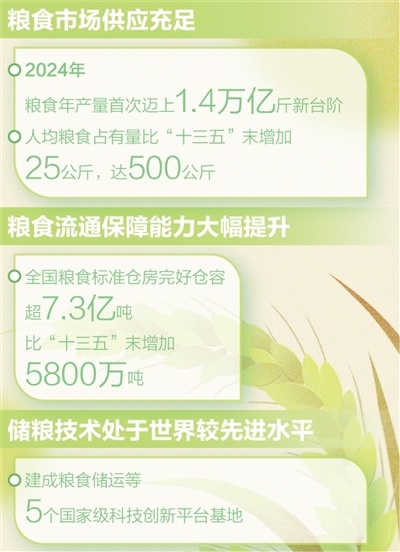
Core Insights - The "14th Five-Year Plan" period has seen significant advancements in China's grain circulation reform and development, ensuring national food security and supporting high-quality economic and social development [1][2] Grain Production and Supply - During the "14th Five-Year Plan" period, China's annual grain production has stabilized above 1.3 trillion jin, with projections for 2024 to exceed 1.4 trillion jin, marking a 25 kg increase in per capita grain availability compared to the end of the "13th Five-Year Plan," reaching 500 kg, which is above the internationally recognized safety line of 400 kg [2][4] - The average annual grain purchase volume has remained above 400 million tons, with improved channels for farmers to sell grain and enhanced services for agricultural enterprises [2][4] Grain Storage and Management - The grain storage capacity has significantly improved, with the total capacity of standard grain warehouses exceeding 730 million tons, an increase of 58 million tons from the end of the "13th Five-Year Plan" [2][4] - The implementation of advanced storage technologies has led to a shift towards high-quality development in grain storage management, focusing on green storage and quality preservation [5] Emergency Response and Supply Chain - The grain emergency response system has been established at national, provincial, municipal, and county levels, with the number of emergency processing enterprises increasing from 5,448 to 6,872, a growth of 26% [6] - Daily processing capacity for emergency grain has risen from 1.2 million tons to 1.78 million tons, an increase of 48%, ensuring sufficient supply for emergencies [6] Quality Standards and Industry Development - Over 100 national standards and 50 industry standards related to grain quality have been revised since 2021, emphasizing green, high-quality, nutritious, and healthy food [7] - Financial investments in quality grain projects have reached 46.2 billion yuan, attracting over 84 billion yuan in social investment, leading to the implementation of over 8,400 projects and the development of 897 quality enterprise brands [7]

科技赋能、全链增值,山东滨州—— 小麦“变身”600多种产品(深阅读)
Ren Min Ri Bao· 2025-08-15 21:48
Group 1: Agricultural Innovation - The transformation of saline-alkali land in Binzhou has led to the cultivation of high-yield wheat varieties, such as "Yutian Wheat 126," which has passed national approval in 2023 [4][6] - The local government and companies are actively promoting salt-alkali resistant seed varieties to enhance agricultural productivity [2][5] - Farmers initially showed skepticism towards new seed varieties but changed their attitudes after witnessing tangible high-yield results [5][6] Group 2: Food Processing and Value Addition - Binzhou's wheat can be processed into over 600 products, significantly increasing its economic value from approximately 3,700 yuan to around 9,140 yuan per ton [12] - The company has developed advanced processing techniques that have increased the value of by-products like wheat bran, which now sells for 30,000 yuan per ton compared to 1,800 yuan previously [8][12] - The company has achieved nearly 100% utilization of wheat, saving 500,000 tons of grain annually through efficient processing [13] Group 3: Waste Utilization and Sustainability - The company has developed a method to convert liquid waste from alcohol production into animal feed, improving feed efficiency by over 10% and increasing economic benefits by over 20% for pig farming [14][16] - The use of anaerobic fermentation for pig manure treatment has resulted in improved soil quality and increased crop yields in previously unproductive saline-alkali fields [15][16] - The overall approach emphasizes a circular economy, where waste products are transformed into valuable resources, contributing to significant cost savings and environmental benefits [14][16]
国家粮食和物资储备局局长刘焕鑫会见秘鲁农业发展与灌溉部部长马内罗
news flash· 2025-07-03 12:01
Core Viewpoint - The meeting between Liu Huanxin, Director of the National Food and Strategic Reserves Administration, and Angel Manero Campos, Minister of Agriculture Development and Irrigation of Peru, focused on enhancing cooperation in the food sector between China and Peru, particularly in areas such as food conservation, digitalization of industries, and technological innovation in agriculture [1]. Group 1 - The meeting aimed to implement the important consensus reached during the meetings of the heads of state of China and Peru [1]. - Both parties expressed their commitment to strengthen mutual support under various bilateral mechanisms [1]. - Discussions included exploring the establishment of a cooperation mechanism to further expand collaboration in the food sector [1].