
美欧关系

Search documents
不出所料,中国送欧洲一句“能救命”的话后,特朗普态度立刻大变
Sou Hu Cai Jing· 2026-01-23 09:40
Group 1 - Europe is increasingly seeking cooperation with China as it recognizes its inability to compete with the United States, with leaders from the UK and France reaching out for investment and support [1][3] - China's willingness to cooperate with Europe provides a potential "backdoor" for Europe to counterbalance US pressure, signaling a reliable partnership amid US-EU tensions [3][4] - The dynamics of US-EU relations are shifting, as evidenced by Trump's recent concessions, which may be influenced by the potential for deeper China-Europe collaboration [6][8] Group 2 - Trump's recent communications indicate a shift in his stance, including the cancellation of tariffs on several European countries and discussions regarding Greenland, reflecting a more conciliatory approach [6][8] - The rapid change in Trump's position raises questions about Europe's newfound leverage in negotiations, potentially due to the implications of strengthened China-Europe ties [8][9] - Despite the apparent cracks in US-EU relations, the long-term influence of the US on Europe remains significant, suggesting that Europe may not fully escape US control [9]

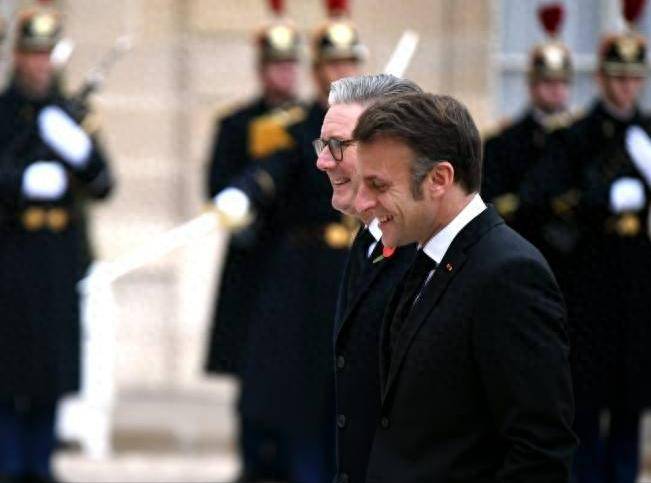
北约秘书长吕特发给特朗普的私密信息,让欧洲人吵翻了!
Xin Lang Cai Jing· 2026-01-21 16:27
Group 1 - The core viewpoint of the article revolves around the controversy sparked by U.S. President Trump's comments regarding Greenland and a private message from NATO Secretary General Jens Stoltenberg, which suggested a willingness to assist in the U.S. efforts to acquire Greenland, leading to significant backlash in Europe [1][3]. - The private message from Stoltenberg was perceived as overly conciliatory, with many European citizens expressing outrage on social media, labeling him a "European traitor" and demanding his resignation, with one post receiving 5,400 likes [3]. - Some individuals argue that Stoltenberg's seemingly flattering remarks were a strategic move to gain leverage in negotiations by appealing to Trump's preferences [6]. Group 2 - There is a counter-narrative among European netizens who believe that criticism of Stoltenberg for "selling out" Europe reflects a misguided approach, suggesting that Europe should adopt a firmer stance against U.S. demands [8]. - This sentiment has been met with skepticism, as some users assert that the U.S. is the one instigating divisions within Europe, rather than external forces like Russia [10].
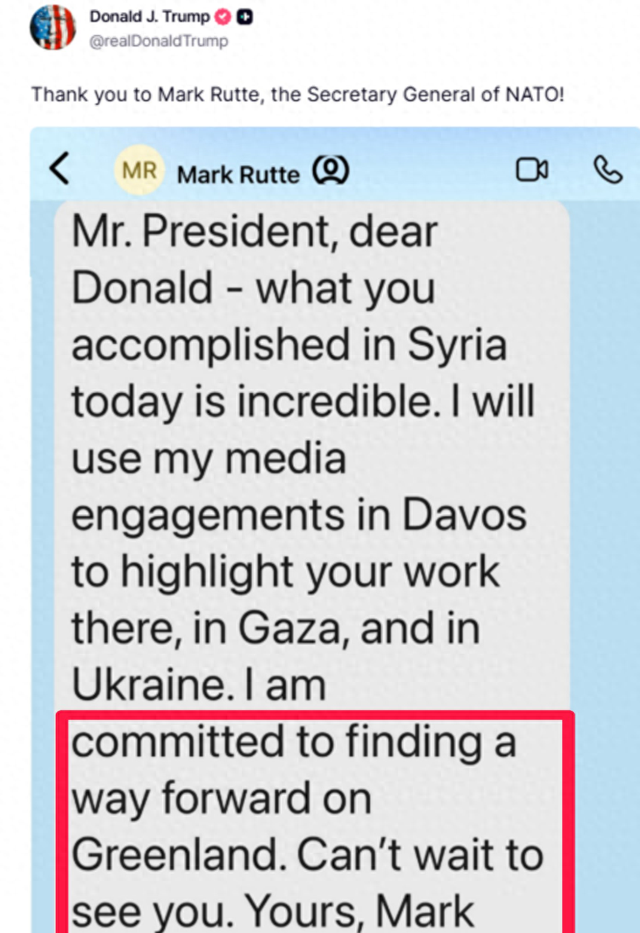
吕特发给特朗普的私密信息,让欧洲人吵翻了!
Xin Lang Cai Jing· 2026-01-21 16:27
在这段私密信息中,吕特不仅用相当亲昵的语气问候特朗普,称颂他的功绩,还在美国意图吞并丹麦格 陵兰岛一事上,表达出了愿意帮忙取得"进展"的意愿。 在动身前往瑞士达沃斯参加世界经济论坛之际,美国总统特朗普在他的社交账号上对欧洲各国又发动了 一波评论,并再次声明他执意让美国得到格陵兰岛。其中,他贴出的一段北约秘书长吕特发给他的私密 信息,更是在欧洲引起了强烈争议。 不过,也有人认为,吕特的这番看似相当"谄媚"的信息,其实是一种策略,通过说美国总统"喜欢听"的 话,从而在谈判桌上争取主动。 结果,这段信息很快就在欧洲人中引起了强烈争议。许多欧洲网民在社交媒体上怒斥吕特的言论是在出 卖欧洲。其中,一则大骂吕特是"欧洲叛徒",并要求他辞职的帖文,更是获得了5400次高点赞。 "当一方扬言要发动入侵时,你不该去谋求妥协之策,而应态度鲜明地表明:吞并北约盟国的行径,是 绝对不能接受的。"该帖文写道。 耿直哥 这种说法很快遭到质疑。有网民提出,欧洲之前本就对美国不断妥协,但对方并没有停下对欧洲提出过 分要求。 此外,在欧洲网民之中还存在另一种让人相当惊愕的声音。因为这种声音居然认为,像上述这种斥责吕 特出卖欧洲,并认为欧洲应该 ...
“夺岛”斗法将欧洲逼到墙角
Xin Lang Cai Jing· 2026-01-20 22:57
Core Viewpoint - The ongoing tensions between the U.S. and Europe over Greenland signify a potential unraveling of the post-World War II transatlantic alliance, with the U.S. adopting a more aggressive stance that threatens traditional diplomatic norms [1][2][3] Group 1: U.S. Actions and Statements - President Trump has threatened to impose tariffs on eight European countries until Greenland is "fully acquired" by the U.S., framing this acquisition as essential for missile defense strategies [1] - The U.S. government has suggested that only through complete control of Greenland can it effectively intercept hypersonic missiles, linking this to its "Golden Dome" missile defense initiative [1] - Trump's administration perceives military exercises by European nations in the Arctic as provocative, indicating a significant shift in U.S. foreign policy towards its allies [2] Group 2: European Response - European leaders have reacted strongly against U.S. tariff threats, with UK Prime Minister Starmer calling it "completely wrong" and French President Macron linking the situation to the Ukraine conflict [1][2] - The notion of "strategic autonomy" has gained traction in Europe, as nations seek to strengthen their collective security mechanisms in response to U.S. actions [3] - The EU is reportedly considering imposing counter-tariffs amounting to $108 billion against the U.S., highlighting the escalating economic tensions [3] Group 3: Historical Context and Implications - The U.S.-Europe alliance, established post-World War II through initiatives like the Marshall Plan and the formation of NATO, is now facing its most severe test since its inception [2][3] - The historical dynamic of "America First" versus European collective security is becoming increasingly pronounced, with Europe feeling cornered by U.S. demands [2] - The reliance on outdated colonial mindsets in modern international relations is seen as detrimental, risking deeper entanglement in geopolitical conflicts [3]

美国财长称美欧关系 “从未如此紧密”
Xin Lang Cai Jing· 2026-01-20 08:41
Group 1 - The World Economic Forum is currently taking place in a Swiss Alpine town, attracting over 3,000 participants from 130 countries, including 850 top CEOs and board chairs [1][5] - The forum aims to facilitate dialogue, policy debates, and business discussions, originally established in 1971 to enhance European corporate management [1][5] - U.S. President Donald Trump's third visit to Davos coincides with concerns over his Greenland acquisition proposal and actions regarding Venezuela's oil resources, which have caused regional unrest [1][5] Group 2 - The European Union is considering using its "trade weapon" mechanism, which includes imposing new tariffs, suspending the EU-U.S. trade agreement, and activating its anti-coercion tool against individuals or entities exerting undue pressure on the EU [2][7] - This anti-coercion tool was introduced in 2021 following China's trade restrictions on Lithuania due to its relations with Taiwan, although there is reluctance among EU countries to activate it due to fears of escalating tensions [2][7] - France and Germany, however, have expressed support for the potential use of this tool [2][7] Group 3 - U.S. Treasury Secretary Steven Mnuchin stated that U.S.-European relations remain strong despite tensions surrounding the Greenland issue, urging trade partners to remain calm as the situation is expected to resolve itself [3][8] - Trump announced a 10% tariff on imports from eight European countries starting in February, following their support for Denmark regarding the Greenland acquisition [3][8]
欧洲多国对美强硬!美欧关系还回得去吗?
Huan Qiu Wang· 2026-01-20 03:15
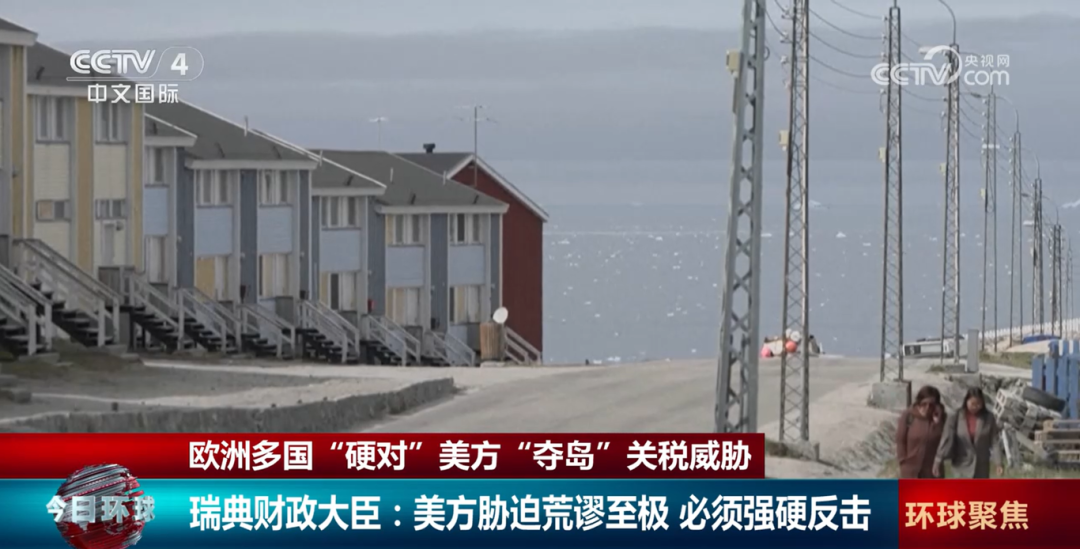
来源:CCTV4 丹麦、挪威、瑞典、法国等八个欧洲国家近来因反对美国控制格陵兰岛而被美方威胁加征关税。 19 日,多个欧洲国家批评美方做法,称不会屈服于压力, 将予以强硬应对。 瑞典财政大臣:美方胁迫荒谬至极 必须强硬反击 瑞典财政大臣伊丽莎白·斯万特松19日表示,美国围绕格陵兰岛问题展开的关税胁迫"荒谬至极"。她表示,由于美国总统特朗普提出完全不合理的要求, 欧洲现在面临前所未有的"动荡不安"态势。她说,欧洲各国普遍认为,必须就此作出强硬、严厉的回击。 德副总理:欧洲准备以强硬方式应对 " 经济讹诈 " 德国副总理兼财政部长拉尔斯·克林拜尔19日表示,欧洲将对美国针对欧洲八国的关税威胁作出一致且明确的回应。潜在反制措施包括冻结原计划本周提 交欧洲议会表决的欧美关税协议;恢复欧盟对美暂停征收的关税;并考虑使用欧洲法律工具,以强硬方式应对"经济讹诈"。 英首相:美国对盟友动用关税手段 " 完全错误 " 欧盟委员会发言人奥洛夫·吉尔19日表示,欧盟将于22日在比利时布鲁塞尔召开紧急峰会,讨论部分欧洲国家因反对美国控制格陵兰岛而被美方威胁加征 关税等问题,并评估欧盟可能采取的反制措施。 英国首相斯塔默19日发表全国 ...
荷兰民调显示近八成受访者不再认为美国可靠
Xin Lang Cai Jing· 2026-01-20 00:12
荷兰大西洋协会19日公布的一项民意调查显示,近八成荷兰受访者不再认为美国是可靠的合作伙伴,多 数人认为欧洲安全已难以继续依赖美国的"无条件支持"。受访者普遍认为,美国在安全、贸易、气候等 领域的政策正在对欧洲造成负面影响。民调还显示,越来越多荷兰人认为美国正使欧洲乃至世界变得更 加不安全。与九个月前该机构进行的上一次调查相比,持这一观点的比例显著上升,从略低于三分之二 增至77%。此外,超过半数受访者认为当前美欧关系"糟糕或非常糟糕"。 ...
特朗普“夺岛”换打“关税牌” 美欧关系何去何从?
Zhong Guo Xin Wen Wang· 2026-01-19 13:57
Core Viewpoint - The article discusses President Trump's announcement to impose tariffs on eight European countries until an agreement is reached regarding the purchase of Greenland, raising questions about the future of US-EU relations and the potential for European unity in response to this pressure [1][2]. Group 1: Tariff Imposition and Its Implications - Trump announced tariffs on Denmark, Norway, Sweden, France, Germany, the UK, the Netherlands, and Finland, indicating a strategy of using tariffs as leverage for territorial acquisition [1]. - The imposition of tariffs signifies a substantial disruption in the economic interdependence between the US and Europe [2]. - European nations participating in military exercises in Greenland aimed to signal to the US that the issue could be resolved within NATO, but Trump has rejected this approach [1][2]. Group 2: European Response and Unity - The eight affected European countries issued a joint statement on January 18, pledging to respond in a coordinated manner, forming a "will alliance" beyond the EU framework [3]. - There is a recognition among European nations that core sovereignty interests are non-negotiable, leading to a potential shift in their approach towards Trump, moving from a stance of concession to one of firmness [3]. - The EU is considering reactivating a previously proposed tariff list and exploring the feasibility of using counter-coercion tools to address Trump's tariff threats [2].
美官员告诉欧洲“落后就该挨打”:格陵兰岛被抢,要怪丹麦保不住
Sou Hu Cai Jing· 2026-01-18 08:06
Group 1 - Trump announced a 10% tariff on eight European countries starting February 1, escalating to 25% by June 1, due to their unwillingness to compromise on Greenland [1][3] - European countries responded by declaring the tariff threat "unacceptable" and emphasized unity and coordination among allies, without directly criticizing Trump [3][4] - The disparity in power between the US and Europe has historically led to European concessions under pressure, as seen in past incidents like the Snowden revelations [4][6] Group 2 - US officials stated that Denmark lacks the capability to defend Greenland, implying that the US could take control if necessary [6][8] - European nations are reportedly discussing withdrawing military intelligence support from the US if Trump proceeds with his plans for Greenland, which could weaken US global strategic deployments [8][10] - Despite the threats, European leaders, particularly pro-US factions, continue to believe in the importance of the transatlantic alliance and are hesitant to confront the reality of US aggression [10][11]
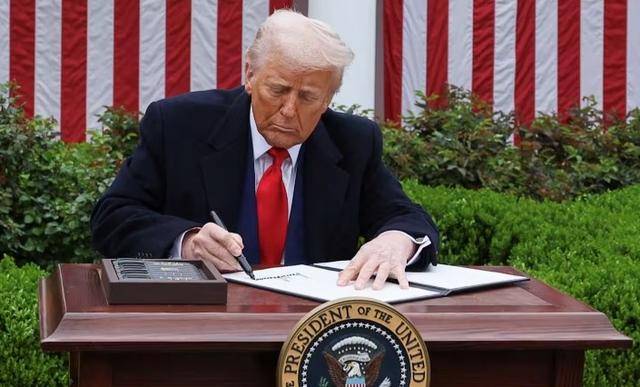
德国派兵了整整13人
Xin Lang Cai Jing· 2026-01-15 15:18
Core Viewpoint - Germany's decision to send 13 troops for military exercises in response to Trump's claims over Greenland reflects Europe's ongoing hope that increased efforts and financial contributions will lead to more favorable treatment from the U.S. [1] Group 1: Military Response - Germany deployed 13 troops, Norway sent 2, and France also participated in the military exercises, emphasizing the importance of Arctic security, NATO, and transatlantic relations [1] - The small number of troops highlights the limited military commitment from Europe, which contrasts sharply with the ambitions of the U.S. under Trump's administration [1] Group 2: Diplomatic Relations - The response from Greenland's autonomous government, stating "we do not agree," was met with Trump's dismissive attitude, indicating a lack of recognition for European allies [1] - The situation illustrates the current state of U.S.-Europe relations, where Europe is focused on emotional ties while the U.S. prioritizes strategic interests and cost-benefit analysis [1] Group 3: European Sentiment - EU foreign minister Karas expressed a sense of helplessness, stating "the world is too bad, it's time to start drinking," which reflects the frustration within Europe regarding its geopolitical position [1] - The military exercise with only 13 personnel symbolizes Europe's struggle to assert itself against U.S. ambitions, revealing a deeper issue in transatlantic relations [1]