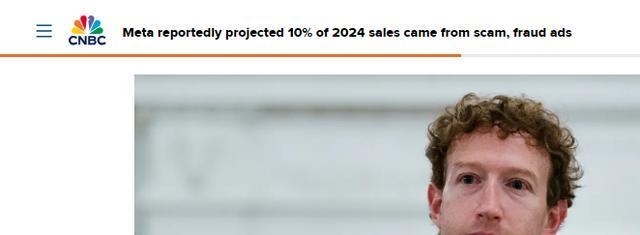
诈骗广告

Search documents
Meta否认诈骗广告牟利1140亿:实际金额较低
Xin Lang Cai Jing· 2025-11-09 07:04
Core Viewpoint - Meta has been accused of generating approximately $16 billion (about 114 billion yuan) in revenue from fraudulent and prohibited advertisements, which constitutes about 10% of its projected revenue for 2024. The company has reportedly failed to effectively identify and block a significant number of these ads over the past three years, exposing billions of users to various scams and illegal products [1]. Group 1: Financial Impact - Internal documents suggest that Meta could face regulatory fines of up to $1 billion related to fraudulent advertisements, while the company earns about $3.5 billion every six months from high-risk scam ads [1]. - Meta's spokesperson, Andy Stone, stated that the estimate of 10.1% of revenue from fraudulent and prohibited ads is "rough and overly inclusive," indicating that the actual figure is lower, although no updated data was provided [1]. Group 2: Regulatory Scrutiny - The U.S. Securities and Exchange Commission (SEC) is currently investigating Meta for its role in promoting financial scam advertisements [1]. - As of 2025, Meta has reportedly removed over 134 million pieces of fraudulent advertisement content [1].

路透:Meta靠诈骗广告年赚160亿美元
Ge Long Hui A P P· 2025-11-08 07:44
Core Insights - Meta predicts that approximately 10% of its total revenue for 2024, amounting to $16 billion, will come from fraudulent activities and prohibited product advertisements [1] - The company has struggled for at least three years to effectively intercept a significant volume of high-risk advertisements, exposing billions of users on platforms like Facebook, Instagram, and WhatsApp to risks such as fraudulent e-commerce, investment scams, illegal online gambling, and prohibited medical products [1] - On average, Meta's platforms display 15 billion "high-risk" scam advertisements daily, with most scams originating from suspicious marketers [1] Revenue Impact - The estimated $16 billion from fraudulent activities represents a substantial portion of Meta's projected revenue for 2024, highlighting the financial implications of these issues [1] - Meta's internal documents suggest that the company only bans advertisers when there is a 95% likelihood of fraud, while less certain cases result in higher advertising fees rather than outright bans [1] User Exposure - The personalized advertising system of Meta has led to users who have clicked on scam ads being shown more scam advertisements, increasing their exposure to potential fraud [1] - Meta's spokesperson claims that the 10.1% revenue estimate is a rough and overly inclusive approximation, indicating that the actual percentage may be lower due to the inclusion of many legitimate ads, although no specific data was provided [1]
路透社曝Meta去年10%销售额疑来自诈骗广告
Huan Qiu Wang Zi Xun· 2025-11-07 03:48
Core Insights - Meta is projected to generate approximately $16 billion in sales from online ads related to fraudulent activities and prohibited products in 2024, accounting for 10% of its total sales [1][2] - The company reportedly earns around $7 billion annually from "high-risk" scam ads, which are shown to users about 15 billion times daily [2][3] - Meta's total sales for 2024 are expected to exceed $164.5 billion, with a recent quarterly sales growth of 26% year-over-year [2][3] Company Response - Meta described the $16 billion estimate as a "rough estimate" and indicated that many of the ads in question are not in violation of policies [1][2] - The company has expressed concerns that abruptly removing scam ads could negatively impact business expectations, despite intentions to reduce false advertising on the platform [2][3] - A spokesperson emphasized that the leaked documents provide a narrow perspective and do not fully reflect the company's efforts to address the issue [2][3]