轻资本模式

Search documents
深度解析奇富科技、乐信、信也科技、嘉银科技、小赢科技、宜人智科2025Q1财报
3 6 Ke· 2025-06-16 04:11
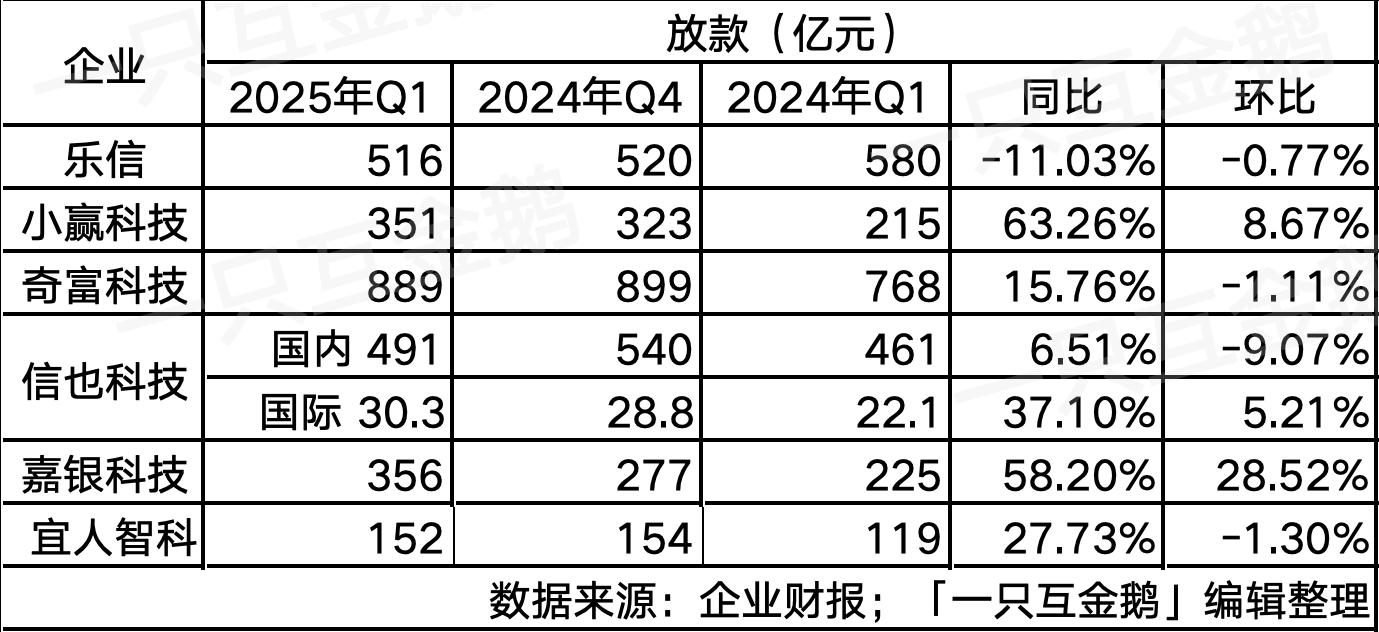
Core Insights - The article discusses the performance of various online financial companies in Q1 2025, highlighting their business models and revenue streams in the evolving fintech landscape in China. Group 1: Business Models of Online Financial Companies - The main business models of online financial companies include self-operated loans, loan facilitation, customer referral, membership and credit report sales, insurance sales, installment shopping, and financial technology services [1][3][6][9][13]. - Loan facilitation is the primary service, which can be categorized into heavy capital models requiring guarantees and light capital models sharing profits with funding sources [4][5]. - Companies are increasingly focusing on customer referral services, leveraging their large customer bases to direct clients to other lending platforms [5][6]. Group 2: Q1 2025 Performance Overview - In Q1 2025, several companies reported varying performance metrics, with most showing year-on-year growth in loan disbursements except for Lexin, which saw an 11% decline [19][22]. - Notable performances include: - Q1 loan disbursements for Qifu Technology reached 888.83 billion yuan, a 15.76% increase year-on-year [22][23]. - Xinyi Technology's international loan disbursements grew by 37.11% year-on-year [19]. - Jiyin Technology reported a 58.2% increase in loan disbursements compared to the previous year [19]. Group 3: Revenue and Profit Trends - Revenue trends varied across companies, with most showing growth except for Lexin, which experienced a 3.1% decline year-on-year [20][22]. - Qifu Technology's revenue reached 46.91 billion yuan, a 12.95% increase year-on-year, while its net profit grew by 54.91% [22][23]. - Jiyin Technology reported a 20.4% increase in revenue, reaching 17.76 billion yuan [20][22]. Group 4: Marketing and Customer Acquisition - Companies are increasing their marketing expenditures to acquire new customers, with Xiaoyin Technology's marketing costs rising by 185% year-on-year [56]. - Qifu Technology's customer acquisition cost increased to 384 yuan, reflecting a strategic shift towards embedded finance channels [24][28]. Group 5: Strategic Developments - Companies are exploring international markets, with Qifu Technology hiring for positions related to operations in the UK, indicating a shift towards developed markets [40]. - Lexin is focusing on risk reduction by directing subprime customers to other platforms, thereby lowering its risk exposure [41][42]. - Jiyin Technology is actively preparing for a potential listing on the Hong Kong Stock Exchange, reflecting its strategic growth ambitions [71].

奇富科技上涨2.49%,报43.57美元/股,总市值58.59亿美元
Jin Rong Jie· 2025-05-22 16:26
Core Viewpoint - QFIN's stock price increased by 2.49% to $43.57 per share, with a market capitalization of $5.859 billion as of May 23 [1] - For the fiscal year ending December 31, 2024, QFIN reported total revenue of 17.166 billion RMB, a year-on-year increase of 5.38%, and a net profit attributable to shareholders of 6.264 billion RMB, a year-on-year increase of 46.18% [1] Group 1: Company Overview - QFIN is a leading credit technology platform in China, focused on providing innovative credit services to financial institutions, consumers, and small and micro enterprises [2][3] - The company aims to enhance the accessibility and personalization of credit services through technology solutions, helping financial institutions identify and assess potential borrowers [2][3] Group 2: Target Audience - The company targets consumers who are underserved by traditional financial institutions, particularly those with short credit histories and high growth potential [3] - QFIN also focuses on small and micro enterprises that lack sufficient credit history or collateral, offering tailored loan products to meet their needs [4] Group 3: Service Offerings - QFIN provides two main types of services: credit-driven services and platform services, both designed to improve the lending process and borrower experience [4][5] - Credit-driven services involve matching potential borrowers with financial institutions, where QFIN assumes some credit risk [4][6] - Platform services include a range of technology solutions for different stages of the loan lifecycle, such as borrower acquisition and credit assessment, without assuming credit risk [5][6] Group 4: Technology Solutions - The company utilizes its "Intelligent Credit Engine" (ICE) to provide smart marketing services and assist financial institutions in initial credit screening [6][7] - QFIN also offers risk management SaaS services to help financial institutions improve their credit assessment processes [7]

贾跃亭:FX项目采用了轻资本路线,与鸿蒙智行相似
Feng Huang Wang· 2025-04-27 02:14
Core Viewpoint - The interview with FF founder Jia Yueting highlights the company's shift from a heavy capital model with the FF91 to a lighter capital approach with the FX project, emphasizing the differences in production strategies and operational focus [1][2]. Group 1: Production Strategy - The FF91 was produced using a self-manufacturing model that required significant capital investment, which was challenging for the company due to its high-end positioning and complex manufacturing requirements [1]. - The FX project adopts a light capital model, focusing on supply chain integration and production capacity through a "bridge model" that collaborates with partners while complying with U.S. tariff laws [1]. - The complexity of manufacturing for the FX project is significantly lower than that of the FF91, as it primarily targets mass-market vehicles [1]. Group 2: Comparison with Huawei's Model - Jia Yueting acknowledges similarities between the FX strategy and Huawei's smart selection model, particularly in the integration of resources, but emphasizes key differences in production responsibility [2]. - Unlike Huawei, where the main factory handles production, the FX project will maintain production control within the company, ensuring independence in brand communication, marketing, and user operations [2]. - The FX model aims to leverage successful industry experiences while creating unique features in product technology, AI empowerment, manufacturing capabilities, and user ecosystem development [2].