
量化紧缩(QT)

Search documents
日本央行缩减购债规模严重冲击需求 日债收益率跳升
智通财经网· 2025-05-20 06:48
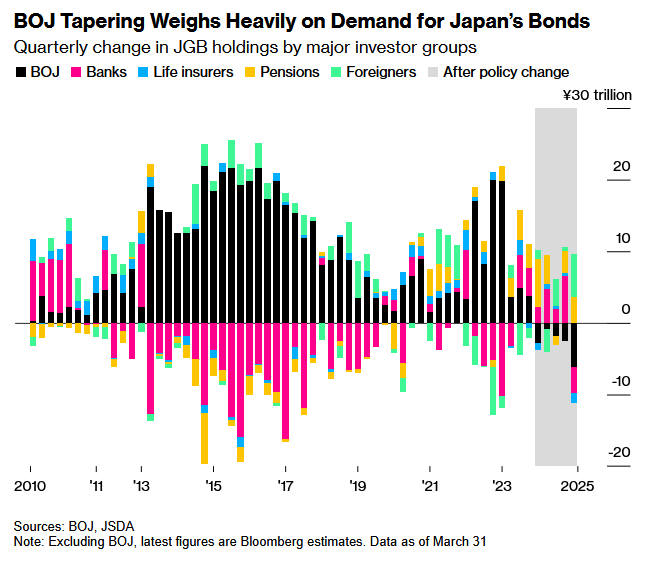
Group 1 - The Bank of Japan's reduction in bond purchases has significantly impacted the demand for Japanese government bonds, as evidenced by a drop in the average bid-to-cover ratio from 2.96 to 2.5 in the recent auction [4] - The bid-to-cover ratio for 20-year Japanese government bonds fell to its lowest level since August 2012, indicating weakened demand [4] - The "tail" difference, which measures the gap between the average winning price and the lowest winning price, reached 1.14, the longest since 1987, signaling further demand weakness [4] Group 2 - Despite foreign investors purchasing a record amount of ultra-long Japanese government bonds in April, their market share remains small, as domestic life insurance companies are reducing their holdings of domestic bonds [8] - Strategist Mark Cranfield noted that while global funds are flowing into Japanese long-term bonds, ultra-long bonds are facing a similar situation to domestic buyers withdrawing from the market [8] - Senior strategist Katsutoshi Inadome expressed disappointment over the market conditions, highlighting that the sell-off has spread to previously stable 20-year bonds due to fiscal expansion risks and declining liquidity [8] Group 3 - As Japanese government bond yields rise sharply, the Bank of Japan plans to meet with representatives from banks and securities companies to gauge their views on the pace of quantitative tightening (QT) [9] - The auction results come amid increased market volatility, partly due to U.S. President Trump's policy actions, and traders are monitoring the impact of Moody's recent downgrade of the U.S. rating on Japan's fiscal policy discussions [9] - Politician Shigeru Ishiba expressed caution regarding additional fiscal spending amid rising national borrowing costs, emphasizing the poor state of Japan's fiscal situation, which he claims is worse than Greece's [9]

美股前瞻 | 三大股指期货齐跌,谷歌(GOOGL.US)、英特尔(INTC.US)盘后公布财报
智通财经网· 2025-04-24 11:55
Market Overview - US stock index futures are all down, with Dow futures down 0.47%, S&P 500 futures down 0.31%, and Nasdaq futures down 0.26% [1] - European indices also show declines, with Germany's DAX down 0.07%, UK's FTSE 100 down 0.04%, France's CAC40 down 0.14%, and the Euro Stoxx 50 down 0.18% [2] - WTI crude oil increased by 1.25% to $63.05 per barrel, while Brent crude rose by 1.03% to $66.80 per barrel [2] US Stock Market Insights - Jefferies highlights a critical point for the S&P 500 index at 5500, which needs to be breached to recover from a 19% drop since February's historical high [3] - Christopher Wood from Jefferies suggests that the golden era for US stocks is over, predicting further declines in US equities, bonds, and the dollar [5] Automotive Industry - Japanese automakers saw a surge in US sales in March, with Toyota's sales up 8% to 231,336 units, Honda's up 13%, and Nissan's up 10% [4] Company Earnings Reports - Merck's Q1 earnings exceeded expectations with sales of $15.5 billion, although they anticipate a $200 million loss due to tariffs by 2025 [9] - American Airlines withdrew its 2025 profit guidance, reporting a Q1 net loss of $473 million, worsened by tariff pressures and government spending uncertainties [9] - Procter & Gamble lowered its annual organic sales growth forecast from 3%-5% to 2% due to tariff pressures and fluctuating consumer demand [10] - Sanofi's Q1 earnings surpassed expectations, driven by strong demand for its Dupixent drug, with sales of €9.89 billion [10] - IBM reported Q1 sales of $14.5 billion, exceeding expectations, but concerns remain regarding the impact of tariffs and government spending cuts on business [11] - Texas Instruments provided a positive Q2 earnings outlook, with expected revenue between $4.17 billion and $4.53 billion, driven by improved demand in industrial and automotive sectors [12] Technology Sector - Google Chrome's potential market value is estimated at over $50 billion, according to competitors, amid ongoing antitrust scrutiny [13] - TSMC plans to begin production using A14 chip technology in 2028, aiming to maintain its leadership in the semiconductor industry [13]



