
风险管理体系

Search documents
华康洁净(301235) - 2025年6月12日投资者关系活动记录表
2025-06-12 10:04
Group 1: Risk Management - The company has established a systematic risk management framework covering the entire lifecycle of contracts, including contract review, execution follow-up, cash flow management, and accounts receivable management, to mitigate performance and financial risks [3]. - The company focuses on proactive and structured risk control measures to ensure business expansion and financial stability [3]. Group 2: Tax and Financial Performance - The corporate income tax rate for 2024 is 15% due to the company's status as a high-tech enterprise [3]. - The company has a current bad debt provision rate of 25%, attributed to the capital-intensive nature of its cleanroom business, which involves long payment recovery periods [3]. Group 3: Share Buyback Program - The company plans to repurchase shares using its own funds and self-raised funds, with a total amount not less than RMB 50 million and not exceeding RMB 70 million, at a price not exceeding RMB 28.00 per share [3]. - The buyback program is progressing normally, with specific updates to be provided in future announcements [3]. Group 4: Order and Revenue Status - As of May 31, 2025, the company has not disclosed the total amount of unrecognized sales revenue from order contracts [3]. - Investors are advised to monitor the company's periodic reports for updates on order status and second-quarter performance [3].
贷款逾期不足5个月便挂牌转让,南银法巴消费金融迫不及待“甩”不良
Bei Jing Shang Bao· 2025-05-13 14:03
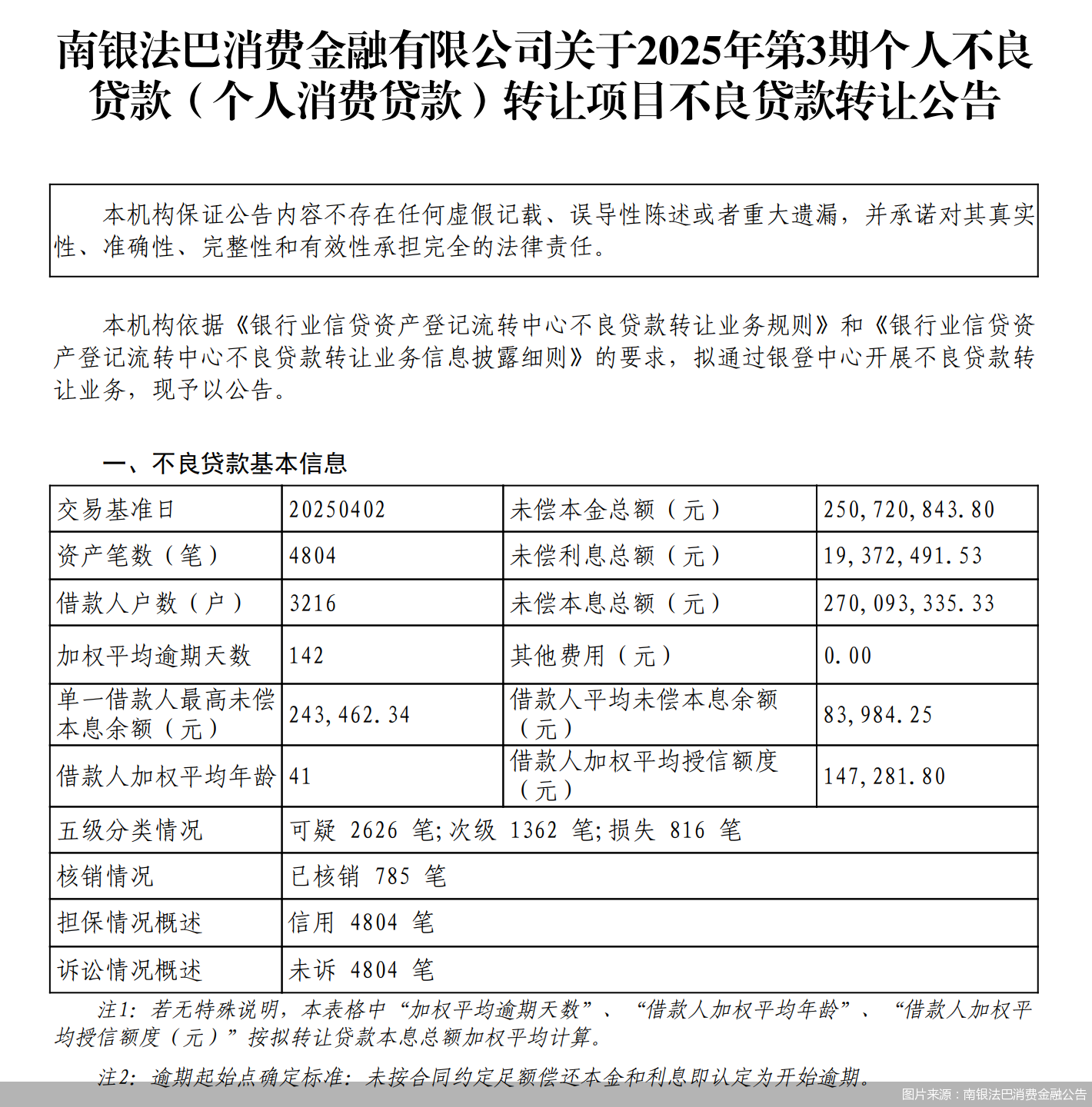
Core Viewpoint - The continuous transfer of non-performing assets by consumer finance institutions indicates significant pressure on performance, non-performing loans, and collection efforts, particularly for South Silver France Consumer Finance, which is seeking to offload short-term overdue assets to alleviate these pressures [4][5][9]. Summary by Relevant Sections Asset Transfer Details - South Silver France Consumer Finance announced the transfer of non-performing loans totaling 270 million yuan, including 251 million yuan in principal and 19 million yuan in interest, involving 4,804 loans with an average overdue period of 142 days [3][4]. - The starting price for the asset package is set at 24.62 million yuan, reflecting a discount rate as low as 0.9 [3]. Industry Context - The consumer finance industry has seen increased frequency in asset transfers due to regulatory pressures and the need to manage credit risk, with South Silver France Consumer Finance's total asset transfer for the year reaching 1.124 billion yuan [9]. - The industry has shifted its definition of non-performing loans, extending the overdue period for classification from 60 days to 90 days, indicating a more lenient approach to asset quality assessment [4][9]. Business Performance - South Silver France Consumer Finance has experienced significant growth, with a reported revenue of 4.595 billion yuan in 2024, a 74.52% increase year-on-year, and a net profit of 303 million yuan, up 172.97% [6]. - The company’s loan balance reached 50.8 billion yuan, marking a 61% increase, primarily driven by its offline lending product, which constitutes 66.76% of its total loan balance [6]. Risk Management Insights - The rapid transfer of non-performing assets suggests potential weaknesses in customer screening and risk assessment processes within the company's offline business model [5][7]. - Experts recommend that the company enhance its risk management framework, improve customer evaluation methods, and explore diverse strategies for non-performing asset recovery beyond mere transfer [10].

宁波银行2025年一季度稳健开局,盈利能力、资产规模与质量持续向好
Quan Jing Wang· 2025-04-29 10:12
Core Viewpoint - Ningbo Bank demonstrated strong resilience in the first quarter of 2025, achieving steady growth in profits and assets despite a challenging external economic environment and intense industry competition [1][4]. Financial Performance - In Q1 2025, the net profit attributable to shareholders reached 7.417 billion yuan, a year-on-year increase of 5.76% [4]. - The operating revenue for the same period was 18.495 billion yuan, reflecting a year-on-year growth of 5.63% [4]. - The annualized weighted average return on equity was 14.18%, while the total asset return rate stood at 0.91% [4]. Asset Growth - As of March 31, 2025, the total assets amounted to 3396.035 billion yuan, representing an 8.67% increase from the beginning of the year [4]. - Loans and advances reached 1640.169 billion yuan, marking an 11.12% growth since the start of the year [4]. - Customer deposits totaled 2182.604 billion yuan, which is an 18.86% increase year-to-date [4]. Risk Management - The bank maintained a non-performing loan ratio of 0.76%, unchanged from the beginning of the year, and a provision coverage ratio of 370.54%, indicating strong risk mitigation capabilities [8]. - The bank's risk management system is comprehensive, covering all processes, chains, cycles, and dimensions, ensuring stable asset quality [8]. Strategic Focus - Ningbo Bank is committed to a strategy of "doing what big banks cannot do," focusing on differentiated development paths and leveraging financial technology to meet diverse customer needs [1][8]. - The bank aims to balance risk and return while adapting to changes in the operating environment, with a focus on sustainable and high-quality growth [8].


【UNFX课堂】外汇知识系列:如何建立黄金期货投资思维体系
Sou Hu Cai Jing· 2025-04-13 02:56
Core Viewpoint - Establishing a systematic investment thinking framework for gold futures requires integrating macroeconomic logic, commodity attributes, market sentiment, and trading strategies to form a comprehensive understanding of gold price fluctuations [1]. Group 1: Understanding the Gold Market - Gold's intrinsic properties include being a safe-haven asset that attracts risk-averse funds during geopolitical conflicts and economic crises, as seen during the 2022 Russia-Ukraine conflict [1]. - Gold futures have unique characteristics, such as leveraged trading through standardized contracts (e.g., COMEX gold at 100 ounces per contract) and a margin system that amplifies risk and returns [2]. Group 2: Analytical Framework Construction - Geopolitical events and black swan occurrences, like wars and sovereign credit crises (e.g., the 2011 European debt crisis), can trigger safe-haven buying, but caution is needed for profit-taking after events settle [3]. - Technical analysis involves assessing long-term trends through weekly/monthly charts (e.g., a decade-long bull market from 2001-2011) and capturing short-term fluctuations via hourly charts [4]. - Historical price points, such as the peak of $2075 per ounce in August 2020 and key psychological levels (e.g., $1800, $1900), are critical for analysis [5]. Group 3: Fundamental Analysis - Key macroeconomic indicators include the U.S. CPI and non-farm payroll data, which influence inflation and employment, subsequently affecting Federal Reserve policies and gold prices through real interest rates [6]. - The 10-year TIPS yield (real interest rate) shows a significant negative correlation with gold prices [6]. - Central bank policies, particularly during the initial phase of a rate hike cycle, can suppress gold prices, but expectations of economic recession may lead to a reversal in gold's favor [6]. - Global central bank gold purchases provide long-term support for gold prices [6]. Group 4: Trading Strategies - Trend-following strategies are suitable during rising recession expectations and ongoing central bank easing [12]. - Mean reversion strategies apply when gold prices deviate from implied values based on real interest rates or when overbought/oversold indicators signal a reversal [15]. - Event-driven strategies involve adjusting positions before key data releases (e.g., non-farm payrolls, CPI) and entering trades based on market reactions [17]. Group 5: Risk Management - Leverage control is essential due to gold futures' high volatility (daily fluctuations of 1-3%), recommending a maximum risk of 2% of the trading capital per trade [19]. - Dynamic stop-loss strategies can be based on support/resistance levels or volatility measures like the Average True Range (ATR) [21][22]. - Hedging strategies may involve inverse positions in the U.S. dollar index or balancing with equity assets [23]. Group 6: Trading Psychology and Cognitive Upgrades - Overcoming cognitive biases, such as anchoring effects and overtrading, is crucial for successful trading in gold [24][25]. - Recognizing the "inflation-recession" cycle of gold can help traders adapt their strategies accordingly [26]. - Continuous review and iteration of trading logic and strategy performance are necessary for improvement [29]. Group 7: Common Misconceptions and Responses - Misconception 1: Viewing gold solely as an inflation hedge; real interest rates must be negative for gold to be truly bullish [31]. - Misconception 2: Ignoring liquidity risks, especially during significant market events that may lead to liquidity shortages [32]. - Misconception 3: Confusing futures with physical gold, as futures contracts incur time costs and potential roll-over losses [33]. Summary of the Gold Investment Framework - The core of the gold investment thinking system is a triadic driving model comprising real interest rates (fundamentals), dollar cycles (monetary attributes), and risk-averse sentiment (emotional factors) [35]. - Strategies should align with market conditions, utilizing trend strategies in trending markets and mean-reversion strategies in sideways markets [36]. - Prioritizing risk management is vital due to gold's volatility, emphasizing survival over profit [37].