
AI训练

Search documents
Reddit stock is tumbling and YouTube may be to blame
Invezz· 2026-01-27 18:06
Core Viewpoint - Reddit's stock (RDDT) is experiencing a significant decline, attributed to YouTube surpassing it as the primary data source for AI models, leading to concerns about Reddit's revenue growth in 2026 [1] Group 1: Impact of YouTube on Reddit - YouTube has overtaken Reddit as the main source for AI training data, negatively impacting Reddit's perceived value among investors [1] - The shift in AI model preferences from Reddit to YouTube is seen as a seismic change, devaluing Reddit's data which was previously considered a "goldmine" for AI firms [1] Group 2: Analyst Insights - Cleveland Research analyst Ross Walthall has indicated a slowdown in revenue growth for Reddit, shifting the narrative from "unlimited growth" to "moderating growth" for 2026 [1] - Walthall noted a decrease in new advertisers on Reddit, with larger US clients reducing their spending forecasts, which adds to the bearish sentiment around RDDT shares [1] Group 3: Stock Valuation Concerns - Despite a recent decline, Reddit's stock is still trading at approximately 57 times forward earnings, making it more expensive than leading AI companies like Nvidia, which has a forward P/E of about 42 [1] - The stock is currently trading slightly above its 100-day moving average at the $184 level, and a decisive break below this price could lead to further downward momentum [1]


99%计算闲置?推理时代,存力比算力香
3 6 Ke· 2026-01-14 12:12
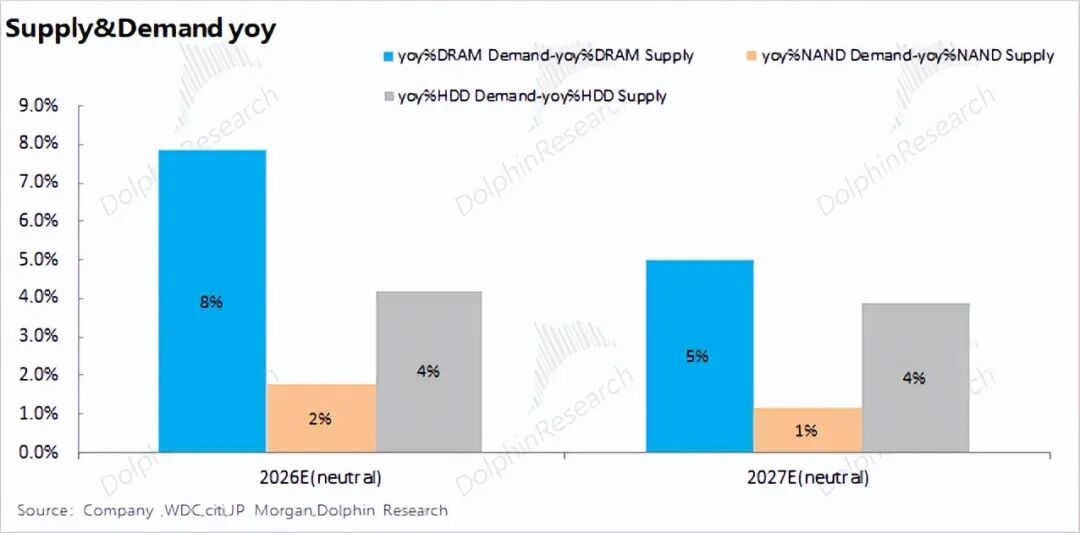
Core Insights - Huang Renxun's speech at CES 2026 has reignited market enthusiasm for storage, particularly with the new Rubin architecture requiring more DDR and NAND compared to the previous Blackwell architecture, leading to a rise in storage stock prices [1] - The market focus has shifted from HBM to traditional storage areas like DDR and NAND, with supply-demand dynamics driving a comprehensive increase in storage prices [1] Group 1: DRAM Market - The supply-demand imbalance for DRAM (including HBM and DDR) is expected to persist until 2027, with demand growth outpacing supply growth during 2026-2027 [2][5] - DRAM production expansion is challenging due to the need for new production lines, leading major manufacturers to focus capital expenditures on DRAM [4] - The demand for DRAM in AI servers is expected to create a significant supply gap by 2027, with a projected demand increase of 222% in 2026 and 80% in 2027 [20][21] Group 2: NAND Market - NAND prices have nearly doubled since the beginning of 2025, driven by supply constraints and increased demand from AI applications [26][28] - The capital expenditure for NAND is expected to rise modestly, with a projected increase to $18.3 billion by 2027, reflecting a compound growth rate of only 6% [30] - The supply-demand gap for NAND is anticipated to remain at 5-6% during 2026-2027, as demand continues to outstrip supply [45] Group 3: HDD Market - HDDs are primarily used for cold storage in AI data centers, with their cost advantage making them a viable option despite slower performance compared to SSDs [48][51] - The supply of Nearline HDDs is expected to grow at 29% in 2026 and 19% in 2027, while demand is projected to increase by 33% and 23% respectively, indicating a tightening supply-demand situation [55]


拓维信息跌2.01%,成交额11.67亿元,主力资金净流出1.09亿元
Xin Lang Cai Jing· 2026-01-07 02:40
Group 1 - The core point of the article highlights the recent stock performance of Tuowei Information, which saw a decline of 2.01% on January 7, with a trading price of 33.58 yuan per share and a total market capitalization of 42.305 billion yuan [1] - As of September 30, 2025, Tuowei Information reported a total revenue of 2.078 billion yuan, representing a year-on-year decrease of 29.43%, while the net profit attributable to shareholders increased by 852.03% to 105 million yuan [2] - The company has a diverse revenue structure, with 72.71% from software and services, 21.74% from intelligent computing products, and 5.55% from other sources [1] Group 2 - The company has not distributed any dividends in the last three years, with a total payout of 138 million yuan since its A-share listing [3] - As of September 30, 2025, the number of shareholders increased to 459,100, with an average of 2,495 circulating shares per person, a decrease of 1.19% from the previous period [2] - Major shareholders include Southern CSI 500 ETF, which holds 14.6368 million shares, and Hong Kong Central Clearing Limited, which increased its holdings by 7.8078 million shares [3]

首都在线跌2.01%,成交额3.45亿元,主力资金净流出3311.76万元
Xin Lang Cai Jing· 2026-01-07 02:35
Group 1 - The core viewpoint of the news is that Capital Online has experienced a decline in stock price and financial performance, with significant changes in shareholder structure and trading activity [1][2][3] Group 2 - As of January 7, Capital Online's stock price decreased by 2.01% to 22.44 CNY per share, with a total market capitalization of 11.285 billion CNY [1] - The company reported a revenue of 926 million CNY for the first nine months of 2025, a year-on-year decrease of 12.05%, while the net profit attributable to shareholders was -99.413 million CNY, an increase of 32.11% year-on-year [2] - The main business revenue composition includes cloud hosting and related services (49.89%), IDC services (45.83%), and other income (4.28%) [1] - The number of shareholders decreased by 25.68% to 65,700, while the average circulating shares per person increased by 34.76% to 5,961 shares [2] - Since its A-share listing, Capital Online has distributed a total of 20.566 million CNY in dividends, with no dividends paid in the last three years [3] - The top circulating shareholder is Hong Kong Central Clearing Limited, holding 8.2544 million shares, an increase of 4.7151 million shares from the previous period [3]

高负载不卡顿:i7处理器编程体验大升级
Xin Lang Cai Jing· 2026-01-07 01:45
Core Insights - The article highlights three different Intel Core i7 processors that cater to various needs of developers, emphasizing their performance and suitability for high-load tasks in both mobile and desktop environments [1][4]. Group 1: Product Recommendations - The first recommended product is the Intel Core i7-9750H, a mobile flagship processor with 6 cores and 12 threads, featuring a base frequency of 2.6GHz and a maximum turbo frequency of 4.5GHz, priced at 0.0 yuan [5][6]. - The second recommendation is the Intel Core i7-12700F, a desktop processor with a hybrid design of 12 cores and 20 threads, a maximum turbo frequency of 4.90GHz, and a price of 2280.0 yuan [3][6]. - The third product is the Intel Core i7-9700, which has 8 cores and 8 threads, a maximum turbo frequency of 4.90GHz, and is priced at 2599.0 yuan, offering strong performance in single-threaded applications [3][6][7]. Group 2: Performance and Features - The i7-9750H is particularly suitable for developers who travel frequently, as it can handle heavy development environments and lightweight AI training tasks, supported by an RTX 2070 Max-Q GPU and 16GB DDR4 RAM [5][6]. - The i7-12700F supports DDR5 4800 MT/s memory and PCIe 5.0, making it ideal for future upgrades and capable of handling large-scale data processing and algorithm simulations with a TDP of only 65W [3][6]. - The i7-9700 remains competitive in Java backend and web full-stack development, offering strong compatibility and stability for users with budget constraints [3][6][7]. Group 3: Target Audience - The i7-9750H is aimed at mobile developers who require portability and performance [4][7]. - The i7-12700F targets high-performance desktop users looking for advanced multi-threading capabilities [4][7]. - The i7-9700 is designed for practical developers who prioritize stability and compatibility in their systems [4][7].

AI竞赛转向推理,如何影响国际科技竞争格局?
2 1 Shi Ji Jing Ji Bao Dao· 2026-01-06 22:41
Core Insights - The release of NVIDIA's next-generation AI chip platform "Rubin" at CES 2026 marks a significant shift in the global AI competition from "training-driven" to "inference-driven" [2][4] - This transition indicates a major evolution in the AI industry ecosystem, infrastructure layout, and international technological competition [2] Group 1: Inference vs. Training - In recent years, large model training has been the focal point of AI development, with models like GPT and Llama driving exponential demand for computing power [2] - However, the true value of AI lies in inference, which is the ability of models to respond in real-time to user inputs in practical applications [2][3] Group 2: Characteristics of Inference Scenarios - Inference scenarios require high frequency, low latency, high concurrency, and cost sensitivity, demanding greater hardware efficiency and energy consumption ratios than training [3] - NVIDIA's Rubin platform is designed specifically for the inference era, achieving up to a 10x reduction in inference token costs and integrating multiple chip types for extreme system collaboration [3] Group 3: Global AI Development Trends - The emergence of Rubin highlights the "Matthew effect" in global AI development, where entities with strong computing power and advanced inference systems will commercialize AI faster, creating a positive feedback loop [3][4] - Conversely, participants lacking foundational infrastructure will increasingly depend on external platforms, leading to a situation of "application prosperity but weak foundations" [3] Group 4: China's AI Industry Challenges and Opportunities - China's AI industry faces both challenges and opportunities as it progresses towards the inference stage, despite significant advancements in large model development [4] - Domestic GPUs have made some breakthroughs, but improvements are still needed in software ecosystems, system collaboration, and energy efficiency [4] Group 5: Recommendations for China's AI Infrastructure - China should accelerate the development of a full-stack inference solution encompassing chips, networks, storage, security, and development frameworks [4][5] - Emphasis should be placed on collaborative design in the development of domestic CPU, DPU, and AI-native storage components, alongside partnerships with cloud service providers [4] Group 6: Focus on Optimization and New Applications - There is a need to advance inference optimization technologies and establish an open-source ecosystem to support core technologies like low-bit quantization and dynamic batching [5] - China should also seize opportunities in physical AI and edge inference, leveraging rich application scenarios in robotics and autonomous driving [5] Group 7: Conclusion on AI Paradigm Shift - The launch of Rubin and similar AI products signifies a milestone in technological iteration and a declaration of the shift in the AI industry paradigm [5] - As AI evolves from merely answering questions to understanding the world and executing tasks, inference capability will become a key metric of national AI competitiveness [5]

100%兼容国产主流软硬件生态!联想问天WR5215 G5服务器发布
Xin Lang Cai Jing· 2026-01-04 10:22
Core Insights - Lenovo has launched its first 2U single-socket server, the Lenovo Wentiang WR5215 G5, based on the AMD EPYC processor, featuring a 50% increase in CPU core count compared to the previous generation [1][3] - The server is designed to provide robust computing power for high-load scenarios such as AI training, virtualization, and scientific computing, with up to 3TB of TruDDR5 memory and 14 PCIe expansion slots [1][3] Performance and Efficiency - The Lenovo Wentiang WR5215 G5 achieves a 25% significant improvement in AI workload performance through deep software-hardware integration optimization [1][3] - Its single-socket design can save up to 25% in overall power consumption compared to traditional dual-socket solutions, while the Lenovo Wentiang Haishen liquid cooling technology enhances cooling capacity by 100% [1][2][4] Compatibility and Cost Savings - The server is fully compatible with mainstream domestic software and hardware ecosystems, having completed deep adaptation and mutual certification with operating systems like Tongxin UOS and Kirin, as well as various domestic databases and virtualization platforms [2][4] - This compatibility helps users achieve smooth migration to domestic platforms and significantly reduces core CPU software licensing costs by up to 50% [2][4] Green Computing Initiatives - The Lenovo Wentiang WR5215 G5 can be equipped with Lenovo Wentiang Haishen liquid cooling technology, which covers CPU, memory, power supply, and GPU, effectively supporting the construction of data centers with a PUE value below 1.2, aligning with sustainable development goals [2][4]

大手笔背后的焦虑,英伟达用200亿美元购买Groq技术授权
Sou Hu Cai Jing· 2026-01-01 10:19
Core Viewpoint - Nvidia announced a significant deal worth $20 billion to acquire technology licensing from AI chip startup Groq, marking its largest transaction in history, comparable to the total of all previous acquisitions [1][3]. Group 1: Transaction Structure - The deal is structured as a non-exclusive technology licensing agreement rather than a full acquisition, which is a strategic move to avoid antitrust scrutiny [3][4]. - Nvidia's market capitalization is approaching $3.5 trillion, making it a target for regulatory oversight on major actions [4][6]. Group 2: Strategic Rationale - The $20 billion investment not only secures technology but also the expertise and patents of Groq's team, particularly its founder, a key figure in AI chip architecture [6][8]. - By attracting Groq's talent, Nvidia effectively removes a critical competitor from the market while gaining access to advanced technology [8][22]. Group 3: Technology Insights - Groq's core product, the Language Processing Unit (LPU), is designed specifically for AI inference, distinguishing it from Nvidia's GPUs, which dominate the training market [9][11]. - Groq claims its LPU offers significantly faster inference speeds and lower costs compared to Nvidia's H100, which could disrupt Nvidia's current market position [11][13]. Group 4: Competitive Landscape - The AI chip market is becoming increasingly competitive, with major players like Google, Amazon, and AMD aggressively pursuing market share in inference technology [19][27]. - Nvidia's acquisition of Groq can be seen as a strategic insurance policy to maintain its competitive edge in the evolving AI landscape [22][29]. Group 5: Market Implications - The integration of Groq's LPU technology into Nvidia's existing product line could enhance its distribution capabilities and accelerate market penetration [25][27]. - This transaction reflects Nvidia's urgency to adapt to a rapidly changing market where it faces significant competition, indicating a shift in the AI chip industry dynamics [27][29].
供销大集:12月30日召开董事会会议
Mei Ri Jing Ji Xin Wen· 2025-12-30 10:26
Group 1 - The company announced that its 11th Board of Directors meeting was held on December 30, 2025, in both in-person and telecommunication formats [1] - The meeting reviewed the proposal regarding the subsidiary's capital increase and the waiver of the right to priority subscription [1] Group 2 - A new type of chip has been developed in China, which can support AI training and embodied intelligence, and is capable of mass production using mature processes of 28 nanometers and above [1]
灿勤科技:12月30日召开董事会会议
Mei Ri Jing Ji Xin Wen· 2025-12-30 10:14
Group 1 - The company, Zhanqin Technology, announced that its third board meeting will be held on December 30, 2025, combining in-person and communication methods [1] - The meeting will review the proposal for the company's 2025 interim profit distribution plan [1] Group 2 - A new type of chip has been developed in China, which bypasses the limitations of lithography machines [1] - This new chip supports AI training and embodied intelligence and can be mass-produced using mature processes of 28 nanometers and above [1]
