
Bubble

Search documents
X @Bloomberg
Bloomberg· 2025-12-15 17:58
Market Analysis - Chipmakers in the US stock market are potentially in a bubble, according to Harvard Business School professors [1]
Cramer’s Stop Trading: Coca-Cola
CNBC Television· 2025-12-15 15:19
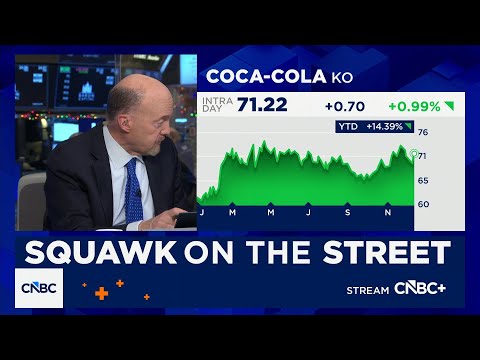
It's time for Jim and stop trading. >> Tripping a piece out by Deutsche Bank about the consu this consumer product group and it talks about how Coca-Cola uh which is one of the great companies of our lifetime right the stock's up 14%. I want to compare that to ARM that's my there I'm talking about my friend Rene Hos and that stock is down and this when a lot of people feel that ARM is handinand with Nvidia and ARM is uh it's up 1% but it's down six today.This is what I'm talking about. The bubble. The bubbl ...


Cramer's Stop Trading: Coca-Cola
Youtube· 2025-12-15 15:19
Group 1 - Coca-Cola's stock has increased by 14%, indicating strong performance in the consumer product sector [1] - There is a perception of a bubble in Coca-Cola, with a preference for its stability and 2.8% yield compared to other stocks [2] - ARM's stock is experiencing volatility, currently up 1% but down 6% on the day, reflecting concerns about its market position [1] Group 2 - The performance of certain stocks over the past six months has been underwhelming, suggesting a lack of a bubble in those areas [3] - Lindy, a diversified industrial gas company, has faced challenges but is noted for its potential [3] - Max Lein is recognized for his innovative approach in the credit industry, showing promise in disrupting traditional practices [3]

S&P 500 Stocks and Gold Haven't Rallied Like This for Decades. Why It's a Warning.
Barrons· 2025-12-10 14:51
Gold prices and S&P 500 stocks have climbed in lockstep. That could be a sign of a bubble, according to researchers. ...
Memos From Howard Marks: Is It A Bubble?
Seeking Alpha· 2025-12-09 23:30
Core Insights - The current moment in history is marked by the rise of transformative technology, particularly artificial intelligence (AI), which is believed to have the potential to change the world significantly. However, there are concerns that this may lead to a speculative bubble similar to past technological bubbles [2][25]. Group 1: Understanding Bubbles - Bubbles are characterized by excessive optimism and can lead to significant short- to medium-term losses for investors, despite the potential for long-term gains [4][5][10]. - Historical patterns show that bubbles often arise from new technologies that capture public imagination, leading to irrational investment behavior [6][8][9]. - The distinction between "inflection bubbles," which can drive technological progress, and "mean-reversion bubbles," which do not contribute to overall advancement, is crucial for understanding the current AI landscape [14][16][22]. Group 2: Current AI Landscape - AI is increasingly integral to the economy, with significant contributions to capital expenditures and overall GDP growth. AI-related stocks have driven a large portion of gains in major indices like the S&P 500 [25][30]. - Nvidia has emerged as a leading player in AI, achieving a market value increase from $626 million at its IPO to a peak of $5 trillion, reflecting an appreciation of approximately 8,000 times [26]. - The future of AI remains uncertain, with questions about which companies will emerge as leaders and how the technology will be monetized. The potential for new entrants to disrupt established players is significant [27][28][32]. Group 3: Investment Behavior and Risks - There is a growing trend of speculative investment in AI startups, with significant funding rounds occurring without clear product offerings or business models, raising concerns about the sustainability of such investments [36][38]. - The use of debt financing for AI infrastructure is increasing, with estimates suggesting that the total investment required could reach $5 trillion. This raises questions about the prudence of such financial strategies in a rapidly evolving technological landscape [41][42]. - Circular deals and vendor financing practices in the AI sector have raised suspicions about the legitimacy of reported profits and the overall health of the industry [33][34]. Group 4: Historical Comparisons and Future Outlook - Historical parallels can be drawn between the current AI situation and past technological bubbles, such as those in aviation and radio, which were characterized by high uncertainty and speculative investment behavior [60][61]. - The current AI boom is seen as potentially transformative, but the speculative nature of investments raises concerns about the possibility of a significant correction in the future [67].


Can AMD outperform Nvidia stock in 2026? This analyst isn't doubting it
Invezz· 2025-12-08 13:36
The artificial intelligence sector is continuing its sharp surge despite fears of a potential 'bubble', and Nvidia is leading the space with over $4.5 trillion market cap. But, heading into 2026, one ... ...

Branch: Dislocations start in private equity and venture capital
CNBC Television· 2025-12-08 13:01
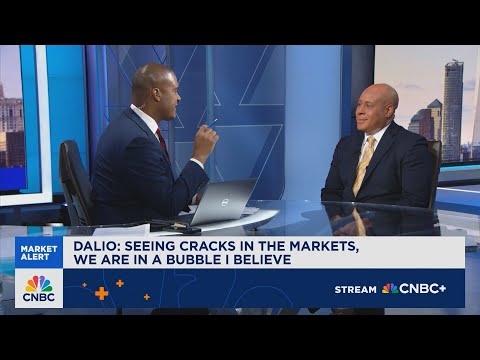
Market Bubble & Potential Weakness - The market may experience pressure as wealth is sold to provide necessary funds, regardless of a bubble [1] - Dislocations are expected in private equity and venture capital due to firms needing to support existing positions that may no longer be feasible [3] - Weakness may emerge in SAS and other software companies if their functions are replaced by AI or other technologies [4] - Issues have already surfaced in the private credit space [4] Earnings Growth & Market Safety - Strong double-digit earnings growth could safeguard the market [4] - The peak impact of physical and monetary stimulus from the previous year is expected to continue through the end of next year, potentially driving double-digit earnings growth into 2026 and beyond [4] - Continued strong tailwinds behind topline and double-digit earnings growth could mitigate the impact of dislocations [5] - The firm has a bullish S&P price target of 7,500, indicating confidence in strong earnings [6] Consumer & Consumption Dynamics - The firm is bullish on consumption but mixed on the consumer [7] - The top 10% of earners account for 50% of consumption [8] - The bottom third of earners account for only 15% of consumption [9] Inflation & Political Issues - Inflation is anticipated to be more of a political issue than an economic one in 2026 [9][11] - The affordability crisis will be intertwined with inflation and will be a central issue as the midterms approach [11] - The affordability crisis affects a plurality of people, particularly the bottom half of earners, making it a key political concern [12]
X @TylerD 🧙♂️
TylerD 🧙♂️· 2025-12-08 00:17
XCOPY bubble(s) now have a final supply of 2.3974MCurrently at $0.51 floor https://t.co/qhwwOimh6i ...
Most extreme 'no hire, no fire' economy we've ever seen, says Wharton's Jeremy Siegel
CNBC Television· 2025-12-05 21:01
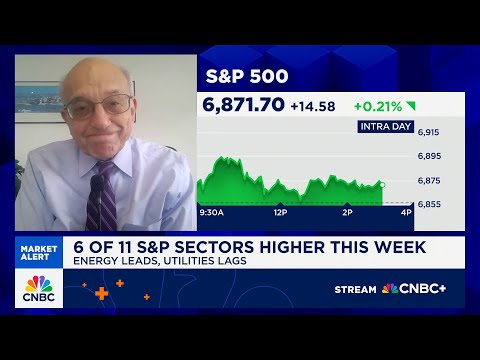
It does take us to our talk of the tape. Can [music] stock stage an endofear run. Let's ask the Wharton professor of finance, Jeremy Seagull.He joins us now. Professor, it's always great to talk to you. We usually do this on Fridays, which affords us the ability to size up this week and the past few weeks at that.I mean, how does this market look to you here. >> The market looks very, very solid. Um, I I'll tell you one thing, I don't think we can rely on seasonal predictions.Uh, you know, we all said, "Oh, ...
X @TylerD 🧙♂️
TylerD 🧙♂️· 2025-12-05 12:17
XCOPY's Bubble(s) have ballooned to 850,000+ in supplyOn their way to passing the 1M mark soon https://t.co/CoOPLTnPXq ...