
Global Supply Chains

Search documents
美国关税影响追踪 - 关税实施后仍在等待峰值清晰度-Americas Transportation_ US Tariff Impact Tracker - Still Waiting On Peak Clarity Post Tariff Implementations
2025-08-12 02:34
Summary of Key Points from the Conference Call Industry Overview - The report focuses on the **transportation industry**, specifically the impact of **US tariffs** on freight flows from **China to the USA** [1][2][5]. Core Observations - **Laden vessels** from China to the USA decreased by **4% sequentially** and **19% year-over-year (YoY)**, indicating a softening trend that may persist through mid-August based on data from the **Port of Los Angeles** [1][5]. - The **tariff-related impacts** are still unfolding, and the upcoming weeks are critical for understanding shipper reactions as the peak season approaches [1][6]. - **Weekly data** can be volatile, but analyzing it over multiple weeks can reveal trends related to tariffs [3][9]. Freight Flow Data - **Container rates** have dropped by **8% sequentially** and are under significant pressure, down **67% YoY** [5][29]. - **Rail intermodal volumes** on the West Coast increased by **1% YoY**, marking the fifth consecutive week of positive growth, suggesting a recovery in logistics following previous disruptions [5][40]. - Planned **TEUs (Twenty-foot Equivalent Units)** into the Port of Los Angeles are expected to drop by **3%** in the near term, with a potential **20% increase** two weeks later [5][33]. Future Projections - The **2025 trade scenario** suggests that shippers may delay orders due to uncertainty, which could lead to an underwhelming peak season in terms of volume and revenue [6]. - If a **re-stock event** occurs in 2026, it could significantly benefit freight flows and margins, especially if consumer spending remains strong during the holiday season [6]. Stock Recommendations - **Transport stocks** may face downward pressure in the second half of 2025 if consumer demand does not increase [8]. - **Freight forwarders** like **EXPD** and **CHRW** are expected to benefit from volatility and potential surges in demand due to tariff pauses [8]. - **Parcel companies** such as **UPS** and **FDX** are also positioned to gain from increased demand for air freight during peak seasons [8]. Additional Insights - The **Logistics Managers Index** indicates that upstream inventories are expanding, while downstream inventories are contracting, reflecting a complex inventory landscape [69]. - The **Supply Chain Congestion Tracker** remains stable, suggesting fluidity in logistics comparable to pre-COVID levels [48][50]. - The **Big Three ports** (LA, Long Beach, Oakland) experienced a **5% YoY decline** in volumes but a **21% sequential increase** from May to June, indicating a recovery trend [52]. Conclusion - The transportation industry is navigating a challenging environment influenced by tariffs, consumer behavior, and inventory management. The upcoming months will be crucial for assessing the impact on freight flows and stock performance in the sector [1][6][8].
X @Bloomberg
Bloomberg· 2025-07-18 01:37
Economic Overview - China's economy remained stable despite tariffs imposed by the Trump administration [1] Trade War Impact - Manufacturers are actively adjusting to the trade war, which poses a threat to global supply chains [1] Future Outlook - The report seeks to explore the future implications of the trade war [1]
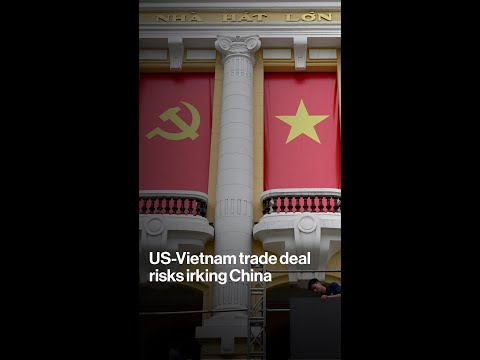
US-Vietnam Trade Deal Risks Irking China
Bloomberg Television· 2025-07-03 11:09
Trade Agreement & Tariffs - US and Vietnam reached a trade deal, avoiding higher tariffs on Vietnamese exports to the US [1] - A 20% tariff will be imposed on Vietnamese exports to the US [1] - A 40% levy will be placed on goods deemed to be trans-shipped (goods with components from other countries routed through Vietnam) [1] - The new US levy on Vietnam is lower than the initially announced 46% but double the 10% universal base rate [2] Potential Risks & China's Role - Risks are still tilted to the downside for Vietnam, according to Bloomberg Economics analysis [2] - China might retaliate despite its trade truths with the US, potentially impacting Vietnam's economy [3] - China's retaliatory moves could have an outsized impact on Vietnam's economy, given its position as Vietnam's largest trading partner and a key source of inputs for domestic production [3] - US efforts to forge deals could isolate Chinese firms from global supply chains, causing increasing wariness from China [3]

U.S. strikes 3 nuclear sites in Iran: What rising retaliation risk means for insurers
CNBC Television· 2025-06-23 00:12
Market Risk & Insurance Adjustments - Insurers are actively assessing and adjusting terms and conditions to account for existing and potential risks in regions like the Red Sea and the Strait of Hormuz [1][2][3] - The number of Western ships transiting the Red Sea has noticeably decreased, reflecting heightened risk awareness [2] - Marine insurance rates in the region have already increased significantly, with shippers paying 60% more than a month ago [5] - Aviation insurance is also likely to rise, with potential exclusion of certain Middle East and North Africa zones from reinsurance coverage, possibly leading to flight cancellations [5] Coverage & Potential Losses - Insurers offer solutions like war risk or political risk coverage, including contingent business interruption insurance for financial losses due to geopolitical disruptions [3] - Major players like Lloyd's of London syndicates, CHUB, AIG, Alons, AXA, Swiss Re, Munich Re, and Everest Group have exposure to these risks [4] - Cyber insurance policies often exclude state-sponsored attacks, potentially leading to costly litigation if insurers deny claims [6] Supply Chain & Trade Flow Impacts - Disruptions to cargo transportation routes, airspace, and canal access significantly affect global supply chains and trade flows, creating both challenges and potential opportunities for insurance [6][7] - The cost for an oil tanker has surged to approximately $100,000 per day, a significant increase from $24,000 just 12 days prior, with expectations it could rise further to $150,000 [7] Behavioral Changes - Some shippers are proactively changing routes to avoid higher premiums, and similar behavioral changes are anticipated in aviation [8]

Why China May Need to Break Up Some Big Businesses
Bloomberg Technology· 2025-06-09 19:39
US-China Trade & Tech Restrictions - Expectation of a shift from broad-based sanctions on semiconductors to more targeted measures [1] - US imposed export restrictions on H-20 chips potentially impacting $4.5 billion in sales [2] - China restricted magnets impacting electric vehicles and smartphones [2] - US retaliated by blocking Leap One SEE engines used by CarMax jets [3] - Specific Chinese companies compete directly with American counterparts in chips, aerospace, defense, critical minerals, and telecommunications [5] - China is the leading trade partner to over 140 countries [7] National Security & Industry Competition - Key verticals where Chinese competition poses a direct threat to American technological leadership include chips, aerospace and defense, critical minerals supply chains, and telecommunications [5][6] - Some Chinese e-commerce and entertainment companies have been embroiled in national security concerns [7][8] - China is disaggregating large businesses to facilitate targeted sanctions [9] Supply Chain & Manufacturing - US needs to unlock natural resources to ensure American national security [14][15] - Resurgence of American aerospace and defense is attributed to the Trump administration's efforts to remove barriers to growth [13][14] - Reinforcement of American supply chains is needed to reduce dependence on Chinese inputs [12]

高盛:美国关税影响追踪器 - 高频趋势仍显示中国对美贸易流量疲软
Goldman Sachs· 2025-05-13 05:39
Investment Rating - The report does not explicitly provide an investment rating for the transportation industry but discusses trends and potential impacts of tariffs on trade flows, indicating a cautious outlook for the sector. Core Insights - The ongoing trade tensions between the US and China are leading to a significant decline in freight flows from China to the US, with a reported drop of 22% year-over-year in laden container vessels [4][9][14]. - There is a bifurcation in trends, with concerns about product availability if the trade war continues, particularly as the second half of the year approaches [4]. - The report highlights the potential for a freight air pocket in the second quarter, which could affect inventory levels and order spikes in the second half of 2025 [5][8]. Summary by Sections Trade Flow Trends - Freight flows from China to the US have decreased by 22% year-over-year, with a sequential drop of approximately 21% in the most recent week [4][9]. - Expected TEU imports into the Port of Los Angeles are set to drop for a third consecutive week, although a sharp spike is anticipated in the following weeks, possibly indicating a shift in trade patterns [4][30]. Inventory and Demand - The Logistics Managers Index (LMI) indicates an expansion in inventory costs, suggesting that goods are not moving as expected, which could lead to empty shelves if the situation persists [4][57]. - There are two main questions being monitored: the potential for empty shelves and whether there will be a spike in orders in the second half of the year, which depends on consumer resilience and the severity of the freight air pocket [4][5]. Future Scenarios - The report outlines three potential scenarios for 2025: continued pull forward leading to inventory build followed by a sharp fall in demand, a stall in pull forward creating an air pocket for volumes, or a scenario where the economy does not fall into recession, leading to a surge in orders [8]. - UPS anticipates a decline of up to 25% in China to US business as the second quarter progresses, while trade from China to the rest of the world is expected to pick up some of the slack [5][8]. Container Rates and Shipping Activity - Ocean container rates from China to the US West Coast have increased by 3% week-over-week but are down 38% year-over-year, indicating a lack of recovery in shipping rates [27]. - Planned TEUs into the Port of Los Angeles have decreased by 32% year-over-year, with forecasts showing a potential increase as trade shifts from China to other regions [30][32].