Risk aversion

Search documents
Bank of Japan Set to Hike Rates to 30-Year High, Posing Another Threat to Bitcoin
Yahoo Finance· 2025-12-13 14:00
Group 1: Bank of Japan Interest Rate Hike - The Bank of Japan (BoJ) is expected to raise interest rates by 25 basis points to 0.75% on December 19, marking the first increase since January and the highest level in approximately 30 years [1] - The rate hike is anticipated to have implications for the yen carry trade, potentially affecting Bitcoin (BTC) through the equities channel [3][4] Group 2: Impact on Global Markets and Cryptocurrency - Historically, developments in Japan have been bearish for Bitcoin and the wider cryptocurrency market, with a stronger yen typically exerting downside pressure on Bitcoin [2] - The last BoJ rate hike in July 2024 led to a significant decline in Bitcoin prices, illustrating the potential for risk aversion in stocks and cryptocurrencies following the upcoming hike [4] Group 3: Current Market Conditions - The yen is currently trading near 156 against the U.S. dollar, slightly stronger than its late November peak, indicating a shift in market sentiment [3] - Japanese bond yields have risen to multi-decade highs, suggesting that the upcoming rate hike reflects official rates aligning with market conditions [6] Group 4: Speculative Positioning and Fiscal Concerns - Speculators currently hold net long positions in the yen, which may reduce the likelihood of a sharp market reaction to the BoJ's rate hike [5] - Japan's fiscal situation, characterized by a debt-to-GDP ratio of 240%, raises concerns about potential market volatility in the coming year [7][8]
Bitcoin falls 5% below $90,000 as investors ditch risk assets
Reuters· 2025-12-01 08:52
Core Insights - Bitcoin has fallen back below $90,000, marking a continuation of losses following its steepest monthly decline since the 2021 crypto crash [1] - The decline in Bitcoin's value is attributed to renewed risk aversion among investors, leading them to exit both stocks and digital assets [1] Market Impact - The recent drop in Bitcoin's price reflects a broader trend of investors moving away from riskier assets amid market uncertainty [1] - The steep monthly decline indicates significant volatility in the cryptocurrency market, reminiscent of past downturns [1]


Sygnia CEO Magda Wierzycka Says Potential for Africa's Youth Is 'Limitless'
Bloomberg Television· 2025-11-29 07:00
Investment Opportunities in Africa - Africa possesses the youngest demographics globally, coupled with increasingly affordable data access, creating a fertile ground for investment [1] - Data accessibility in Africa presents opportunities in healthcare, such as point-of-care diagnostic machines for rural areas, enabling remote diagnosis and medicine delivery via drone technology [2][3] - Agriculture in Africa offers potential for increased crop yields by 20% to 30% through technology, addressing food security issues [4] Risks and Concerns - A potential bubble and increased risk aversion globally could hinder growth in African markets [5][6] - Corruption is a pervasive issue, but opportunities exist through private-public partnerships and engagement with local players to navigate red tape [7][9] Economic Landscape - A significant informal economy in Africa presents opportunities for technology to enable commerce and tap into this sector [10] - Data technology and access to data in African communities are crucial for development and creating opportunities [11]

Market's seen a change toward institutional risk aversion, says Interactive Brokers' Steve Sosnick
CNBC Television· 2025-11-24 19:05
Market Sentiment and Rate Cut Expectations - The market's mindset has shifted, with the mood changing after indications of potential rate cuts [2] - The stock market is highly dependent on rate cut expectations, with improved expectations leading to a better market mood [8] - A previous drop in rate cut expectations from approximately 80% to 30-35% correlated with a difficult November for the market [7] - The market appears to need a Federal Reserve rate cut to continue moving higher [5] Macroeconomic Factors and Correlations - The market is moving higher on fundamentals, specifically improving rate cut expectations [4] - Bitcoin's correlation with the NASDAQ and S&P 500 is seen as a proxy for risk among investors [9][11] - The AI trade is a powerful force in the markets and may interplay with the rate cut story [9] Technical Analysis and Market Positioning - The market experienced a paradigm shift, breaking through the 50-day moving average [10] - The market broke through the 100-day moving average but is now back above it [11] Crypto Market Dynamics - Many new investors ("crypto tourists") entered the crypto market this year due to ETFs, broadening exposure [12] - Crypto, excluding ETFs, often involves high leverage (e g, 20:1), making it susceptible to downswings [13]
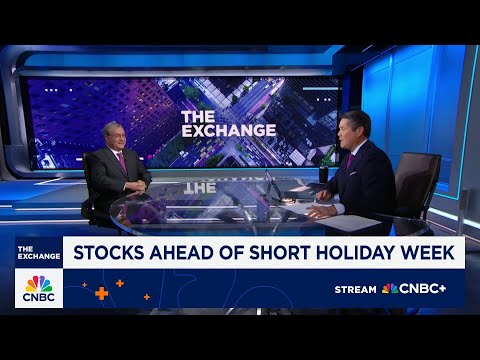
Market's seen a change toward institutional risk aversion, says Interactive Brokers' Steve Sosnick
Youtube· 2025-11-24 19:05
Group 1: Market Sentiment and Fed Rate Cuts - The market's sentiment has shifted significantly following comments from John Williams regarding potential rate cuts, indicating a strong correlation between market performance and Fed rate expectations [2][5][8] - Rate cut expectations have risen from around 30-35% to approximately 70-75%, leading to improved market conditions [7][8] - The stock market appears to be heavily reliant on the Fed's decisions regarding rate cuts, suggesting that a favorable monetary policy is crucial for continued market growth [5][8] Group 2: Correlations and Market Dynamics - There is a notable correlation between Bitcoin and major indices like NASDAQ and S&P 500, driven by the same mega-cap stocks influencing both markets [11] - The influx of new investors into cryptocurrencies, referred to as "crypto tourists," has broadened exposure and created a sentiment spillover effect between crypto and traditional equities [12] - The leverage in cryptocurrency investments makes them more susceptible to volatility, which can impact broader market sentiment [13] Group 3: Technical Indicators and Market Positioning - Recent weeks have seen a paradigm shift in market dynamics, with key moving averages like the 50-day and 100-day showing significant changes [10] - The market is currently navigating a phase of consolidation, with uncertainty about future catalysts for growth [10] - The interplay between AI-driven trades and rate cut expectations is becoming increasingly relevant in shaping market strategies [9]


X @Bloomberg
Bloomberg· 2025-11-14 08:30
Bitcoin fell further below the $100,000 mark as a bout of risk aversion sweeping across markets saw investors yank nearly $900 million from funds investing in the token https://t.co/5uOROFKV9a ...
Alphabet is well positioned with AI applications, says GMO's Tom Hancock
Youtube· 2025-11-10 21:19
Core Viewpoint - The current rebound in big tech stocks is influenced by long-term AI success rather than short-term government issues, presenting potential buying opportunities [2][4]. Group 1: Market Dynamics - The volatility in the market is expected to continue, with a fundamental risk being the potential drying up of funding if risk aversion increases [4]. - Companies with strong balance sheets and diversified businesses, such as Meta, Microsoft, and Alphabet, are well-positioned to weather short-term issues [5][6]. Group 2: Sector Preferences - Healthcare is highlighted as a preferred sector, particularly managed care names that may be undervalued due to ACA subsidy concerns [7]. - Big pharma stocks are also favored, with specific mention of Pfizer and the GLP-1 agreements indicating that regulatory rhetoric may be overstated [8]. Group 3: Investment Picks - Major holdings include Microsoft and Alphabet, with Alphabet noted for its unique position in the AI ecosystem, leveraging its own TPU chips and proprietary data [9][10]. - Alphabet's regulatory challenges appear to be diminishing, enhancing its attractiveness as an AI investment [11].


Risk Proxies Challenge Bitcoin's Bounce; HYPE, XMR Shine: Crypto Daybook Americas
Yahoo Finance· 2025-10-23 11:15
Market Overview - The crypto market is attempting to regain upward momentum, with Bitcoin (BTC) aiming to surpass $110,000, while the CoinDesk 20 Index has increased by over 1% in the last 24 hours, with notable gains in tokens like HYPE, KHYPE, and XMR [1] - Social media sentiment remains positive, driven by expectations of a 25 basis points rate cut by the Federal Reserve, which is part of a liquidity easing cycle [2] Market Dynamics - The dollar index is showing bullish trends, which may restrict Bitcoin's upside potential [2] - Risk proxies such as the iShares iBoxx $ High Yield Corporate Bond ETF (HYG) and Financial Select Sector SPDR Fund (XLF) have breached key support levels, indicating underlying weakness in the market [3] - Volume studies suggest persistent weakness in the Bitcoin market, corroborating a bearish outlook in BTC options on Deribit and Standard Chartered [3] Economic Factors - Recent banking funding stress and liquidity tightening are negatively affecting Bitcoin's performance, although there are indications that the bull run is not over, with lower bond yields and economic slowdown risks potentially leading to aggressive Fed easing [4] - Oil prices have risen by 4% following U.S. sanctions on major Russian suppliers, which may introduce increased volatility and risk aversion in the market [4] Upcoming Events - Binance Square is hosting an AMA on October 23 regarding the growth and community building of early-stage projects [7] - The U.S. Department of Labor will not release its usual jobless claims reports due to a federal government shutdown on October 23 [7] - SSV DAO is voting on amendments to focus SSV 2.0 on a protocol that enables atomic cross-rollup transactions, with voting ending on October 23 [7]
Bond ETFs in Focus as Treasury Yield Touches 3-Year Low
ZACKS· 2025-10-17 14:01
Core Insights - U.S. Treasury yields have declined significantly, with the two-year yield reaching its lowest level since 2022 and the 10-year yield falling below 4%, indicating increased risk aversion among investors amid economic uncertainty [1][3][7] Market Conditions - The decline in Treasury yields is attributed to multiple factors, including renewed credit risks in regional banks, fears of an imminent recession due to the ongoing government shutdown, dovish central bank policies, and heightened trade tensions [3][6][7] - Regional banking stocks have faced significant losses, with Zions Bancorp and Western Alliance reporting substantial loan losses, leading to declines of 13% and 11% in their stock prices, respectively [4] - Higher tariffs imposed by the U.S. government have increased monthly costs for American households, with estimates suggesting an annual cost increase of $2,300 per household, contributing to recession fears [5][6] Investment Opportunities - Bond exchange-traded funds (ETFs) are becoming increasingly attractive as investors seek stability during market volatility, acting as "efficient shock absorbers" due to their diversification and liquidity [2][8] - The inverse relationship between bond prices and yields means that as demand for U.S. government bonds rises, bond prices increase, leading to a decline in yields [9] Notable Bond ETFs - iShares 0-3 Month Treasury Bond ETF (SGOV) has approximately $59.14 billion in net assets and an average yield to maturity of 4.08% with fees of 9 basis points [11] - SPDR Bloomberg 1-3 Month T-Bill ETF (BIL) has about $42.59 million in assets under management and an average yield to maturity of 4.05% with fees of 14 basis points [12] - Vanguard Short-Term Treasury ETF (VGSH) tracks the Bloomberg U.S. Treasury 1-3 Year Bond Index, with approximately $27.6 billion in net assets and an average yield to maturity of 3.64% with fees of 3 basis points [13] - Schwab Short-Term U.S. Treasury ETF (SCHO) has around $11.45 billion in total net assets and an average yield to maturity of 3.78% with fees of 3 basis points [14]

Sensex down 297 points on foreign fund outflows
Rediff· 2025-10-14 11:51
Market Performance - Benchmark stock indices Sensex and Nifty ended lower due to weak trends in Asian and European markets and fresh foreign fund outflows [1] - The 30-share BSE Sensex declined by 297.07 points or 0.36% to settle at 82,029.98, with an intraday drop of 545.43 points or 0.66% to 81,781.62 [3] - The 50-share NSE Nifty decreased by 81.85 points or 0.32% to 25,145.50 [3] Sector Performance - Major laggards among Sensex stocks included Bajaj Finance, Bharat Electronics, Tata Steel, Tata Consultancy Services, NTPC, Trent, Asian Paints, and Axis Bank [4] - Gainers in the market included Tech Mahindra, ICICI Bank, Power Grid, Hindustan Unilever, and Reliance Industries [6] Market Sentiment - The equity markets experienced broad-based profit-booking amid a lack of fresh domestic triggers, influenced by weak cues from Asian and European peers [6] - Renewed US-China trade tensions have reignited risk aversion, leading to a shift towards safe-haven assets such as gold and US Treasury bonds, while equities faced pressure due to escalating global trade uncertainty [7] Foreign Investment - Foreign Institutional Investors (FIIs) offloaded equities worth ₹240.10 crore on Monday, indicating a trend of foreign fund outflows [8] Global Market Influence - Asian markets, including South Korea's Kospi, Japan's Nikkei 225, Shanghai's SSE Composite Index, and Hong Kong's Hang Seng, ended lower, contributing to the negative sentiment in the Indian markets [7] - Global oil benchmark Brent crude dropped by 1.82% to $62.17 a barrel, reflecting broader market trends [7]