Trade wars

Search documents
August jobs report: hiring stalls with unemployment up to 4.3%
Fastcompany· 2025-09-05 18:01
Core Insights - The U.S. labor market is showing signs of cooling, with only 22,000 jobs added in August, significantly lower than the 79,000 in July and below the expected 80,000 [2] - The unemployment rate increased to 4.3%, the highest since 2021, indicating a decline in job market momentum [2] - Manufacturing and construction sectors experienced job losses, with factories shedding 12,000 jobs and construction cutting 7,000 jobs [2] - The Federal Reserve is likely to cut interest rates in response to the weak job numbers, as the labor market's performance is influenced by interest rate hikes and trade policy uncertainties [2] Labor Market Performance - The Labor Department's report revealed a downward revision of 21,000 jobs for June and July, with actual job losses of 13,000 in June, marking the first monthly decline since December 2020 [2] - The number of Americans applying for unemployment benefits rose to the highest level since June, although claims remain within a healthy range [2] - U.S.-based employers announced over 892,000 job cuts through August, surpassing the total of 761,000 for all of 2024 [2] Economic Policy Impact - President Trump's economic policies, including trade wars, have contributed to uncertainty in the labor market, affecting hiring decisions [2] - The Federal Reserve's reluctance to cut rates has been influenced by the impact of Trump's import taxes on inflation [2] - The Labor Department is facing challenges in data collection due to a decline in company response rates to surveys, which has dropped from 60% to 40% over the past decade [4]


X @Investopedia
Investopedia· 2025-09-03 12:00
Last week, a judge ruled that most of President Donald Trump's tariffs are illegal, setting up a showdown in the Supreme Court. That leaves the future of Trump's trade wars once again up in the air. https://t.co/9dORBycTx5 ...
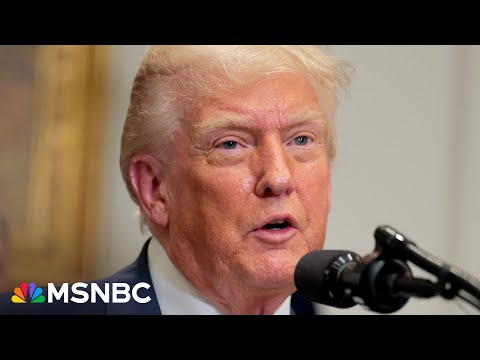
'Nothing is fixed': Trump's new tariff regime is lacking some key details
MSNBC· 2025-08-09 04:37
Trade Policy & Economic Impact - The Trump administration's tariffs have pushed the average tariff rate to 186%, levels not seen since the 1930s [1] - These tariffs introduce uncertainty, potentially causing domestic businesses to retract and impacting consumer affordability [9][10] - Tariffs could cost US households approximately $2,400 per year [17] - There are nearly 2 million people unemployed, the highest level since the pandemic [16] Legal & Political Challenges - The legality of the tariffs is being challenged in court, with the Federal Circuit potentially ruling them unlawful [12] - The statute used to justify the tariffs doesn't explicitly mention tariffs, circumventing established trade deal frameworks [14][15] - The impact of the trade wars may influence the 2026 political landscape and Trump's long-term legacy [28] Global Trade & Business Uncertainty - The current trade situation is confusing for companies, with sectoral and country tariffs intersecting [6][7] - Trade deals lack detailed documentation, relying on "made for TV tweets and comments," leading to disagreements and back trading [5] - Trump's approach of continuously revisiting deals creates uncertainty for countries and companies, hindering planning and management [8]
Jefferies:中国钢铁减产的反直觉后果
2025-07-14 00:36
Summary of Key Points from the Conference Call Industry Overview - The conference call focuses on the **Metals & Mining** industry, particularly the **Chinese steel production** and its implications on global markets [1][2][3]. Core Insights and Arguments - **Chinese Steel Production Cuts**: Chinese officials have mandated the closure of up to **50 million tonnes per annum (mtpa)** of steel capacity to address structural overcapacity issues, which is expected to support finished steel prices globally [1][2]. - **Impact on Exports**: Despite a **0.6% year-over-year (y/y)** increase in steel production in Q1, domestic demand declined by over **1%**. Finished steel exports rose by **9% y/y** through May, indicating a strategy to shift overproduction to foreign markets [2]. - **Trade Barriers**: The steel industry faces challenges from rising trade barriers, with Baowu Steel projecting a **15 million tonne** decline in exports by 2025 due to trade measures, which could lead to a significant downturn in the second half of the year [2]. - **Domestic Demand Decline**: Baowu anticipates a **2% potential decline** in domestic steel demand this year, suggesting that even with stimulus measures, production and demand are likely to decrease [2]. - **Peak Steel**: The analysis suggests that China has reached "peak steel," indicating a potential long-term decline in production levels [2]. Implications for Raw Material Markets - **Seaborne Demand**: The cuts in steel production may initially reduce demand for iron ore and metallurgical coal, as China accounts for approximately **70%** and **20%** of seaborne demand in these markets, respectively [3]. - **Global Steel Production**: Countries like India, South Korea, and Vietnam may benefit from reduced Chinese exports, potentially leading to increased steel production and higher global steel prices [3]. - **Price Recovery**: Lower Chinese steel exports could catalyze a recovery in seaborne metallurgical coal demand and prices, as well as high-grade iron ore prices [4]. Market Outlook - **Neutral Stance**: The outlook for iron ore and metallurgical coal markets is neutral in the near term, with expectations of adequate supply. However, lower Chinese exports could positively impact demand and prices for these commodities [4]. - **Preferred Miners**: Vale and Glencore are identified as preferred major global miners for exposure to potential price upside in metallurgical coal and high-grade iron ore [4]. Additional Important Information - **Financial Metrics**: The conference call includes various financial metrics and forecasts for commodities, including price forecasts for iron ore and coal, as well as company-specific financial data for Vale and Glencore [6][10]. - **Analyst Ratings**: The call features analyst ratings and price targets for companies within the sector, indicating a "Buy" rating for both Vale and Glencore, with specific price targets set for their stocks [8][10]. This summary encapsulates the critical insights and implications discussed during the conference call, providing a comprehensive overview of the current state and future outlook of the Metals & Mining industry, particularly in relation to Chinese steel production and its global impact.

Jamie Dimon sells $31.5M worth of JPMorgan shares in latest round of stock sales
New York Post· 2025-04-14 23:44
Core Insights - JPMorgan Chase CEO Jamie Dimon sold approximately $31.5 million worth of the bank's shares, marking his first sale since becoming CEO in 2005 [1][2] - The bank surpassed first-quarter profit estimates due to record equities trading and increased fees from debt underwriting and mergers [1][2] - Dimon's 2024 pay package increased by 8.3% to $39 million, reflecting his continued influence in the industry [2] Share Sale Details - Dimon sold 133,639 shares at a closing price of $234.72, which represents a 0.6% decline on that day [2] - The share sale is part of JPMorgan's preparations for a future leadership transition, as Dimon is 69 years old and has led the bank for 19 years [2][3] Succession Planning - The bank's board is focused on succession planning, which Dimon identified as his most important task [3] - Dimon has expressed concerns about potential long-term negative impacts of trade wars, including persistent inflation and high fiscal deficits [3]