Wage growth

Search documents
How's the economy doing? It depends how much you make. 💵
Yahoo Finance· 2025-10-12 22:30
Economic Disparity - The US economy is experiencing a K-shaped recovery, with higher-income Americans trending upward while lower-income Americans trend downward [2] - The pay gap between higher and lower-income Americans is at its highest ever, with a nearly 530% pay difference [3] - Wealth inequality is evident in stock ownership, with the wealthiest 1% of households owning about 40% of stocks and the next 19% owning nearly 50% [4] Consumer Spending - Overall consumer spending is strong, but driven largely by higher-income Americans [2] - Spending growth for higher-income households was up 220% in August compared to a 030% year-over-year increase for lower-income households [2] - After-tax wage growth for lower-income households was up 090% year-over-year in August, while for higher-income households, it was up 360% [2] Market Sentiment - Conflicting headlines about economic growth, strong spending, stagnant labor market, and rising prices are contributing to consumer sentiment [1][4]


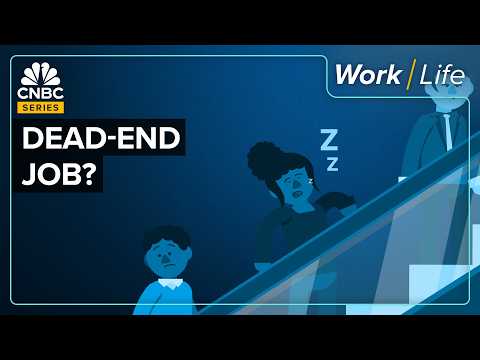
Why So Many Americans Feel Stuck At Work
CNBC· 2025-09-24 16:00
Labor Market Trends - The US economy has lost 1.2 million jobs since April 2024 [1] - The quits rate is down to about 2% after fluctuating since the pandemic [1] - Employers are hiring at the slowest pace since 2013, excluding the pandemic dip and rise [1] - Almost 1 in 5 job seekers surveyed said they're not confident that they will find a great job that they like [5] - A natural attrition of 20% in a company is mentioned [8] Employee Engagement & Productivity - Four out of five employees surveyed said they're not thriving at work [3] - 58% of US professionals surveyed believe they have a wide range of skills that are being underutilized in their current roles [3] - Employee disengagement adds up to about $5 million a year in lost productivity for a typical 1000 person company [12] - The average disengaged worker could cost the company $4,000 over the course of a year, while an executive could cost $20,000 [12][13] - Globally, low employee engagement is estimated to cost $9.6 trillion annually, or around 9% of global GDP [16] Wage & Bargaining Power - Wage growth has cooled, and job switching premiums have shrunk [6] - The minimum wage has been sitting at the same level since 2009 [19] - Workers have lost a bit of their bargaining power in the current environment [20]
🚨David Friedberg: "Socialism will sweep over this nation"
All-In Podcast· 2025-08-11 17:34
Economic Predictions - A prediction suggests socialism will sweep over the nation, potentially worse than previous issues [1] - Wage growth is stagnant, impacting people across income levels due to increased costs of groceries and home goods [1] - Rent increases annually while salaries remain stagnant, creating financial strain [1] Government Impact - Nearly half of Americans are employed directly or indirectly by the government [2] - Inefficient government allocation of capital contributes to inflation [2]

X @Bloomberg
Bloomberg· 2025-08-07 03:00
Macroeconomic Trends - Japan's civil servants are poised for the largest pay raise in 34 years [1] - This pay increase could strengthen the positive feedback loop of wage and price growth [1] Monetary Policy Implications - The Bank of Japan has long sought this virtuous cycle as a prerequisite for further monetary tightening [1]
U.S. economy adds 147,000 jobs in June
NBC News· 2025-07-03 14:01
Employment & Economic Growth - The US economy added 147,000 jobs in June, exceeding expectations [1] - The unemployment rate slightly decreased to 4.1% [1][4] - Average hourly earnings show a 3.7% growth over the past year, indicating compensation for employed individuals [2][11] - The first quarter GDP number came in at 0.5%, indicating a not strong but not weak economy [15] Sector Performance - State government jobs were a significant driver of job growth, contrasting with weaker private sector job growth [3] - The healthcare sector, including residential care facilities and nursing homes, consistently drives employment [6] - Federal government jobs decreased by 7,000, totaling 69,000 cuts so far [5] - Mining, quarrying, manufacturing, and wholesale trade experienced little change, aligning with expectations given trade policy uncertainty [7] Monetary Policy & Consumer Behavior - The possibility of a Federal Reserve rate cut next month decreased from 25% to approximately 2%, suggesting a relatively strong economy [8] - Wage growth was slightly below expectations at 0.2% compared to the expected 0.3% [10] - There's a bifurcation in the labor market, with employed individuals experiencing decent wage growth, while recently unemployed or graduated individuals face some weakness [12] - Consumers are saving more, potentially slowing down spending and economic activity [13][14]

US Employers Are Hiring, Despite Uncertainty | Presented by CME Group
Bloomberg Television· 2025-06-09 09:59
Employment Landscape - The non-farm payrolls report, while stronger than expected, indicates a slowing employment landscape [1] - Headline data decreased compared to the previous month, which was also revised downwards [1] - Employers may be reducing hiring due to tighter financial conditions, while incentivizing current employees with higher wages [1] Wage Growth & Labor Force - Strong wage growth coupled with a lower labor force participation rate was observed [1] Monetary Policy Implications - Continued wage pressures may keep inflation elevated, potentially delaying Federal Reserve rate cuts [2] - The low unemployment rate provides no immediate impetus for a rate cut [2]

Visa Inc. (V) Bernstein's 41st Annual Strategic Decisions Conference (Transcript)
Seeking Alpha· 2025-05-28 17:40
Core Insights - Visa's CFO, Chris Suh, discussed the current spending environment, highlighting consumer sentiment and economic indicators [3][4]. Group 1: Economic Indicators - Employment numbers are reported to be strong, with stable wage growth contributing to a resilient consumer base [4]. - Inflation has moderated, which has positively impacted consumer spending behavior [4]. Group 2: Spending Trends - There is an observed uncertainty in consumer sentiment, which is reflected in the overall spending trends both domestically and in cross-border transactions [3]. - Despite the noise in the economic environment, Visa relies on factual data to assess the situation [3].


Private Payrolls in February Well Below Expectations
ZACKS· 2025-03-05 16:45
Group 1: Tariff Policy Impact - The stock market has been significantly affected by tariff policies discussed by President Trump, with market indexes declining between 2.5-5% over the past week due to the potential imposition of tariffs on trading partners [1] - Commerce Secretary Howard Lutnick indicated that an announcement regarding tariffs may be forthcoming, which has led to fluctuations in major indexes [2] - Lutnick suggested that the White House may consider reducing tariffs based on compliance with the U.S. MCA trade policy, particularly affecting domestic automakers [3] Group 2: Employment Data - The ADP private-sector payroll report revealed an increase of +77K jobs, which is significantly lower than the expected +148K and the lowest since July of the previous year [4] - Goods-producing jobs increased by +42K, outperforming the +36K in private-sector services for the first time in recent memory [5] - Small firms lost -12K positions, while large companies gained +37K and medium-sized businesses added +46K jobs, with Leisure & Hospitality leading the gains [6] Group 3: Wage Growth Metrics - Job Stayers experienced an average wage increase of +4.7% year-over-year, while Job Changers saw an average increase of +6.7%, indicating a slight decrease from the previous month [7] Group 4: Upcoming Economic Reports - Economic reports expected to be released include the final S&P Services PMI for February, ISM Services, and Factory Orders for January, which are anticipated to show positive trends [8]



ADP +77K, Far Lower than Expected; Tariff News Forthcoming?
ZACKS· 2025-03-05 16:35
Group 1: Tariff Policy Impact - The stock market has been significantly affected by tariff policies discussed by President Trump, with market indexes declining between 2.5% to 5% over the past five days due to the potential imposition of tariffs of 20% or 25% on major trading partners [1] - Commerce Secretary Howard Lutnick indicated that the White House may consider reducing tariffs based on compliance with the U.S. MCA trade policy, particularly affecting domestic automakers [3] Group 2: Employment Data - The ADP private-sector payrolls report showed an increase of only 77,000 jobs in February, which is about half of the expected 148,000 and the lowest since July of the previous year [4] - Goods-producing jobs increased by 42,000, outperforming the services sector, which added only 36,000 jobs [5] - Small firms lost 12,000 positions, while large companies gained 37,000 and medium-sized businesses added 46,000 jobs, with the Leisure & Hospitality sector leading job growth [6] Group 3: Wage Growth Metrics - Job Stayers experienced an average wage increase of 4.7% year-over-year, while Job Changers saw a 6.7% increase, indicating a slight decrease from the previous month [7] Group 4: Upcoming Economic Reports - Anticipated economic reports include the final S&P Services PMI for February, expected to approach the growth threshold, and Factory Orders for January, which are projected to show a positive swing after a previous decline [8]