Diversification

Search documents
Level Up Your Portfolio With These Emerging Market ETFs
ZACKS· 2025-12-19 16:36
Core Insights - Emerging markets showed strong performance in 2025, with stocks rising approximately 26% despite geopolitical and tariff uncertainties [1] - Investor sentiment towards emerging markets has significantly improved, with net sentiment reaching a record high according to an HSBC survey [2] Market Performance - The Dow Jones Emerging Markets Index has increased by 18.64% year to date, outperforming the S&P 500 Index, which has gained 15.19% during the same period [3] - Emerging market equity funds experienced inflows of $2.78 billion in the week ending December 10, marking the seventh consecutive week of net buying [7] Investment Trends - Investors are diversifying away from U.S. equity trades, particularly in light of concerns over a potential AI-driven bubble, leading to increased interest in emerging market funds [4][6] - The weakening U.S. dollar and expectations of further Federal Reserve rate cuts are enhancing the attractiveness of emerging market funds [8][9] Fund Recommendations - Suggested emerging market equity ETFs include iShares Core MSCI Emerging Markets ETF (IEMG), Vanguard FTSE Emerging Markets ETF (VWO), and iShares MSCI Emerging Markets ETF (EEM) [11] - For emerging market bonds, recommended ETFs include iShares J.P. Morgan USD Emerging Markets Bond ETF (EMB) and Vanguard Emerging Markets Government Bond ETF (VWOB) [14] Economic Fundamentals - Emerging market fundamentals are strengthening, with improvements in sovereign credit gaining momentum year after year, as noted by a strategist at Morgan Stanley [13]

X @Crypto.com
Crypto.com· 2025-12-18 18:00
Bundle up and diversify 💼Trade smarter this festive season and beyond with Crypto Baskets 🧺Check out the full list 👉 https://t.co/qrlEg69JFH https://t.co/OLvFkw3dcK ...
Defray Concentration Risk With This Equal-Weight ETF
Etftrends· 2025-12-18 13:41
Core Viewpoint - The concentration risk in the market is increasingly relevant due to the dominance of a few mega-cap growth stocks, particularly the "Magnificent Seven," which significantly influences market performance [1][3]. Group 1: Market Concentration - The top 10 domestic stocks by market value now account for 35% of the broader market, a figure that has doubled over the past decade [2]. - This top-heavy market structure raises concerns about vulnerability, as any downturn in these leading stocks could lead to significant declines in overall market performance [3][5]. Group 2: Investment Strategies - The ALPS Equal Sector Weight ETF (EQL) is highlighted as a potential investment option, as it offers a strategy that equally weights sectors rather than individual stocks, which has historically led to superior returns compared to other equal-weight ETFs [4]. - Investors are advised to diversify their portfolios beyond a few dominant stocks to mitigate risks associated with market concentration [3][5]. Group 3: Historical Context - Historical examples, such as the dot-com bubble, illustrate the dangers of high market concentration, where a surge in the share of the largest stocks led to significant market volatility and losses when expectations were not met [4].

I'm 65 and Retiring Soon. What's the Best Way to Structure My Portfolio?
Yahoo Finance· 2025-12-18 05:00
Core Insights - The transition from wealth accumulation to distribution during retirement requires careful consideration of personal preferences, risk capacity, and lifestyle needs [1][3] - Retirement planning is a multi-stage process, with a pre-retirement phase of three to five years for adjusting investments and mindset [1][3] Portfolio Structure - A retirement portfolio should reflect individual needs, lifestyle, risk tolerance, and financial resources, emphasizing diversification across various factors [3] - Assessing risk tolerance is crucial, as it may not align with the necessary risk to maintain purchasing power and growth [4] - A core portfolio should include low-cost, diversified index or exchange-traded funds (ETFs) across equities, bonds, and both domestic and international investments [5] Investment Considerations - For those with the capacity to accept volatility, adding speculative assets like gold and cryptocurrencies can provide growth opportunities [6] - The average life expectancy in the U.S. is approximately 80 years for women and 74 years for men, indicating that retirement can last 25 to 35 years, necessitating a balance of conservation and growth in funding [7]
3 Ultra-Safe Vanguard ETFs to Buy, Even if There's a Stock Market Sell-Off in 2026
The Motley Fool· 2025-12-18 04:15
Core Insights - The S&P 500 has shown significant growth, with an increase of over 15% in 2025, following gains of over 20% in both 2024 and 2023, compared to its historical average annual return of 9% to 10% [1][2] Group 1: ETF Performance and Characteristics - The Vanguard Total Stock Market ETF (VTI) is the largest ETF globally, surpassing $2 trillion in net assets, and includes thousands of companies not in the S&P 500, representing about 16% of the total U.S. stock market [5][6] - The Total Stock Market ETF is expected to perform similarly to the S&P 500 over the long term but may be more suitable for investors wanting full market participation [6][7] - The Vanguard Value ETF focuses on value stocks, which tend to perform better during market sell-offs, with major holdings in companies like JPMorgan Chase and Berkshire Hathaway, and offers a yield of 2.1% with a P/E ratio of 21.2 [9][10] - The Vanguard Consumer Staples ETF yields 2.2% and includes major companies like Walmart and Coca-Cola, which are expected to perform well during economic downturns due to their strong supply chains [12][13] Group 2: Market Trends and Investor Behavior - The S&P 500's rapid rise is attributed to strong earnings growth from key companies, including Nvidia, which, along with 19 others, constitutes about half of the index [2] - The consumer staples sector has underperformed in 2025, facing challenges from inflation and reduced consumer spending, but is expected to hold up during market sell-offs [11][13] - Investors are encouraged to use ETFs as part of a diversified portfolio, allowing for exposure to different sectors while managing risk [14]

How Hasbro's Meeting the Tariff Challenge
Bloomberg Television· 2025-12-18 02:32
The challenge, especially within my supply chain, is now how do you have enough productivity initiatives to offset the the increased cost of of all the products for the industry as a whole. You have more than 80% dependence on China as a sourcing market for some of the bigger players. That exposure is less and they have more nimble, more flexible supply chains to navigate this disruption For the medium sized and smaller players, this has been very, very disruptive.Can you just move your supply chain out of ...

Luxury consumer can not continue to bail out the overall economy, says BCA's Doug Peta
CNBC Television· 2025-12-17 21:50
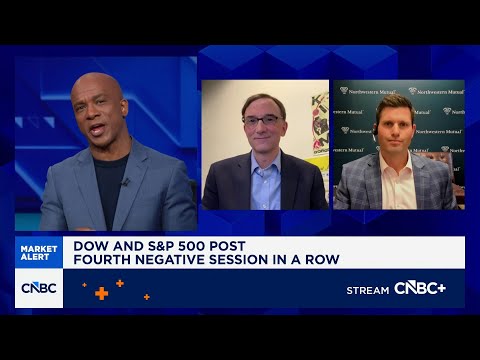
Meanwhile, it was yet another day where the AI narrative had the market swinging back and forth. So, as we head into 2026, how should investors distinguish what's a move led purely by an AI headline and what's a real concern for the market. Joining us now are Doug Peta.He is chief US investment strategist at BCA Research and Matt Stucky, chief portfolio manager at Northwestern Mutual Wealth Management. Guys, welcome. Um, let's see.Uh, Matt, how should investors treat this AI turbulence in a market that's st ...
Why The Bitcoin 'Santa Rally' Could Begin With A Flush To $80,000
Yahoo Finance· 2025-12-17 19:30
Market Overview - Bitcoin (BTC) has fallen below the psychological level of $90,000, indicating increased pressure on leveraged positions and breaking from its consolidation range [1] - The market is punishing excessive risk-taking, with Bitcoin clearing its first major support at $87,000, suggesting further downside targets are still in play [3] Analyst Insights - Prominent analyst Trader Mayne describes the breakdown from the triangle apex as a significant short-term development, warning of potential further downside as leverage is flushed out [2][3] - Ethereum (ETH) is showing relative strength, holding key monthly demand zones, while the ETH/BTC pair is trending higher [4] Future Projections - Mayne predicts a high probability of Bitcoin reaching the $80,000 lows if U.S. equities weaken further, noting that a 2%-3% pullback in the S&P 500 could push risk assets into demand zones [4][5] - The current higher-timeframe downtrend remains in control, with bears retaining the advantage until Bitcoin breaks its diagonal resistance and reclaims key levels [5] Macro Considerations - Upcoming macro risks include the Bank of Japan's policy decision, which could lead to renewed unwinding of the yen carry trade if rates are raised, adding pressure to global risk assets [5]
5 International ETFs to Buy for 2026
Benzinga· 2025-12-17 17:47
Core Insights - Diversification remains a successful investment strategy, with international stocks significantly outperforming U.S. equities in 2025, as evidenced by the S&P 500's 15% increase compared to Spain's 40% and South Korea's 65% gains [1] Group 1: International Stock Performance - South Korea's KOSPI Composite Index has risen over 65% YTD, driven by favorable domestic policies and a tech sector buoyed by AI advancements [3] - Spain's IBEX 35 index has increased more than 40% YTD, supported by a booming banking sector and a GDP growth of 3%, nearly tripling the overall EU GDP growth [5][7] - The Canadian stock market has seen gains exceeding 30% in 2025, with the iShares MSCI Canada Index Fund up nearly 35%, benefiting from reduced tariffs and strong performance in megacap banks [12][15] Group 2: ETFs for International Exposure - The Franklin FTSE South Korea ETF (NYSE:FLKR) offers exposure to South Korean equities with a low expense ratio of 0.09%, heavily weighted towards Samsung Electronics and SK Hynix [4] - The iShares MSCI Spain ETF (NYSE:EWP) has a 0.50% expense ratio and $1.6 billion in AUM, with over 40% of its holdings in the finance sector, including major banks like Santander and BBVA [7] - The Franklin FTSE Latin America ETF (NYSE:FLLA) provides broad exposure to Latin American markets with a 0.19% expense ratio, focusing on Brazilian and Mexican stocks [10] - The Vanguard FTSE Europe ETF (NYSE:VGK) has gained nearly 35% YTD, with a low expense ratio of 0.06% and a diverse portfolio of over 1,200 stocks [11] - The iShares MSCI Canada Index Fund (NYSE:EWC) has a 0.50% expense ratio and focuses on major banks, with top 10 holdings accounting for over 43% of its assets [15]

Are Small-Caps Worth a Steak Dinner?
Etftrends· 2025-12-17 12:23
Core Viewpoint - As 2025 approaches, there is a growing debate regarding concentration and high valuations in large-cap stocks, alongside concerns about macroeconomic uncertainty and economic conditions, leading to a collective call for diversification, particularly highlighting opportunities in small-cap stocks [1] Group 1 - The discussion emphasizes the need for diversification in investment strategies [1] - There are concerns about the concentration of investments in large-cap stocks and their lofty valuations [1] - The macroeconomic environment and economic conditions are contributing to the call for diversification [1] Group 2 - Small-cap stocks are identified as a specific area of opportunity within the diversification strategy [1]