
Trade War

Search documents
X @The Economist
The Economist· 2025-10-09 14:25
Donald Trump’s trade war has cemented Brazil’s place as the soyabean superpower https://t.co/0BlF5Zh4SL ...
X @Bloomberg
Bloomberg· 2025-10-08 09:05
EU officials see new US demands for trade concessions as well as other measures as potentially undercutting a recent trade agreement that brought the allies back from the brink of a trade war https://t.co/7OxFokXn9N ...
The Tariff Tango: Trump’s Latest Market Moves and the Enduring Economic Enigma
Stock Market News· 2025-10-07 06:00
Core Viewpoint - The announcement of a 25% tariff on imported medium and heavy-duty trucks by former President Donald Trump is expected to impact the market and domestic manufacturers significantly, with a scheduled implementation date of November 1, 2025 [1][12]. Market Reaction - The stock market showed a mixed reaction, with major indices like the DOW, S&P 500, and NASDAQ posting gains following the tariff announcement [2]. - Specific sectors, particularly domestic truck manufacturers, experienced notable stock price increases, indicating a positive market sentiment towards the tariff [2]. Company-Specific Impacts - PACCAR, a leading U.S. truck manufacturer, saw its stock price rise by 6.7% in pre-market trading and 4.9% by the end of the trading session on September 26, reflecting investor optimism about increased domestic demand and profit margins due to the tariff [3][12]. - Ford Motor Co. also experienced a stock increase of 3.4% on September 26, reaching its highest level since July 2024, although analysts noted that the impact of the tariff on Ford's overall business might be limited due to its small production of Class 7 trucks [4][12]. Historical Context - Trump's trade policies, characterized by unpredictability and a focus on tariffs, have evolved from surprise announcements to a more established routine, affecting market stability and investment strategies [5][11]. - The previous U.S.-China trade tensions resulted in a significant loss of $1.7 trillion in market value, highlighting the potential risks associated with such protectionist measures [6]. Analyst Perspectives - Analysts from Cambridge University Press pointed out the inconsistency of Trump's tariff actions, which often lead to destabilizing effects on the stock market and the U.S. dollar [7]. - The tariffs, while aimed at foreign producers, ultimately act as a hidden tax on American consumers and businesses, raising concerns about long-term economic implications [8][13]. Strategic Adaptations - Companies and governments are reportedly implementing contingency plans to manage disruptions caused by U.S. trade policies, indicating a shift towards more resilient supply chains [10]. - The Hudson Institute suggests that Trump's trade policy aims to revitalize American manufacturing, using tariffs to provide domestic producers with a competitive edge [10].



X @Bloomberg
Bloomberg· 2025-10-06 13:43
Exports of US spirits are slumping as Trump’s trade war ripples through global liquor markets and Canadian retailers remain steadfast in keeping American booze off their shelves https://t.co/3kopAVHwz4 ...
US soybean farmers, deserted by big buyer China, scramble for other importers
Yahoo Finance· 2025-10-03 16:22
Core Insights - Illinois soybean growers are facing significant financial losses, averaging up to $64 per acre due to low crop prices and weak exports, as estimated by the University of Illinois [1][8] - The U.S. soybean industry is struggling to find alternative markets to replace China, which has historically been the largest importer of U.S. soybeans [2][15] - The trade war between the U.S. and China has led to a 39% drop in U.S. soybean exports to China by volume, resulting in a 51% decrease in value, equating to a loss of billions for farmers [8][18] Market Dynamics - Farmers are storing their crops in hopes of price recovery, as they have sold some harvests at prices below production costs [2][5] - The U.S. has seen a slight increase in exports to countries like Bangladesh and Vietnam, but these markets are not sufficient to offset the losses from the absence of Chinese demand [9][12] - The U.S. Agriculture Secretary announced a commitment from Taiwan for $10 billion in U.S. agricultural purchases over four years, but this does not represent an increase in demand [11] Industry Impact - The decline in soybean exports has negatively affected related industries, including equipment manufacturers like CNH, which reported a 20% drop in net sales in its agriculture business [19] - The financial strain on farmers is expected to have broader implications for rural America, affecting various sectors beyond agriculture [18] - The U.S. soybean industry is exploring new markets in regions like Southeast Asia and North Africa, but these efforts are still in early stages and may take time to yield results [10][14]
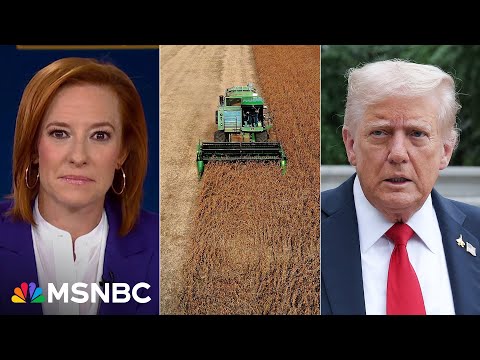
'A perfect storm of ugly': Trump's policies are devastating U.S. farmers
MSNBC· 2025-10-03 04:50
So, right now, as we monitor the impacts of the ongoing government shutdown, try to keep you all informed and updated, our nation's farmers, especially those who grow and export soybeans, are dealing with a crisis of their own. This all started with Trump's trade war with China. And I will get to that in a moment, I promise. But the way Treasury Secretary Scott Besson tells it, somehow Joe Biden, yes, the man who has not been president for eight months, is at fault here. At the meeting in Geneva, when I ask ...
China has not bought a bushel of soybeans from U.S. farmers this year. What happens to the crop now?
Yahoo Finance· 2025-10-02 20:19
Core Insights - The U.S. soybean industry is facing significant challenges due to retaliatory tariffs imposed by China, which have increased the overall duty rate on U.S. soybeans to 34% by 2025, making U.S. soybeans prohibitively expensive compared to South American supplies [1][2] - China has not purchased any U.S. soybeans for the 2025-26 marketing year, marking a drastic shift as it previously accounted for around 52% of U.S. soybean exports [3][12] - The U.S. is expected to lose soybean market share to South America permanently, as China increasingly sources soybeans from Brazil and Argentina due to lower prices [4][5] Tariffs and Market Dynamics - The combination of tariffs and trade wars has blunted the competitive advantage of U.S. soybean growers, leading to a significant decline in exports to China [2][3] - U.S. soybean prices have been negatively impacted, with current prices around $10.13 per bushel, down from profitable levels of $14 to $15 [16] Shifts in Supply Chains - China has been building its reserve storage of soybeans, allowing it to reduce reliance on U.S. supplies [7] - Investment in Brazil's agricultural infrastructure by China has facilitated increased soybean production there, further diminishing U.S. market share [8] Domestic Demand and Biofuel - The U.S. biofuel program may help replace some lost soybean demand, with biomass-diesel production rising significantly from 1,471.7 million gallons a decade ago to 4,292.4 million gallons in 2023 [10][11] - However, the U.S. will not be able to fully compensate for the lost demand from China through domestic biofuel policies alone, as it will take years to build the necessary infrastructure [11] Economic Impact on Farmers - The lack of Chinese purchases is expected to create substantial losses for U.S. farmers, leading to storage issues and financial strain [13][15] - Input costs for farming have been rising, further squeezing profit margins for farmers [17]
When Will Watson Learn?
Yahoo Finance· 2025-10-02 10:10
Corn Market - The corn market showed new buying interest with December futures testing $4.10, reaching a high of $4.1925 overnight on low trade volume of 10,500 contracts [1] - The National Corn Index increased to $3.7450, up 1.25 cents from Tuesday, indicating slight upward pressure on cash bids [1] - December futures are currently priced at $4.1650, placing them in the lower 23% of their 5-year price distribution range based on weekly closes [1] - Open interest in corn increased by 22,000 contracts during the recent rally, suggesting that the price movement was not solely due to short-covering [1] Soybean Market - The soybean market remained near unchanged, with November futures showing a trading range of 6.0 cents and a volume of 15,300 contracts [3] - The National Soybean Index rose to $9.3350, up 13.25 cents, but there are concerns about the sustainability of this increase due to weakening basis in some areas [3] - The Index recorded its lowest monthly close since August 2020, raising questions about future price movements amid government shutdowns affecting sales announcements [3] Wheat Market - The wheat sub-sector was also near unchanged, with December SRW futures showing a trading range of 2.75 cents and a volume of 5,350 contracts [4] - The National SRW Index reported a daily gain of 3.0 cents, despite December futures closing lower, indicating potential discrepancies in market fundamentals [4] - Concerns arise regarding the reliability of National Indexes, as significant changes in cash prices and basis could indicate corrupted data affecting market analysis [4]
X @The Wall Street Journal
The Wall Street Journal· 2025-09-30 01:17
From @WSJopinion: Business spending dropped sharply in the second quarter. Blame the trade war, writes @MarkSkousen1. https://t.co/4tQqua8cKd ...
Opinion | Beneath the GDP, a Recession Warning
WSJ· 2025-09-28 20:40
Core Insights - Business spending experienced a significant decline in the second quarter, primarily attributed to the ongoing trade war [1] Group 1: Economic Impact - The trade war has led to a sharp decrease in business investment, indicating a negative impact on economic growth [1] - Companies are becoming increasingly cautious in their spending due to uncertainty surrounding trade policies [1] Group 2: Sector Analysis - Certain sectors are more affected by the decline in business spending, particularly those heavily reliant on exports [1] - The overall sentiment in the business community reflects concerns over future profitability and market stability due to trade tensions [1]