
Consumer Spending

Search documents
Mayfield: China’s chip crackdown isn’t a game changer for this bull market
CNBC Television· 2025-10-10 11:27
Got to start with that Nvidia news. The idea of uh Chinese regulators and the government cracking down on on chip imports of Nvidia's chips. Uh what that could mean for the broader markets especially considering the waiting of Nvidia.>> Yeah, I mean obviously it's not good news. I mean we we saw some of the the news uh about rare earths a couple days ago as well. I I think putting the screws uh to the US a little bit ahead of the next round of negotiations u makes a lot of sense.you know, as far as Nvidia, ...



‘Scarred’ Britons are afraid to spend, says Bank of England official
Yahoo Finance· 2025-10-09 13:58
Catherine Mann says interest rates should be held at their current level to combat inflation - Laura Zapata/Bloomberg' Britons “scarred” by years of high inflation are spending less and saving more, a Bank of England official has said. Catherine Mann, a member of the Bank of England’s Monetary Policy Committee (MPC), said real terms household spending had flatlined since the pandemic and blamed the “scarring” effects of “high and volatile inflation”. Speaking at a Resolution Foundation event, Ms Mann sa ...
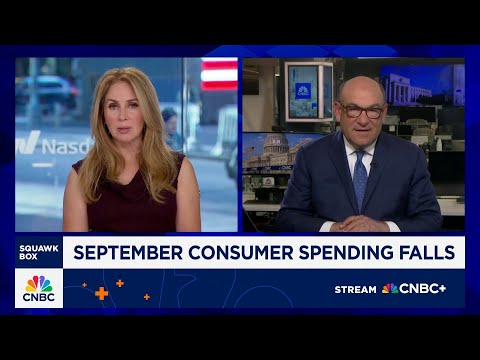
Consumer spending falls in September, CNBC/NRF Retail Monitor finds
CNBC Television· 2025-10-09 13:17
The CNBC NRF retail report is out right now. Steve Leeman joins us with the numbers. And Steve, what's the news.Good morning, Becky. Consumers hit the pause button in September after two months of uh good gains. According to the CNBC NRF Retail Monitor, hopes are that it's a pause that refreshes ahead of this approaching holiday season.Never too early to start thinking about that. The monitor, which is powered by real credit card spending data from Affinity Solutions, dropping 0.7% for total retail sales XO ...
Who’s going to ‘eat’ tariffs? Not US shoppers
The Economic Times· 2025-10-09 11:10
Core Insights - The article discusses the impact of rising import costs and tariffs on consumer behavior and retail sales during the crucial holiday shopping season, known as the Golden Quarter [1][2][20]. Retail Dynamics - Retailers are facing a challenging environment as they attempt to sell full-price merchandise while consumers are increasingly seeking deals due to higher prices [2][20]. - Companies like Nike Inc. and Elf Beauty Inc. have already raised prices, with Primark also adjusting prices in its US stores, indicating a broader trend of price increases across the retail sector [3][20]. - Walmart has reported rising costs each week as new supplies of imported goods arrive, reflecting the ongoing impact of tariffs on retail pricing [3][20]. Consumer Behavior - Despite a 3.5% increase in US retail sales in August, much of this was attributed to inflation, with underlying volume growth only at 0.4%, indicating a slowdown in consumer spending [5][20]. - Consumers have adapted to rising prices by employing strategies such as buying private label goods, shopping at discount stores, and purchasing in bulk to save money [9][10][12][21]. - Shoppers are also substituting more expensive items with cheaper alternatives, which could affect holiday spending patterns [13][21]. Sales Projections - Overall sales in the final quarter are expected to increase by only 3.1%, the lowest growth in five years, factoring in inflation with a US CPI of 2.9% in August [15][21]. - Retailers may need to increase promotions to move inventory, which could lead to greater discounting and reduced profit margins as they absorb more of the tariff burden [14][15][21]. Economic Influences - Higher-income consumers have seen improved financial conditions due to a strong stock market, which may benefit luxury brands like LVMH [17][21]. - Consumer behavior may also shift unexpectedly during tough economic times, leading to increased holiday spending despite caution [18][21]. - However, ongoing tariff-driven price increases into the new year may dampen consumer sentiment once credit card bills arrive [19][21].



跨资产简报 - 中国股市涨势是否可持续?5 分钟了解关键争论 -Cross-Asset Brief-Is the Rally in Chinese Equities Sustainable Key Debates In Under 5 Minutes – September 2025
2025-10-09 02:00
Summary of Key Points from the Conference Call Industry or Company Involved - The discussion primarily revolves around the **Chinese equities market** and broader **macro-economic trends** affecting various regions, including the **US** and **Japan**. Core Points and Arguments 1. **Sustainability of the Chinese Equity Rally** - The sustainability of earnings growth in China is promising, with critical sectors such as internet, tech, and pharma showing positive revision trends. The risk of significant misses in consensus earnings is decreasing, indicating stable or higher-than-expected growth in the coming months [24][25][26] 2. **US Dollar Outlook** - The expectation is for the DXY to weaken by approximately **7%**, driven by a combination of the USD's weakening and debates surrounding its safe-haven status. This could lead to increased attractiveness of FX-hedging USD assets [8] 3. **US Consumer Spending Trends** - Consumer spending is slowing, with nominal consumption forecasted to decelerate to **3.8%** in 2025 from **5.7%** in 2024. The spending is increasingly bifurcated, with upper-income groups driving resilient consumption while younger cohorts face challenges due to a weaker labor market and higher living costs [17][18] 4. **Impact of Fed Cuts on US Housing Market** - It is unlikely that another **5 Fed cuts** will revive the US housing market. A significant drop in primary rates (by **100bp or more**) is needed for a sustained increase in existing sales. Current affordability issues in the housing market persist, limiting the effectiveness of lower mortgage rates [21][24] 5. **Japanese Bonds and Fiscal Expansion** - Potential fiscal expansion in Japan is not expected to weigh heavily on Japanese bonds. The fiscal metrics have improved, and the fiscal term premium has retreated. Long-end JGBs may sell off if certain political candidates win, but no additional JGB issuance is anticipated [12][15] Other Important but Possibly Overlooked Content - The **China Earnings Revision Breadth (ERB)** is currently the highest among major markets, indicating a positive outlook for Chinese equities compared to the US [25] - The report highlights the importance of understanding the bifurcation in consumer spending, which could have implications for various sectors and investment strategies [17][18] - The analysts emphasize the need for investors to consider multiple factors in their investment decisions, as Morgan Stanley may have conflicts of interest due to its business relationships with covered companies [5][34]

X @The Wall Street Journal
The Wall Street Journal· 2025-10-08 13:06
Consumer Behavior - High-spending, low-risk consumers are consolidating multiple high-fee credit cards into a single card [1] Industry Strategy - Card issuers are competing to become the primary, indispensable credit card for consumers [1]
We will see services inflating faster than goods, says J. Rogers Kniffen WWE CEO
CNBC Television· 2025-10-07 13:14
Joining us with more on the retail landscape, Jan Niffin, J Rogers Niffin, worldwide CEO. Jan, it's great to see you. So, uh, following up on Courtney's point there, um, how do you see these these brands, these retailers managing tariffs right now.And do you think that's going to change going into the holiday season. What should consumers expect in terms of pricing, in terms of inventory selection. I think Courtney, you pretty well nailed it.We don't really see a lot getting passed through right this moment ...

X @The Wall Street Journal
The Wall Street Journal· 2025-10-07 00:38
Many high-spending, low-risk consumers with multiple high-fee credit cards are choosing just one of them, and card issuers seek to become the one card they can’t live without https://t.co/JvWLM7hcx5 ...
X @The Wall Street Journal
The Wall Street Journal· 2025-10-06 11:03
Consumer Behavior - High-spending, low-risk consumers are consolidating multiple high-fee credit cards into one [1] Credit Card Industry - Card issuers are competing to become the single, indispensable credit card for consumers [1]
5 Debt and Housing Metrics Investors Should Consider Before Buying S&P 500 Stocks at All-Time Highs
Yahoo Finance· 2025-10-05 22:20
Group 1 - The stock market does not fully represent the broader economy, as consumer spending is under significant pressure, particularly in the consumer discretionary and staples sectors [1] - Restaurant and retail stocks are experiencing substantial declines, while earnings for home improvement companies like Home Depot have been decreasing in recent years [1] - The Federal Reserve's interest rate cuts may benefit consumer spending, but a quick recovery is not anticipated [2] Group 2 - Rising credit card debt and high mortgage interest rates are straining consumers, with a concerning increase in credit card debt observed in recent years [5][6] - The financial health of U.S. households can be likened to assessing a company's balance sheet, where high debt levels limit spending capacity [6] - The housing market is facing a prolonged period of unaffordability, as indicated by metrics such as the Case-Shiller Housing Index, which shows elevated home prices [7]