Net Interest Margin

Search documents
Great Southern Bancorp(GSBC) - 2025 Q2 - Earnings Call Transcript
2025-07-17 20:00
Financial Data and Key Metrics Changes - The company reported net income of $19,800,000 for Q2 2025, an increase from $17,000,000 in the same quarter last year, translating to $1.72 per share compared to $1.45 per share previously [5][12] - Net interest income rose to $51,000,000, an 8.9% increase from $46,800,000 a year ago, with an annualized net interest margin improving to 3.68%, up 25 basis points from the previous year [7][12] - Non-interest income decreased to $8,200,000, down 16.5% from the prior year, primarily due to unusual items affecting both periods [14][15] Business Line Data and Key Metrics Changes - Gross loans totaled $4,600,000,000, a decline of 3.3% from the previous year, with significant payoffs impacting the loan portfolio [7][8] - The largest loan categories remained multifamily and commercial real estate lending, with outstanding construction loans at $367,000,000 [8] - Non-performing assets were $8,100,000, representing 0.14% of total assets, with no provision for credit losses recorded [9][20] Market Data and Key Metrics Changes - Total deposits decreased by $73,900,000 or 1.6% from the previous quarter, but increased by $78,600,000 or 1.7% compared to the end of 2024 [8][19] - The company experienced a reduction in brokered deposits, which contributed to the overall decrease in total deposits [8][19] Company Strategy and Development Direction - The company emphasized maintaining strong credit quality while pursuing relationship-driven loan growth to support long-term stability [11][21] - There is a focus on prudent risk management and disciplined expense management to enhance financial resilience [6][10] Management's Comments on Operating Environment and Future Outlook - Management expressed optimism for long-term growth but acknowledged a competitive lending environment with limited opportunities [26] - The company plans to continue managing expenses carefully, with some potential increases in technology-related costs anticipated [31][32] Other Important Information - The company redeemed $75,000,000 in subordinated notes to save on future interest costs [21] - A new stock repurchase authorization for an additional 1,000,000 shares was approved, with nearly 176,000 shares repurchased in Q2 2025 [22] Q&A Session Summary Question: Loan growth outlook for the second half of the year - Management is optimistic long-term but noted a competitive environment with limited origination opportunities in the near term [26][27] Question: Expected loan payoffs - Payoffs are unpredictable, and while there was a significant payoff in Q2, future payoffs are difficult to forecast [28][29] Question: Expense control for the second half of the year - Management expects expenses to remain consistent, with some minor increases due to technology investments and potential adjustments in compensation costs [30][31] Question: Rental income expectations - Rental income increased due to a larger OREO balance, and similar levels are expected unless leases expire [39][42] Question: Margin sustainability - Management indicated that while there may be slight improvements in margin, the termination of the interest rate swap in Q4 will present challenges [43][46]

Fifth Third Q2 Earnings Top Estimates on Higher NII & Fee Income
ZACKS· 2025-07-17 17:41
Core Insights - Fifth Third Bancorp (FITB) reported second-quarter 2025 adjusted earnings per share (EPS) of 9 cents, which was below the Zacks Consensus Estimate of 87 cents and down from 86 cents in the prior-year quarter [1][2][8] - The results were positively impacted by an increase in net interest income (NII), fee income, and loan balances, but faced challenges from higher expenses and deteriorating asset quality [1][8] Financial Performance - Total quarterly revenues reached $2.25 billion, marking a 7.7% year-over-year increase and surpassing the Zacks Consensus Estimate by 1.8% [3] - NII (on a fully taxable equivalent basis) was $1.5 billion, up 7.6% year over year, exceeding the estimate of $1.48 billion [3] - The net interest margin (on an FTE basis) improved to 3.12% from 2.88% year over year, surpassing the estimate of 3.05% [3] - Non-interest income rose 7.9% year over year to $750 million, driven by increases in wealth and asset management revenues and consumer banking fees, exceeding the estimate of $721.6 million [4] - Non-interest expenses increased 3.5% year over year to $1.26 billion, primarily due to rising costs across all components except occupancy and other non-interest income, slightly below the estimate of $1.27 billion [4] Credit Quality - The provision for credit losses was reported at $173 million, a significant increase of 78% from the previous year, exceeding the estimate of $149.1 million [5] - Total non-performing portfolio loans and leases rose to $886 million, up 37.8% year over year [5] - Net charge-offs increased to $139 million or 0.45% of average loans and leases on an annualized basis, down from $144 million or 0.49% in the prior-year quarter, slightly below the estimate of $145.3 million [6] - The total allowance for credit losses increased by 5.5% to $2.56 billion year over year, surpassing the estimate of $2.53 billion [6] Capital Position - The Tier 1 risk-based capital ratio was reported at 11.83%, down from 11.93% in the prior-year quarter [7] - The CET1 capital ratio decreased to 10.56% from 10.62% year over year [7] - The leverage ratio improved to 9.42% compared to 9.07% in the year-ago quarter [7] Strategic Outlook - The rise in NII, driven by loan growth, deposit rate management, and fixed-rate asset repricing, supported top-line growth [9] - Strategic acquisitions have diversified Fifth Third's revenue sources, which is expected to aid future top-line growth [9] - However, higher expenses and weak asset quality remain concerns in the near term [9]



Bank7(BSVN) - 2025 Q2 - Earnings Call Presentation
2025-07-17 14:00
Financial Performance - Total assets increased to $1835965 thousand, a 28% increase from the previous quarter[2] - Total loans reached $1497356 thousand, reflecting a 52% growth[2] - Total deposits amounted to $1594138 thousand, up by 28%[2] - Net income rose to $11105 thousand, a 74% increase[2] - Diluted earnings per share increased to $116, a 74% increase[2] Balance Sheet & Capital Management - Cash + unpledged securities + undrawn credit totaled $75714 million, providing 262x coverage of adjusted uninsured deposits of $28909 million[5] - Loans repricing in ≤1 year: $126 billion (8431%), with $108 billion (7192%) repricing daily[5] - The bank's CET1 ratio is 1389%, Tier 1 Leverage is 1249%, and TCE/TA is 1205%, all significantly above regulatory thresholds[5] Loan Portfolio - Variable-rate loans constitute 75% ($11263 million) of the loan portfolio, while fixed-rate loans account for 25% ($3737 million)[45] - Nonperforming loans to total loans ratio is 037%[5] - The loan portfolio has grown at a CAGR of 138% since 2020[57]

Zacks Initiates Coverage of Waterstone Financial With Neutral Recommendation
ZACKS· 2025-07-16 16:21
Core Viewpoint - Zacks Investment Research has initiated coverage of Waterstone Financial, Inc. (WSBF) with a Neutral recommendation, indicating a balanced outlook for the company despite its capital strength and earnings stability, due to several risk factors and operational inefficiencies limiting near-term upside potential [1] Financial Strength - Waterstone's financial foundation is robust, with a Common Equity Tier 1 (CET1) capital ratio of 20.32% and a Total Capital Ratio of 21.40% as of March 2025, significantly exceeding regulatory minimums [2] - The company offers a consistent dividend yield of 4.4%, above the industry average, with the most recent quarterly dividend of 15 cents per share declared in June [2] Performance Metrics - Improvements in net interest margin from 2.15% in Q1 2024 to 2.47% in Q1 2025 reflect effective asset-liability management and lower borrowing costs [3] - Interest-earning asset yields rose to 5.46%, while reliance on higher-cost Federal Home Loan Bank borrowings has significantly declined [3] Liquidity Position - As of March 31, 2025, Waterstone holds $43.3 million in cash and has $377 million in unused FHLB borrowing capacity, indicating a strong liquidity position [4] - The deposit base continues to expand, particularly in time deposits, providing flexibility in funding and pricing strategies [4] Challenges - The Mortgage Banking segment reported a $1.6 million loss in Q1, reversing a profit from the same period last year, driven by a 20% decline in loan originations [5] - The company has $21.8 million in unrealized losses on its securities portfolio, primarily in government-sponsored mortgage-backed securities, which could impact book value if interest rates rise [5] Credit Quality - Substandard commercial real estate loans are elevated at $11.9 million, with collateral-dependent loans rising sharply to $17.5 million, indicating potential pressure in the CRE segment [6] - Nonaccrual loans increased to $7.4 million, highlighting concerns regarding credit quality trends [6] Market Sentiment - Waterstone's share price has underperformed compared to peers and the broader market, reflecting tepid investor sentiment [7] - Trading multiples suggest the stock is not overvalued but do not indicate a compelling discount, with the market pricing in a stable but limited growth trajectory [7]


Loan Growth, Higher Rates to Support Truist's Q2 Earnings
ZACKS· 2025-07-15 16:21
Core Insights - Truist Financial (TFC) is set to announce its second-quarter 2025 results on July 18, with a positive lending environment despite macroeconomic uncertainties [1] Lending and Loan Growth - Strong growth in commercial and industrial (C&I) loans, which make up nearly 50% of TFC's total loans, alongside decent demand for consumer loans, accounting for almost 40% of total loans [2] - The consensus estimate for TFC's average earning assets in Q2 is $478.4 billion, reflecting a slight increase from the previous year [3] Net Interest Income and Margins - The Federal Reserve maintained interest rates at 4.25-4.5%, which is expected to positively impact TFC's net interest income (NII) and net interest margin due to higher rates and loan growth [4] - The consensus estimate for Q2 NII is $3.58 billion, indicating a 1.4% year-over-year increase [4] Non-Interest Income Estimates - Service charges on deposits are estimated at $234 million, showing a marginal rise from the previous year, while card and payment-related fees are expected to decline by 2.2% to $225 million [6] - Mortgage banking income is projected to rise significantly, with a consensus estimate of $113 million, reflecting a 34.5% increase year-over-year [7] Fee Income and Expenses - Investment banking and trading income is estimated at $266 million, indicating a 7% year-over-year decline, while lending-related fees are expected to rise by 4.5% to $93 million [8][9] - Total non-interest income is projected at $1.41 billion, showing growth from the prior year [10] Cost and Expense Projections - Non-interest expenses are anticipated to rise by 5.5% year-over-year, with total adjusted non-interest expenses estimated at $2.96 billion [13] - Management expects adjusted expenses to increase by 2-3% sequentially due to higher personnel costs [13] Asset Quality and Credit Losses - TFC is likely to have set aside significant provisions for potential delinquent loans, with an estimated provision for credit losses of $407.9 million, reflecting a 9.6% year-over-year decline [14] - The consensus estimate for total non-accrual loans and leases is $1.56 billion, suggesting a 9.6% year-over-year increase [15] Earnings and Sales Expectations - The consensus estimate for TFC's earnings is 92 cents per share, indicating a 1.1% rise from the previous year, while sales are projected at $4.98 billion, reflecting a marginal year-over-year increase [17]


2 Consumer Loan Stocks Showing Promise Despite Industry Headwinds
ZACKS· 2025-07-15 14:26
Industry Overview - The Zacks Consumer Loans industry includes companies providing various loan products such as mortgages, credit card loans, and personal loans, which are crucial for generating net interest income (NII) [3] - The industry's performance is highly sensitive to the overall economic conditions and consumer sentiments, with many providers also engaging in commercial lending and asset recovery to diversify revenue sources [3] Key Influencing Factors - **Asset Quality**: Prolonged high interest rates are affecting borrowers' repayment capacity, leading to increased reserves by loan providers to mitigate rising defaults, which is deteriorating asset quality [4] - **Interest Rates & Loan Demand**: Steady interest rates have slightly improved loan demand, but consumer confidence remains low due to tariff-related uncertainties, limiting growth in net interest margin (NIM) and NII [5] - **Lending Standards**: Improved credit scores due to the removal of tax liens from credit reports have expanded the borrower pool, while relaxed lending standards are helping meet loan demand [6] Industry Performance - The Zacks Consumer Loans industry has a Zacks Industry Rank of 155, placing it in the bottom 37% of over 250 Zacks industries, indicating underperformance in the near term [7][8] - Analysts have revised the industry's earnings estimates for the current year down by 7.9%, reflecting a loss of confidence in earnings growth potential [9] Market Comparison - Over the past two years, the Zacks Consumer Loans industry has outperformed the Zacks S&P 500 composite and the Zacks Finance sector, with a collective stock increase of 68.3% compared to 39.5% and 42% respectively [11] Valuation Metrics - The industry has a trailing 12-month price-to-tangible book ratio (P/TBV) of 1.33X, above the five-year median of 1.03X, but significantly lower than the S&P 500's ratio of 13.33X [14][16] Investment Opportunities - **Capital One Financial Corporation (COF)**: Focused on consumer and commercial lending, COF is well-positioned for growth with a market cap of $141.3 billion and expected earnings growth of 10.7% and 20% for 2025 and 2026 respectively [21][20] - **Enova International, Inc. (ENVA)**: A financial technology company with a market cap of $2.94 billion, ENVA has seen a 20.7% increase in shares this year and is expected to grow earnings by 28.9% and 17.6% in 2025 and 2026 respectively [26][25]



Fed's extended rate hike campaign is expanding banks' net interest margins: Argus Research's Biggar
CNBC Television· 2025-07-15 14:10
Financial Performance - Banks are expected to report good results, with upward rerating in stocks justified by improved macro environment [2] - Loan growth is decent at about 3% for both commercial industrial and consumer [3] - Higher for longer interest rates have resulted in some upward repricing on securities [3] - 3% loan growth can translate into 5% to 6% net interest income growth [3] Macroeconomic Factors - Deregulatory environment is constructive for banks [2] - Employment is healthy, which is a significant determinant for delinquencies and loan loss provisions [4] - The shock factor of tariffs has abated, with companies finding ways to navigate the tariff environment [6] Potential Risks and Opportunities - Uncertainty from tariffs could result in more moderate loan growth and pause on expansion plans [7] - Trade finance might be negatively impacted by tariffs [7] - IPO and M&A activity could be much stronger in the absence of tariff conversations [7] - Potential for rebound in capital markets generally [7]
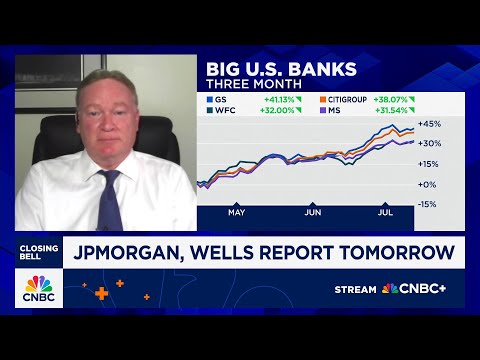
RBC's Cassidy expects median EPS and capital markets revenue to grow in this round of bank eanrings
CNBC Television· 2025-07-14 22:07
Market Expectations & Potential Catalysts - Optimism is high for large-cap banks' Q2 earnings, with focus on loan growth and investment banking activity in the second half of the year [2][3] - IPO market recovery is seen as a potential catalyst for investment banks [3] - High valuations (e g, Bank of America trading at a PE of around 15) suggest caution going into earnings announcements [4] - Regulatory changes are a significant driver for bank stock movements this year [6] Key Metrics & Risk Factors - Net interest income growth, impacted by net interest margin, is a key focus [9] - Credit quality remains generally good, but commercial real estate office market and low FICO score consumers are potential areas of concern [8] - Risk-on sentiment suggests less concern about credit picture, while risk-off would increase focus on credit [7][8] Mergers and Acquisitions - Industry expects consolidation among regional banks due to deregulation [13] - The top 5-7 banks control 85-90% of the assets, with smaller banks controlling the rest, indicating increased polarization in banking [14] - Potential for big regionals to merge or be acquired by G-SIBs exists [15] - Clarity on Basel III endgame proposal is needed before M&A activity accelerates [15] Leadership Transition - Jamie Dimon's leadership has significantly impacted JP Morgan's stock [10] - Jamie Dimon's eventual retirement will likely negatively impact the stock on the day of the announcement [12] - Marianne Lake is considered a potential successor to Jamie Dimon [11]


Schwab Stock Touches 52-Week High: Is This the Right Time to Buy SCHW?
ZACKS· 2025-07-08 16:01
Core Viewpoint - Charles Schwab (SCHW) has reached a 52-week high of $92.65, with a 23.1% gain over the past three months, outperforming the Zacks Finance sector and the S&P 500, but underperforming the industry and Robinhood Markets, Inc. [1][9] Group 1: Revenue Drivers - Increased market volatility due to tariff policy concerns is expected to drive Schwab's trading revenues, benefiting from heightened market participation [3][4] - Schwab's acquisitions, including TD Ameritrade and USAA's Investment Management Company, have strengthened its position and diversified revenues, supporting top-line expansion [5] - The company's total client assets reached $10.35 trillion as of May 31, 2025, with a five-year CAGR of 20.1%, driven by acquisitions and market appreciation [6] Group 2: Financial Performance - Schwab's total net revenues have experienced a CAGR of 12.8% over the past five years, with managed investing solutions revenues growing at a CAGR of 12.2% [7] - The Federal Reserve's unchanged interest rates are likely to aid Schwab's net interest margin (NIM) and net interest revenue (NIR) expansion, with NIM increasing to 2.12% in 2024 from 1.98% in 2023 [10][11] - As of March 31, 2025, Schwab's cash and cash equivalents were $35 billion, and total debt was $39.9 billion, supporting its low-cost capital structure and capital distributions [13] Group 3: Shareholder Returns - Schwab announced an 8% increase in its quarterly dividend to 27 cents per share in January 2025, having raised dividends four times in the past five years [14] - The company has a share repurchase program with approximately $7.2 billion in authorization remaining as of March 31, 2025 [14] Group 4: Future Outlook - The Zacks Consensus Estimate for earnings is projected at $4.28 and $5.06 per share for 2025 and 2026, respectively, indicating growth of 31.7% for 2025 and 18.3% for 2026 [15] - Despite rising operating expenses, the company is expected to benefit from tariff policy concerns and higher interest rates, making Schwab a favorable investment option [18]


Capital One Hits 52-Week High: Should You Buy the Stock Now?
ZACKS· 2025-07-01 14:45
Core Insights - Capital One Financial Corporation (COF) shares reached a 52-week high of $215.62 after passing the Federal Reserve's 2025 stress test, indicating strong capital reserves to absorb significant losses [1][8] Stock Performance - Over the past three months, COF stock has increased by 16.8%, outperforming the industry growth of 11.5% and the S&P 500 Index's 9% [2] Growth Drivers - The company has pursued a robust inorganic expansion strategy, including the acquisition of Discover Financial for $35.3 billion and Velocity Black in 2023, enhancing shareholder value [5] - COF's total revenues have shown a five-year compound annual growth rate (CAGR) of 6.5% from 2019 to 2024, with continued growth momentum into the first quarter of 2025 [6] - The Domestic Credit Card division, which represents 94.9% of credit card net revenues, has seen improvements in loans held for investment, indicating strong growth opportunities [11] - The net interest margin (NIM) has increased from 6.63% in 2023 to 6.88% in 2024, benefiting from high rates and steady demand for credit card loans [12] - As of March 31, 2025, Capital One's total debt was $41.8 billion, with cash and cash equivalents at $48.6 billion, indicating a strong liquidity position [13] Challenges - COF has experienced a rising expense base, with a CAGR of 6.8% over the last five years, primarily due to increased marketing costs and inflation [16] - The provision for credit losses has increased with a CAGR of 13.4% from 2019 to 2024, reflecting deteriorating asset quality amid a challenging macroeconomic environment [20] Earnings Outlook - Analysts have revised earnings estimates for 2025 and 2026 upward by 16.9% and 4.7%, respectively, indicating optimism about the company's growth potential [22] - The estimated year-over-year growth rates for earnings are 5.8% for 2025 and 27.4% for 2026 [22] Valuation - COF stock has a P/E (F1) ratio of 14.41, which is higher than the industry's 11.51, suggesting that the stock may be trading at a premium [26]