Quantum Computing

Search documents
Quantum Computing Inc. to Participate in the 2026 Cantor Global Technology & Industrial Growth Conference
Prnewswire· 2026-03-06 13:30
Core Viewpoint - Quantum Computing Inc. (QCi) is participating in the 2026 Cantor Global Technology & Industrial Growth Conference, highlighting its commitment to advancing quantum technology and engaging with investors [1] Group 1: Conference Participation - Dr. Yuping Huang, CEO, and Chris Roberts, CFO, will attend the conference in New York City on March 10-11, 2026 [1] - Dr. Huang will participate in quantum panels on March 10 at 3:50 PM ET and March 11 at 3:30 PM ET [1] - Management will be available for one-on-one meetings during the conference, encouraging investor engagement [1] Group 2: Company Overview - Quantum Computing Inc. is a technology company focused on quantum optics and integrated photonics, providing accessible and affordable quantum machines and TFLN foundry services [1] - The company's products are designed to operate at room temperature and low power, making them cost-effective [1] - QCi's technology portfolio includes capabilities in high-performance computing, artificial intelligence, cybersecurity, and remote sensing applications [1] Group 3: Recent Developments - Through the acquisition of Luminar Semiconductor, QCi has accelerated its technology roadmap and expanded its manufacturing capabilities and product portfolio [1]




Earnings From Quantum Pure-Plays Like IonQ Have Wall Street Salivating Over Their Growth Prospects
Barrons· 2026-03-06 12:33
Core Insights - Analysts express optimism regarding the growth prospects for IonQ, D-Wave Quantum, and Rigetti Computing [1] Company Summaries - IonQ is viewed positively by analysts, indicating strong potential for future growth [1] - D-Wave Quantum is also highlighted as having favorable growth prospects, suggesting a positive outlook for its business model and technology [1] - Rigetti Computing is included in the list of companies with optimistic growth expectations, reflecting confidence in its strategic direction and market position [1]

SuperQ Quantum CEO Dr. Muhammad Khan Appointed as Forbes Business Council Member Leader to Drive Global Cybersecurity Strategy
TMX Newsfile· 2026-03-06 12:00
Core Insights - SuperQ Quantum Computing Inc. has announced the appointment of Dr. Muhammad Ali Khan as a Member Leader within the Forbes Business Council, focusing on Cybersecurity in the Quantum-AI era [1][2][3] Company Developments - Dr. Khan's leadership role will involve steering discussions on quantum-resistant security and the implementation of guard rails for autonomous AI applications [2] - The appointment follows SuperQ's successful debut of ChatQLM at CES 2026, marking a significant step in the transition from experimental quantum technology to practical consumer applications [3] - SuperQ aims to democratize complex computational power, positioning itself as a leader in the "Quantum Utility" era [3][4] Leadership and Expertise - Dr. Khan has a distinguished background as a Silicon Valley entrepreneur and researcher, with accolades including being a Rhodes Scholar and contributions to bridging theoretical science with industrial applications [4] - His insights will focus on the "Sovereign-by-Design" philosophy, which aims to help enterprises secure data against quantum threats while leveraging AI for immediate returns on investment [4] Industry Perspective - Dr. Khan emphasizes that quantum computing is a current asset class rather than a future concept, aiming to guide businesses through the transition from predictive AI to prescriptive quantum optimization [5] - SuperQ is committed to reducing barriers to quantum and supercomputing commercialization, targeting enterprise transformation and consumer adoption through its flagship Super™ platform [5][6] Strategic Initiatives - The Super™ platform is designed to make advanced computational power accessible, enabling various sectors such as finance, healthcare, and defense to achieve immediate business impacts [6] - SuperQ is expanding its international presence, establishing Super Hubs in key regions including the US, Middle East, and Asia [6][10]

美国 IT 硬件:2026 年 TMT 论坛要点-US IT Hardware Takeaways from the 2026 TMT Forum
2026-03-06 02:02
Summary of Key Points from the 2026 TMT Forum on U.S. IT Hardware Industry Overview - The report covers the U.S. IT Hardware industry, focusing on companies such as Sandisk (SNDK), Seagate (STX), Everpure (PSTG), Rigetti Computing (RGTI), Logitech (LOGI), and Arista Networks (ANET) [1] Company-Specific Insights Sandisk (SNDK) - Sandisk is optimizing long-term profits by securing elevated pricing through Long-Term Agreements (LTAs), which enhance demand visibility and stabilize supply [2][8] - The shift in NAND demand from consumer markets to data centers is leading to clearer demand signals from customers, allowing for better forecasting [9] - Management is confident in mid-to-high-teens bit supply growth, despite concerns about Chinese competitors [10] - Progress on High Bandwidth Flash (HBF) is notable, with expectations for it to bridge performance gaps in AI inference workloads [11] Seagate (STX) - Seagate is pursuing a stable pricing strategy, with expectations for HDD exabyte growth to sustain a mid-20s CAGR over the next 3-5 years [3][12] - Management believes that NAND price inflation will not significantly shift demand back to HDDs, as cloud infrastructure has separated storage needs [13] - The company anticipates average price per terabyte to remain flat to slightly up for CY26, with pricing discussions already underway for CY27 [13] Everpure (PSTG) - Everpure is targeting the hyperscaler market with its DirectFlash technology, which offers significant price-performance improvements over traditional SSDs [4][17] - The company expects double-digit exabyte shipments in 2026, with gross margins projected between 75% and 85% for hyperscaler products [17] Rigetti Computing (RGTI) - Rigetti emphasizes superconducting qubits as the best approach for quantum computing, with a multi-chiplet strategy to enhance yield and performance [5][18] - The company sees quantum computing as a long-term opportunity, with commercial applications expected around 2029 [5][19] - Rigetti's architecture focuses on chiplet-based systems, which improve yield and reduce costs compared to monolithic designs [20] Logitech (LOGI) - Logitech's growth is driven by the existing PC installed base and increasing attach rates for peripherals, rather than new PC sales [6][27] - The company is expanding its B2B segment, particularly in video collaboration, aiming for a balanced revenue mix between consumer and enterprise [28][29] - Logitech's innovation strategy includes significant R&D investment, leading to a consistent launch of new products [31] Arista Networks (ANET) - Arista views AI as a major opportunity, with Ethernet becoming essential for AI networking across various applications [32][33] - The company is expanding its cloud-based architectural model into enterprise markets, focusing on reliability and automation [34] - Arista is managing supply chain constraints effectively, which supports its growth in AI networking [35] Additional Insights - The report highlights the importance of technological advancements and strategic positioning in the evolving IT hardware landscape, particularly in response to AI and data center demands [1][32] - Companies are focusing on long-term agreements and innovative technologies to mitigate cyclical downturns and enhance profitability [2][9][10][12][17] This summary encapsulates the key findings and insights from the 2026 TMT Forum, providing a comprehensive overview of the U.S. IT Hardware industry and the strategic directions of key players.

Fireside Chat with Xanadu Founder & CEO Christian Weedbrook, Mar 11 at 2PM ET
Yahoo Finance· 2026-03-05 21:10
Core Insights - Xanadu is a Canadian quantum computing company aiming to create accessible and useful quantum computers, founded in 2016 and currently valued at $3.1 billion [3][5] - The company is recognized for its development of PennyLane, an open-source software library for quantum computing [3] - A fireside chat featuring CEO Christian Weedbrook will discuss Xanadu's journey, the SPAC deal with Crane Harbor Acquisition Corp., and predictions for quantum breakthroughs by 2026 [2][5] Company Overview - Xanadu specializes in quantum hardware and software, positioning itself as a leader in the quantum computing industry [3] - The company has a mission to democratize quantum computing technology for widespread use [3] Leadership Profile - Christian Weedbrook, the founder and CEO of Xanadu, has extensive experience in quantum computing, including a postdoctoral fellowship at MIT and the University of Toronto [5][6] - Weedbrook's background includes over a decade of experience in industry, government, and research related to quantum technologies [6] Industry Context - The SPAC deal with Crane Harbor Acquisition Corp. is significant for the quantum computing sector, indicating growing interest and investment in this technology [5] - Predictions suggest that quantum breakthroughs will impact various industries by 2026, highlighting the potential for transformative advancements [5]
D-Wave (QBTS) CEO on Earnings, Quantum Computing Profits & Acquisitions
Youtube· 2026-03-05 21:01
Company Performance - D-Wave Quantum reported a revenue of $24.6 million for 2025, marking a 179% increase over 2024 [1][2] - The company ended 2025 with over $850 million in cash and has already secured over $32 million in new sales bookings in the first two months of 2026, surpassing total bookings for all of last year [2][3] Product Development - D-Wave launched its latest generation of quantum computers, the Advantage 2, which can solve real-world problems that classical computers cannot [4] - The company has also introduced new software to support its quantum systems, enhancing the ability to solve complex computational problems more efficiently than classical systems [4] Strategic Positioning - D-Wave is recognized as a leader in both annealing quantum computing and gate model quantum computing, following the acquisition of Quantum Circuits, a spin-out from Yale University [5][6] - This dual platform strategy positions D-Wave as a one-stop shop for quantum computing, capable of addressing a full range of customer use cases [6] Financial Stability - Analysts suggest that D-Wave is in a stronger financial position compared to competitors, as it does not need to rely heavily on public markets for funding [7][8] - While the company is not yet profitable, it is on a positive trajectory towards achieving profitability [8] Future Outlook - D-Wave is optimistic about the timeline for general use quantum computing, estimating that commercial gate model systems could be available in 5 to 7 years, which is more optimistic than the 10 to 20 years suggested by others [9][10]


Evercore ISI Lowers its Price Target on D-Wave Quantum Inc. (QBTS) to $42 and Maintains an Outperform Rating
Yahoo Finance· 2026-03-05 20:28
Core Insights - D-Wave Quantum Inc. (NYSE: QBTS) is recognized as one of the 10 fastest-growing stocks on the NYSE, indicating strong market interest and potential for growth [1]. Financial Performance - For Q4 2025, D-Wave reported an adjusted EPS of (9 cents), which was below the consensus estimate of (6 cents) [3]. - The company's Q4 revenue was $2.75 million, falling short of the consensus estimate of $3.74 million [3]. - Bookings for Q4 totaled $13.4 million, showcasing a significant aspect of the company's sales performance [3]. Management Commentary - CEO Alan Baratz highlighted 2025 as a transformative year for D-Wave, noting growth in revenue, bookings, technical milestones, and scientific breakthroughs [3]. - Baratz mentioned that the company is entering 2026 with "exceptional momentum," having generated over $30 million in bookings in January alone [3]. - The acquisition of Quantum Circuits, Inc. and securing an eight-figure enterprise QCaaS agreement were emphasized as key developments that reflect growing customer confidence [3]. Analyst Ratings - Evercore ISI analyst Mark Lipacis lowered the price target for D-Wave to $42 from $44 while maintaining an Outperform rating [2]. - Mizuho analyst Vijay Rakesh also reduced the price target to $40 from $46, keeping an Outperform rating after the earnings report [2].
IBM and University Researchers Create a Never-Before-Seen Molecule and Prove its Exotic Nature with Quantum Computing
Prnewswire· 2026-03-05 19:00
Core Insights - An international team of scientists from IBM and several universities has created and characterized a novel molecule with a half-Möbius electronic topology, marking a significant advancement in both chemistry and quantum computing [1][2] Group 1: Discovery and Characteristics - The newly synthesized molecule, CCl, exhibits a unique electronic structure where electrons travel in a corkscrew-like pattern, fundamentally altering its chemical behavior [1] - This is the first experimental observation of a half-Möbius electronic topology in a single molecule, which has never been synthesized or predicted before [1] - The molecule can be reversibly switched between different states, demonstrating that electronic topology can be deliberately engineered [1] Group 2: Quantum Computing Contribution - The research highlights the capability of quantum computers to simulate complex molecular behaviors that classical computers struggle to model, particularly due to the entangled interactions of electrons [1][2] - Utilizing IBM's quantum computer, the team was able to explore configurations involving 32 electrons, showcasing the potential of quantum hardware in advancing scientific research [2] - The integration of quantum processing units (QPUs) with classical computing resources allows for solving complex problems more efficiently than traditional methods [1] Group 3: Implications for Future Research - The discovery opens new avenues for controlling material properties through topology, similar to how spintronics transformed data storage [2] - The rapid advancement of quantum hardware suggests that this research is just the beginning, with future potential for exploring even more complex molecular systems [2] - The findings contribute to IBM's legacy in nanoscale science and highlight the company's ongoing commitment to innovation in quantum computing and material science [1]


X @TylerD 🧙♂️
TylerD 🧙♂️· 2026-03-05 17:31
Chicago going QuantumPsiQuantum (@PsiQuantum):For decades, America's industrial might was forged at the U.S. Steel South Works site in Chicago.Today, steel beams are rising once again at the Illinois Quantum and Microelectronics Park, where PsiQuantum will deploy America's first utility-scale quantum computer.A https://t.co/1SuR1mPkQH ...
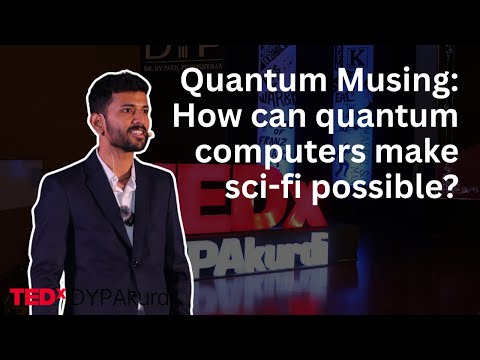
Quantum Musing: how can Quantum computers make sci-fi possible? | Rajan Chopra | TEDxDYPAkurdi
TEDx Talks· 2026-03-05 16:42
हेलो एवरीवन। हमारा दिमाग, हमारी इंट्यूशन हमें तो बस हजारों फैसले लेने में मदद करती है। बट आज यहां पे मैं एक छोटी सी स्टोरी सुनाने आया हूं। बस एक छोटा सा डिसीजन लेना आप। एक ऐसी सिचुएशन जिसमें यही इंट्यूशन शायद हमारी सबसे बड़ी दुश्मन बन जाने वाली है। इमेजिन करो एक ऐसी जानलेवा बीमारी फैल रही है जिसको सॉल्व करने के लिए जिसका इलाज ढूंढने के लिए हमने बहुत पावरफुल सुपर कंप्यूटर में प्रोग्राम को रन किया है। चल रहा है धीरे-धीरे। हमारे पास दो ऑप्शन एक बहुत बड़ा डिसीजन लेना आप। पहला ऑप्शन है कि हम प्रोग्राम को आज ही र ...