
Monetary Policy

Search documents
Dollar Recovers as EUR/USD Weakens
Yahoo Finance· 2025-12-18 15:37
Currency Market Overview - The dollar index (DXY00) increased by +0.09%, recovering from early losses due to Eurozone fiscal concerns impacting EUR/USD [1] - The dollar found support as US weekly jobless claims fell to 224,000, close to expectations of 225,000 [3] - The dollar initially declined due to weaker-than-expected US reports on November CPI and December Philadelphia Fed business outlook survey [1][3] Federal Reserve Actions - The Federal Reserve is increasing liquidity in the financial system by purchasing $40 billion a month in T-bills, which is putting pressure on the dollar [2] - There are concerns regarding President Trump's potential appointment of a dovish Fed Chair, which could be bearish for the dollar [2] Economic Indicators - The US November CPI rose by +2.7% year-on-year, which was weaker than the expected +3.1% [3] - The November core CPI increased by +2.6% year-on-year, also below expectations of +3.0%, marking the smallest pace of increase in 4.5 years [3] - The December Philadelphia Fed business outlook survey unexpectedly fell by -8.5 to -10.2, contrary to expectations of an increase to 2.3 [3] Market Expectations - Markets are pricing in a 27% chance that the FOMC will cut the fed funds target range by 25 basis points at the upcoming January 27-28 meeting [4] Eurozone Economic Concerns - The euro (EUR/USD) decreased by -0.20% as ECB officials indicated that the cycle of interest rate cuts is likely finished based on growth and inflation outlooks [5] - Fiscal concerns in the Eurozone are heightened after Germany announced plans to increase federal debt sales by nearly 20% to a record 512 billion euros ($601 billion) to fund increased government spending [5]
美国11月CPI意外偏低 分析师观点分化:数据偏软支撑降息 但需警惕政府停摆影响
Zhi Tong Cai Jing· 2025-12-18 15:16
Core Insights - The November inflation data in the U.S. significantly underperformed market expectations, with the Consumer Price Index (CPI) rising by 2.7% year-on-year, compared to the anticipated 3.1% [1] - The core CPI, excluding food and energy, increased by 2.6%, down from 3.0% in September, indicating a further easing of inflationary pressures [1] - Financial markets reacted positively, with major indices rising, U.S. Treasury yields declining, and the dollar index weakening [1] Group 1: Economic Analysis - Brian Jacobsen from Annex Wealth Management noted that housing inflation, a major component of CPI, has significantly slowed down, suggesting that previous inflation drivers are no longer central to current inflation [2] - Peter Cardillo from Spartan Capital Securities highlighted that the drop in core inflation to 2.6% and overall inflation to 2.7% is favorable for both the Federal Reserve and financial markets, potentially paving the way for multiple rate cuts in the first quarter of 2026 if the trend continues [2] - Jan Nevruzi from TD Securities emphasized that the inflation data fell below nearly all predictions, indicating a clear dovish trend despite potential technical issues in data collection [2] Group 2: Market Reactions and Future Outlook - Kay Haigh from Goldman Sachs Asset Management cautioned against overinterpreting the data due to the noise from missing October data, suggesting that the Fed will likely focus on the December CPI data for clearer signals [3] - Seema Shah from Principal Global Investors stated that the significant drop in November inflation supports dovish views within the Fed, increasing the likelihood of rate cuts occurring earlier than expected in 2026 [3] - Jamie Cox from Harris Financial Group remarked that the inflation impact from tariffs has largely dissipated, making the case for further rate cuts clearer as the rationale for maintaining restrictive monetary policy weakens [3] Group 3: Market Sentiment - Chris Zaccarelli from Northlight Asset Management pointed out that there are currently no signs of sustained high inflation, alleviating concerns within the Fed about the risks of renewed inflation from continued rate cuts [4] - Zaccarelli also suggested that if dovish perspectives prevail, further monetary easing could support stock market performance, with potential for continued market gains as economic growth, corporate earnings improve, and inflation remains controlled [4]
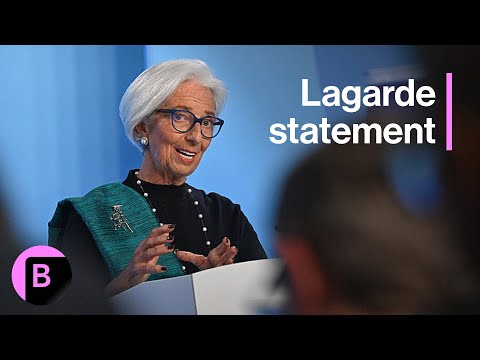
ECB Decision: Lagarde on Growth, Interest Rates, Uncertain Inflation
Bloomberg Television· 2025-12-18 14:48
The governing council today decided to keep the three key ECB interest rates unchanged. Our updated assessment reconfirms that inflation should stabilize at our 2% target in the medium-term. The new Euro system staff projections show headline inflation averaging 2.1% in 25, 1.9% in 26, 1.8% 8% in 28, sorry, 1.8% in 27 and 2% in 28. For inflation, excluding energy and food, staff project an average of 2.4% in 25, 2.2% in 26, 1.9% in 27, and 2% in 28.Inflation has been revised up for 2026, mainly because staf ...

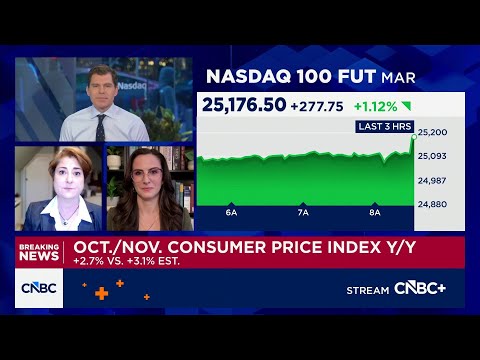
Tariffs are showing up in core goods within CPI, says Brookings' Wendy Edelberg
CNBC Television· 2025-12-18 14:16
Let's bring in our panel. Joining us now, Brookings Institution Economic Studies senior fellow Wendy Edelberg and American Institute for Economic Research Monetary Economics Managing Director Lydia Mashburn Newman. Welcome to you both.Uh Wendy, I mean, I know you haven't kind of been able to dig into the guts of this report, but it seems like a pretty benign reading. Uh how do you feel about it. Yeah, it's frustrating because they haven't even posted the information that I would need to to really um parse a ...
X @Bloomberg
Bloomberg· 2025-12-18 14:04
The Bank of England delivered a final rate cut for 2025, as expected. The Monetary Policy Committee was divided - also as expected. The big question now for the Bank is: will the UK economy deteriorate further, or bounce back next year? https://t.co/hLB2qCF3Pt ...
November consumer prices rose at a 2.7% annual rate, lower than expected, delayed data shows
CNBC· 2025-12-18 13:31
Group 1 - Core CPI increased by 2.6% over 12 months, lower than the expected 3% increase [1] - The consumer price index rose at a 2.7% annualized rate last month, while economists expected a rise of 3.1% [1][2] - The report is the first to cover the period during the U.S. government shutdown, which disrupted data collection and led to the cancellation of the October CPI release [2][3] Group 2 - Economists may be cautious in interpreting the report as a sign of a downward trend in inflation due to the absence of October comparison data [3] - Investors are analyzing the report for insights on future Federal Reserve monetary policy moves, especially after the Fed cut its benchmark overnight rate by 25 basis points for the third consecutive time [4] - A stable CPI suggests the Fed is focused on protecting the employment market, indicating a potential "Fed put" for the economy, which could support stock prices [5] Group 3 - Following the report, stock futures rose, with S&P 500 futures up about 0.5%, breaking a four-day losing streak [6] - Treasury yields decreased, with the 10-year note yield trading around 4.11% [6]

Policy Decisions Tilt Risks Toward EUR/GBP Downside: 3-Minute MLIV
Bloomberg Television· 2025-12-18 12:17
The market context today is dominated by two big central banks here in Europe, of course, the Riksbank as well. So as we look ahead to those, is there anything that unites them or should we tackle them separately. I think separately, let's take a step back.Also, don't forget, there's the Nordics Bank. Oh, yes. There's four big European ones that we're looking at.I think, you know, Bank of England is, I think, the biggest surprise there. There's been a lot of dovish pricing. You had inflation comin significa ...

X @Bloomberg
Bloomberg· 2025-12-18 10:57
US Treasuries edged higher on Thursday ahead of a US inflation report which policymakers and investors will be parsing for clues on the outlook for monetary policy next year. https://t.co/oVK0frcFm8 ...
Stock market today: Why S&P 500, Nasdaq, Dow dropped - AI stocks crash hit Oracle, Nvidia, AMD, Broadcom, Alphabet
The Economic Times· 2025-12-17 23:35
Market Overview - US stocks experienced a decline, with the S&P 500 dropping 1.16% to 6,721.43, the Nasdaq Composite falling 1.81% to 22,693.32, and the Dow Jones Industrial Average decreasing by 228.29 points, or 0.47%, settling at 47,885.97. This marks the fourth consecutive negative day for both the S&P 500 and the Dow [1][11]. Company-Specific Developments - Oracle's stock fell by 5.4% following a report that Blue Owl Capital withdrew from financing a $10 billion data center project in Michigan, citing concerns over Oracle's debt and spending. Oracle has disputed this report, asserting that the project is still progressing [2][10]. - Other major AI-linked stocks also saw declines, with Broadcom dropping over 4%, Nvidia nearly 4%, Advanced Micro Devices more than 5%, and Alphabet falling over 3%. Month-to-date, Oracle and Broadcom have declined more than 11% and approximately 19%, respectively [3][11]. Industry Insights - There is a noticeable rotation from large-cap growth stocks to large-cap value stocks, as investors adopt a more defensive posture in anticipation of future market conditions. The key question being raised is who will successfully monetize the significant investments in AI [5][12]. - The rotation away from highly valued tech names into more fairly valued sectors is expected to continue into 2026, with uncertainty around monetary policy potentially leading to increased market volatility [6][12]. - Analysts are focusing on free cash flow as a critical factor in determining the profitability of AI investments, emphasizing that while balance sheets can be manipulated, free cash flow cannot [7][12]. Economic Context - Recent economic data, including the November jobs report, has influenced market sentiment, with analysts looking for signals regarding the Federal Reserve's future interest rate decisions. Fed Governor Chris Waller indicated that there is still room for potential interest rate cuts, suggesting a scope of "50 to 100 basis points" [8][12].




Dollar Pushes Higher as Stocks Weaken
Yahoo Finance· 2025-12-17 20:35
Economic Indicators - The Eurozone's November CPI was revised downward to +2.1% year-on-year from +2.2% [6] - Eurozone Q3 labor costs increased by +3.3% year-on-year, the smallest rise in three years [6] - The German December IFO business conditions survey unexpectedly fell to a 7-month low of 87.6, against expectations of an increase [7] Central Bank Policies - The Federal Reserve is expected to continue cutting interest rates in 2026, while the European Central Bank (ECB) is perceived to have completed its rate-cutting cycle [6] - The markets are pricing in a 0% chance of a -25 basis point rate cut by the ECB at the upcoming policy meeting [7] - Fed Governor Christopher Waller indicated that interest rates are still 50-100 basis points above neutral, allowing for steady rate cuts without urgency [3][5] Currency Movements - The Euro fell by -0.04% against the dollar due to a stronger dollar and dovish economic indicators from the Eurozone [1] - The dollar index rose by +0.24%, supported by weakness in GBP/USD and yen, as well as increased liquidity demand from a stock market slump [5] - USD/JPY rose by +0.63%, influenced by the dollar's strength and concerns over Japanese fiscal policy [8] Precious Metals Market - Precious metals, including gold and silver, saw significant gains, with March silver reaching an all-time high of $66.48 per troy ounce [12] - Demand for precious metals is bolstered by safe-haven buying amid geopolitical tensions and dovish comments from the Fed [12][13] - Central bank demand for gold remains strong, with China's PBOC increasing its reserves by +30,000 ounces to 74.1 million troy ounces in November [14]