Trade War

Search documents
X @Bloomberg
Bloomberg· 2025-08-21 15:22
Trade Policy Impact - US President imposed tariffs on imports from Canada [1] - Small businesses are bearing the costs of the trade war following the tariff announcement [1]
X @Bloomberg
Bloomberg· 2025-08-20 23:05
Since US President Donald Trump waged a trade war against both countries, India and China have accelerated their efforts to repair ties with each other. Here's what you need to know https://t.co/L9cHwDg3gB ...
The PlayStation 5 Is About To Get A Major Price Increase — Here's When And How Much
Forbes· 2025-08-20 17:10
Core Insights - The PlayStation 5, released in November 2020, is experiencing a price increase nearly five years into its lifecycle, with prices rising by $50 for each model [3][4] - The price hike is effective from August 21, providing minimal notice to consumers [3] - Sony cites a challenging economic environment as the reason for the price increase, without specifying details [4] Pricing Changes - PlayStation 5: $499.99 > $549.99 [5] - PlayStation 5 Digital Edition: $449.99 > $499.99 [5] - PlayStation 5 Pro: $699.99 > $749.99 [5] Economic Context - The current global economy has disrupted traditional tech pricing norms, making it uncertain whether consoles will be more expensive at launch [3] - Factors contributing to the price increase include inflation, trade wars, and overall economic uncertainty [4]



扛不住了!美国大豆协会:没有一个市场能与中国对大豆的需求相提并论
Sou Hu Cai Jing· 2025-08-17 12:08
Core Insights - The article highlights the unprecedented challenges faced by U.S. soybean farmers due to climate disasters, rising costs, and the impact of U.S. government tariff policies leading to a significant decline in international demand, particularly from China [1][2][4] Group 1: Market Dynamics - U.S. soybean is a crucial agricultural product, with China being its largest buyer, importing approximately 221.3 million tons from the U.S. in 2024, compared to less than 6 million tons from Mexico, the second-largest market [1] - Since the imposition of tariffs by the Trump administration in 2017, China has significantly reduced its purchases of U.S. soybeans, resulting in a drastic drop in U.S. soybean exports, which fell to a 20-year low of only 3 million tons sold as of July 24 [1][2] Group 2: Supply Chain Challenges - Brazil has secured significant soybean supplies for September and October, totaling 800 million tons and 400 million tons respectively, which constitutes nearly half of China's expected demand for those months, further squeezing U.S. export opportunities [2] - The U.S. soybean market typically sees sales begin on October 1, but the current tariff situation has led to China not purchasing any U.S. soybeans this year, severely impacting U.S. farmers [2] Group 3: Agricultural Conditions - U.S. soybean and corn crops are suffering from adverse weather conditions, including excessive rainfall leading to pest infestations and crop diseases, which have delayed planting and reduced yield potential [4][5] - Farmers are incurring additional costs to manage these challenges, such as purchasing propane to dry corn, further straining their financial situation [5] Group 4: Economic Pressures - The prices of U.S. agricultural products have been declining over the past three years due to factors like reduced cattle herds and lower ethanol production, while costs for seeds, fertilizers, land, and machinery continue to rise [5] - The economic conditions for U.S. agriculture are reportedly more challenging than during the previous trade war period under the Trump administration [5] Group 5: Government Response - The Trump administration has proposed $60 billion in subsidies over the next decade to support farmers, but this has faced criticism for benefiting large producers over family farms and for not adequately addressing the immediate export challenges [7] - Despite calls for increased soybean purchases from China, market analysts question the feasibility of such transactions given China's established supply chain with Brazil [6][7]

X @Bloomberg
Bloomberg· 2025-08-15 13:14
Sector Performance - Two of Canada's most vulnerable sectors to the US trade war experienced strong sales in the second quarter [1] - This strong sales performance reversed an earlier tariff-driven slump [1]
X @The Economist
The Economist· 2025-08-14 10:40
Trade War Status - Sino-American trade war has settled into uneasy stasis after months of tit-for-tat tariffs [1] Economic Strategy - China is using the time to hone a sophisticated arsenal of devastating economic weaponry [1]
X @The Economist
The Economist· 2025-08-13 15:00
Geopolitical & Economic Strategy - Sino-American trade war has settled into uneasy stasis [1] - China is using the time to hone a sophisticated arsenal of devastating economic weaponry [1]
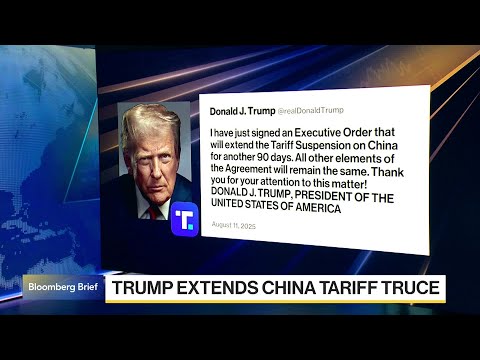
Trump Extends US-China Trade Truce by 90 Days
Bloomberg Television· 2025-08-12 09:48
Trade War Truce - US defers tariffs on Chinese goods for another 90 days into early November [1] - This extension aims to reduce uncertainty in the US economy [1] - Previous tariff escalations in April negatively impacted financial markets [2] US-China Relations - The extension provides an opportunity for both sides to address issues before a potential summit between President Trump and President Xi Jinping [2] - China has been asked to purchase soybeans, but there has been no confirmation from the Chinese side [3] Evolving Trade Dynamics - The trade war has evolved from focusing on goods like soybeans to a tech war [3]
Why MP Materials Stock Got Mashed on Monday
The Motley Fool· 2025-08-11 23:09
Core Viewpoint - MP Materials, the only rare earth mine operator in the U.S., faced a decline in stock price due to a downgrade by CFRA analyst Matthew Miller, despite an increase in the price target for the shares [1][2]. Group 1: Analyst Rating Changes - CFRA's Matthew Miller downgraded MP Materials from a strong buy to a buy, while raising the price target from $68 to $88 per share [2]. - Investors reacted negatively to the downgrade, focusing on the recommendation change rather than the price target increase [2]. Group 2: Financial Projections - Miller revised his EBITDA estimate for MP Materials to $850 million from $650 million for the year, indicating a stronger operational performance [3]. - Despite the improved EBITDA outlook, Miller projects a net loss of $0.10 per share, which is an improvement from his previous estimate of a $0.36 loss [3]. Group 3: Market Conditions - MP Materials operates in a volatile environment due to ongoing trade tensions, particularly with China, which is a significant consumer of rare earths [4]. - The company's unique position as the sole rare earth pure-play in the U.S. adds inherent value, making it a stock worth considering for investment [4].