减重药

Search documents
两个月股价拉升逾70%,九源基因(02566)的基石们仍未盈利?
智通财经网· 2025-07-22 01:54
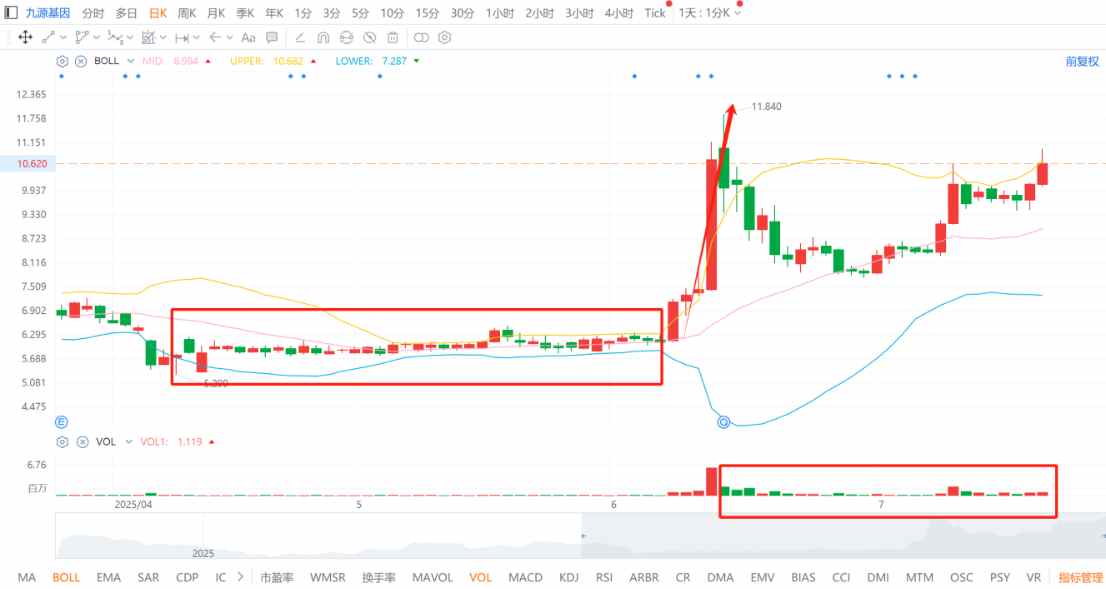
Core Viewpoint - Jiuyuan Gene, known for its domestic weight-loss drug similar to Semaglutide, faced significant stock price volatility after its Hong Kong IPO, initially dropping nearly 60% from its issue price before experiencing a substantial rebound in mid-2023 [1][2]. Group 1: Stock Performance - Jiuyuan Gene's stock price fell 38.41% on its first trading day and reached a new low of 5.15 HKD within two months, representing a decline of nearly 60% from its issue price of 12.42 HKD [1]. - After a period of low trading, the stock price surged by 26.52% in June and 35.03% in July, totaling over 70% increase in less than two months [1]. - The stock experienced a technical rebound starting January 16, 2023, after hitting a new low, but this rebound lasted only two months before the price fell again [2]. Group 2: Trading Volume and Market Behavior - During the horizontal trading phase from April 15 to June 6, 2023, Jiuyuan Gene's stock price remained stable around 6.20 HKD, with a minimal increase of 2.32% [3]. - The trading volume during this period was low, indicating a lack of selling pressure and accumulation of shares by buyers [3]. - Following a significant price increase on June 12, 2023, the stock faced a rapid decline, with a maximum drop of 34.46% over two weeks [5]. Group 3: Cornerstone Investors and Lock-up Period - Jiuyuan Gene had seven cornerstone investors, with a lock-up period of six months ending on May 28, 2023, during which 49.66% of shares were subject to release [6][8]. - On the release day, the stock price rose by 3.18%, despite the high percentage of shares being unlocked, indicating that cornerstone investors did not sell off their holdings immediately [8]. - The cornerstone investors faced a floating loss of 50.24% as of the release date, with the stock needing to rise at least 4.64% for them to break even [8]. Group 4: Future Prospects - Jiuyuan Gene's product JY29-2 is expected to be the first biosimilar to Semaglutide approved for commercialization in China, which could enhance the company's market position in the growing weight-loss drug sector [9].

“次抛”变“月抛”,减重药大战为何“卷向”预装笔
Di Yi Cai Jing· 2025-06-12 11:52
Group 1 - The core viewpoint of the articles highlights the launch of Eli Lilly's multi-dose prefilled pen for its GLP-1 drug Tirzepatide in China, aimed at increasing supply to meet growing patient demand [1][2] - The new multi-dose prefilled pen allows for four fixed doses, enabling a single pen to be used for a month, which is more cost-effective and environmentally friendly compared to the previous single-use version [1] - Eli Lilly's competitor, Novo Nordisk, has already adopted a multi-dose prefilled solution for its GLP-1 drug Semaglutide, indicating a competitive landscape in the GLP-1 market [1] Group 2 - Eli Lilly's latest multi-dose prefilled pen is currently imported, with no plans for domestic production announced yet [2] - In October 2024, Eli Lilly plans to invest approximately 1.5 billion RMB to upgrade its Suzhou factory's capacity to meet the demand for innovative diabetes and obesity drugs in China [2] - Both Eli Lilly and Novo Nordisk are actively competing for the global GLP-1 market, engaging in mergers and collaborations, with Novo Nordisk recently announcing a partnership with Deep Apple Therapeutics to develop therapies for cardiac metabolic diseases [2]


“减重效果比司美格鲁肽高近50%”!
第一财经· 2025-05-12 03:05
Core Viewpoint - The competition between the two leading GLP-1 weight loss drugs, Tirzepatide and Semaglutide, is intensifying, with recent studies showing Tirzepatide's superior weight loss efficacy compared to Semaglutide [1][2]. Group 1: Clinical Study Results - The SURMOUNT-5 study demonstrated that patients using Tirzepatide lost an average of 20.2% of their body weight after 72 weeks, compared to 13.7% for those using Semaglutide, indicating a nearly 50% higher weight loss effect for Tirzepatide [1]. - In the study, 64.6% of participants on Tirzepatide achieved a weight loss of at least 15%, while only 40.1% of those on Semaglutide did [1]. Group 2: Market Dynamics - Tirzepatide's sales exceeded $2.3 billion in the first quarter, while Semaglutide's weight loss sales were approximately $2.64 billion, reflecting a 13% quarter-over-quarter decline for Semaglutide [2]. - Novo Nordisk's stock has dropped nearly 50% since its peak in June last year, attributed to the competitive pressure from Tirzepatide's strong data [2]. Group 3: Future Market Potential - Barclays Bank projects that the global weight loss drug market could reach $150 billion by 2030, with China emerging as a significant market following the U.S. [4]. - Over 500 million adults in China are affected by overweight and obesity, with obesity-related healthcare costs expected to account for 22% of national medical expenses by 2030 [4]. Group 4: Development of New Drugs - Both companies are accelerating the development of next-generation GLP-1 weight loss drugs, with oral formulations being a key area of competition [4]. - Novo Nordisk's oral Semaglutide application has been accepted by the FDA, with a decision expected in Q4 of this year, potentially making it the first oral GLP-1 drug for long-term weight management [4].