医保政策

Search documents
黑天鹅!刚刚,美国政府,“正式关门”
Zhong Guo Ji Jin Bao· 2025-10-01 05:03
Core Points - The U.S. government has officially shut down for the first time in nearly seven years due to a failure to reach an agreement on a temporary funding bill, primarily over healthcare benefits [1][2] - Approximately 750,000 federal employees may be forced into unpaid leave, although historically, they receive back pay once the government reopens [3] - The shutdown will disrupt various public services, including delays in economic data releases and processing of passport and visa applications [8][9] Group 1: Government Shutdown Overview - The shutdown occurred after both the Republican and Democratic parties failed to pass their respective funding proposals, with a 60-vote threshold needed in the Senate [2] - The White House budget director indicated that federal employees should report to work to initiate an orderly shutdown plan [2] - The shutdown is a result of a funding gap, as Congress has not passed the necessary appropriations bills for the new fiscal year [5] Group 2: Impact on Federal Services - Essential services related to law enforcement and public safety will continue, but employees in these roles will work without pay [9] - Non-essential services, such as national park facilities and certain economic data reports, will be suspended [8][9] - Private companies relying on federal contracts will face revenue losses, and employees in these sectors typically do not receive back pay during shutdowns [10]
大健康国际(02211)公布年度业绩 公司拥有人应占亏损2600.6万元 同比盈转亏
智通财经网· 2025-09-30 13:19
Core Points - The company reported a revenue of approximately 711.5 million, representing a year-on-year decrease of 34.7% [1] - Gross profit was approximately 113.4 million, down 37% year-on-year [1] - The company recorded a loss attributable to owners of 26.06 million, marking a shift from profit to loss compared to the previous year [1] - Earnings per share were reported at a loss of 32.46 cents [1] Revenue Analysis - The decline in revenue is primarily attributed to the impact of new healthcare insurance policies in China [1] - Additionally, there was a decrease in the number of active customers within the national distribution network [1]
大健康国际公布年度业绩 公司拥有人应占亏损2600.6万元 同比盈转亏
Zhi Tong Cai Jing· 2025-09-30 13:17
Group 1 - The company reported a revenue of approximately 711.5 million, representing a year-on-year decrease of 34.7% [1] - Gross profit was approximately 113.4 million, down 37% compared to the previous year [1] - The company experienced a loss attributable to owners of 26.06 million, marking a shift from profit to loss year-on-year [1] - Earnings per share were reported at a loss of 32.46 cents [1] Group 2 - The decline in revenue is primarily attributed to the impact of new healthcare insurance policies in China [1] - There was a decrease in the number of active customers within the national distribution network [1]
都是错的!关于医保这些误区不要信,事关就医、报销,个人账户!
Sou Hu Cai Jing· 2025-09-29 22:42
Core Viewpoint - The article highlights misconceptions surrounding medical insurance policies in China, particularly regarding hospitalization duration, big illness insurance, and the use of personal medical accounts, emphasizing the need for better public understanding of these policies. Group 1: Hospitalization Policies - Many patients are misled to believe that they must be discharged after 15 days of hospitalization due to insurance regulations, which is not true as there is no such policy from the national medical insurance department [1][5] - Medical institutions often pressure patients to leave or transfer based on the false claim that their insurance limit has been reached, which violates insurance agreements [5] Group 2: Big Illness Insurance - Big illness insurance is not limited to specific diseases but is based on the cumulative medical expenses incurred by any illness, allowing for broader coverage [2] - In 2023, 11.56 million people benefited from big illness insurance reimbursements, with an average reduction in out-of-pocket expenses of approximately 8,000 yuan, and the maximum reimbursement can reach hundreds of thousands of yuan [1] Group 3: Medical Account Misconceptions - There is a common misconception that personal medical accounts will be cleared if contributions are suspended for three months; however, the balance remains intact despite any interruptions in payments [5] - The personal medical account consists of current year funds and accumulated balances from previous years, and funds can be used for family members' medical expenses, but the card cannot be lent to others [6][7] Group 4: Direct Settlement for Cross-Province Medical Treatment - The process for direct settlement of medical expenses when seeking treatment outside one's registered area involves prior registration, selecting a designated medical institution, and using an electronic medical insurance card for payment [4] - The direct settlement system has been expanded to cover both outpatient and inpatient services across provinces, enhancing accessibility for patients [8]
趋势研判!2025年中国依达拉奉行业发展历程、产业链图谱、发展背景、市场规模、竞争格局及发展趋势分析:市场集中度较高[图]
Chan Ye Xin Xi Wang· 2025-09-13 02:11
Overview - The demand for Edaravone in China is driven by a large population of stroke patients, with sales peaking at 5.548 billion yuan in 2016 [1][8]. - The sales dropped significantly to 1.53 billion yuan by 2024 due to regulatory changes and market dynamics [1][9]. Development History - Edaravone was first approved in Japan in 2001 and introduced to China by Xiansheng Pharmaceutical in 2003 [3][4]. - The market demand grew rapidly from 2015 to 2018, establishing Edaravone as a key product in the neuropharmaceutical sector [3][5]. Market Dynamics - In 2019, Edaravone was included in the first batch of the National Key Monitoring Rational Drug Use Directory, leading to a decline in sales [4][5]. - The seventh batch of national drug procurement initiated in 2022 further impacted sales, with Edaravone being the only drug from the monitoring list to be included in the procurement [5][9]. Industry Chain - The upstream of the Edaravone industry includes raw materials, intermediates, packaging, and pharmaceutical equipment [6]. - The midstream consists of production companies, while the downstream includes hospitals and pharmacies, with hospitals being the primary distribution channel [7]. Market Background - Edaravone is primarily used for treating acute ischemic stroke, with its effectiveness linked to timely administration within 48 hours post-stroke [8]. - The aging population in China has led to an increase in stroke and other neurological disease incidences, with stroke patients reaching 27.461 million by 2024 [8]. Competitive Landscape - The Edaravone market in China is highly concentrated, with 54 approved products from 32 companies as of August 2025 [10]. - Xiansheng Pharmaceutical is the leading company, having launched the first Edaravone injection in China [10][11]. Company Profiles - Xiansheng Pharmaceutical reported a total revenue of 6.635 billion yuan in 2024, with a gross profit of 5.325 billion yuan and a gross margin of 80.25% [11]. - Jilin Boda Pharmaceutical, a key player, has a production capacity of 3 million 10ml and 2 million 20ml Edaravone injections annually, with a revenue of 733.38 million yuan in 2024 [12]. Future Trends - Innovations in Edaravone formulations are expected, including the development of oral tablets, which could enhance patient compliance [13]. - The expansion of insurance coverage and accelerated drug approvals are anticipated to increase market accessibility and demand, although cost control will be essential due to potential pricing pressures from insurance policies [13].


健帆生物(300529) - 2025年8月28日投资者关系活动记录表
2025-09-01 09:16
Financial Performance - In the first half of 2025, the company achieved revenue of 1.134 billion CNY, a year-on-year decrease of 24.15% [1] - Net profit for the same period was 389 million CNY, down 29.46% year-on-year [1] - Operating cash flow was 538 million CNY, exceeding net profit by 149 million CNY, indicating high-quality cash flow [1] - Gross margin stood at 79.82%, while net margin was 34.26%, reflecting strong overall profitability [1] Marketing Progress - In the nephrology sector, sales from kidney disease products reached 784.97 million CNY, accounting for 69.20% of total revenue [2] - The KHA series generated 79.98 million CNY in sales, a 27.34% increase year-on-year, covering over 700 hospitals [2] - The pHA series, launched in November 2023, achieved sales of 11.75 million CNY, with a remarkable growth of 374.22% [2] - In the hepatology sector, sales reached 131.53 million CNY, representing 11.59% of total revenue [2] - The critical care sector generated 142.31 million CNY, accounting for 12.54% of total revenue [3] Research and Development - R&D investment amounted to 97 million CNY, representing 8.59% of total revenue [5] - The company obtained 15 new patents, bringing the total to 393, including 111 invention patents [5] - Two products received CE certification under the new EU MDR regulations, allowing sales in EU countries [5] Dividend Policy - The company distributed a cash dividend of 620 million CNY for the 2024 fiscal year, with a payout ratio exceeding 75% [5] - Cumulative dividends since the company's IPO amount to 4.07 billion CNY, 2.9 times the amount raised through IPO and refinancing [5] Social Responsibility - The company donated cash and materials valued at 19.17 million CNY for charitable projects, reflecting its commitment to social responsibility [5] Future Outlook - The company plans to enhance its focus on the blood purification field and expand its international market presence [8] - It aims to increase the penetration rate of kidney products and improve clinical application frequency [11] - The company is exploring new business areas related to metabolic cardiovascular diseases and health management [15] - Future international business growth will be driven by academic promotion and partnerships with key hospitals [14]

港股创新药概念股走低,恒生创新药ETF跌近2%
Mei Ri Jing Ji Xin Wen· 2025-08-27 05:38
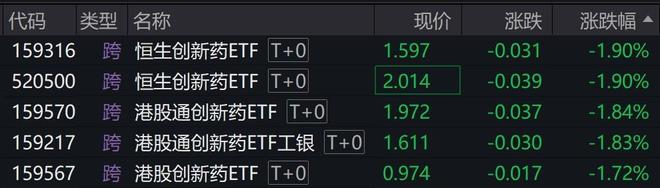
Group 1 - The Hong Kong innovative drug concept stocks have declined, with companies such as 3SBio and Hansoh Pharmaceutical dropping over 4%, while Innovent Biologics, CSPC Pharmaceutical Group, and China National Pharmaceutical Group fell over 3% [1] - The Hang Seng Innovative Drug ETF has decreased nearly 2% due to market influences [1] Group 2 - Several ETFs related to innovative drugs have shown declines, with specific prices and percentage drops noted, such as the Hang Seng Innovative Drug ETF at 1.597, down 1.90% [2] - A brokerage firm indicated that the collection of chemical drugs has completed ten batches, with the new batch increasing quality requirements and reflecting a reduction in "involution," leading to a diminishing marginal impact [2] - The Pharma collection is gradually clearing out, entering a period of innovative transformation and harvest, with favorable medical insurance policies expected to support rapid growth of innovative drugs [2]
昨日“吸金”超2300万元, 生物医药ETF(159859)实时成交额居同标的之首,创新药ETF天弘(517380)溢价交易
2 1 Shi Ji Jing Ji Bao Dao· 2025-08-27 02:44
Group 1 - The biopharmaceutical sector is currently active, with the Biopharmaceutical ETF (159859) showing a slight increase of 0.23% and a trading volume exceeding 48 million yuan, indicating strong investor interest [1] - The Biopharmaceutical ETF (159859) closely tracks the National Biopharmaceutical Index (399441.SZ), covering various sectors such as innovative drugs, CXO, vaccines, and blood products, making it the largest and most liquid product in its category [1] - The Innovation Drug ETF Tianhong (517380) has seen a slight decline of 0.24% but has recorded a net inflow of over 22.56 million yuan over the past five trading days, reflecting ongoing investor confidence [1] Group 2 - The Chinese government has approved a plan to develop the Jiangsu Free Trade Zone into a globally influential biopharmaceutical industry hub, enhancing its international competitiveness [2] - Major innovative pharmaceutical companies have reported strong performance in their 2025 semi-annual reports, with Heng Rui Pharmaceutical achieving a revenue of 15.76 billion yuan, a year-on-year increase of 15.88%, and a net profit of 4.45 billion yuan, up 29.67% [2] - The domestic innovative drug industry is entering a phase of performance realization after a decade of development, with a focus on the upcoming policy changes and the establishment of a new pricing mechanism for newly launched drugs [3]




尚荣医疗拟终止高端医疗耗材产业化项目,剩余募资拟补流动资金 | 医药早参
Sou Hu Cai Jing· 2025-08-25 23:36
Group 1 - Shangrong Medical has decided to terminate its "High-end Medical Consumables Industrialization Project" and will use the remaining raised funds, estimated at 360 million yuan, to permanently supplement working capital, pending shareholder approval [1] - The termination of the project highlights previous strategic missteps, and the company needs to accurately position itself and explore new business opportunities to avoid continued weak performance [1] Group 2 - Zhejiang Medicine reported a net profit of approximately 670 million yuan for the first half of 2025, a year-on-year increase of 113.5%, despite a slight revenue decline of 1.9% to about 4.32 billion yuan [2] - The significant profit increase is attributed to rising demand and prices in the life nutrition product segment, but the company needs to address the revenue decline and progress in innovative drug development to maintain growth [2] Group 3 - Shutaishen reported a revenue decline of 31% to 126 million yuan for the first half of 2025, with a net loss of 24.64 million yuan, worsening from a loss of 342,000 yuan in the same period last year [3] - The revenue drop and increased losses are primarily due to the impact of centralized procurement, medical insurance policies, and market competition on core products, with reduced R&D investment and no commercialization of innovative drugs [3] Group 4 - Huaxia Eye Hospital achieved a net profit of 280 million yuan in the first half of 2025, a year-on-year growth of 6.2%, with total revenue of 2.139 billion yuan, up 4.3% [4] - The growth in revenue and profit is driven by strong performance in refractive and posterior segment projects, although cataract project revenue has declined; the company shows resilience and potential for steady development through increased R&D investment [4]


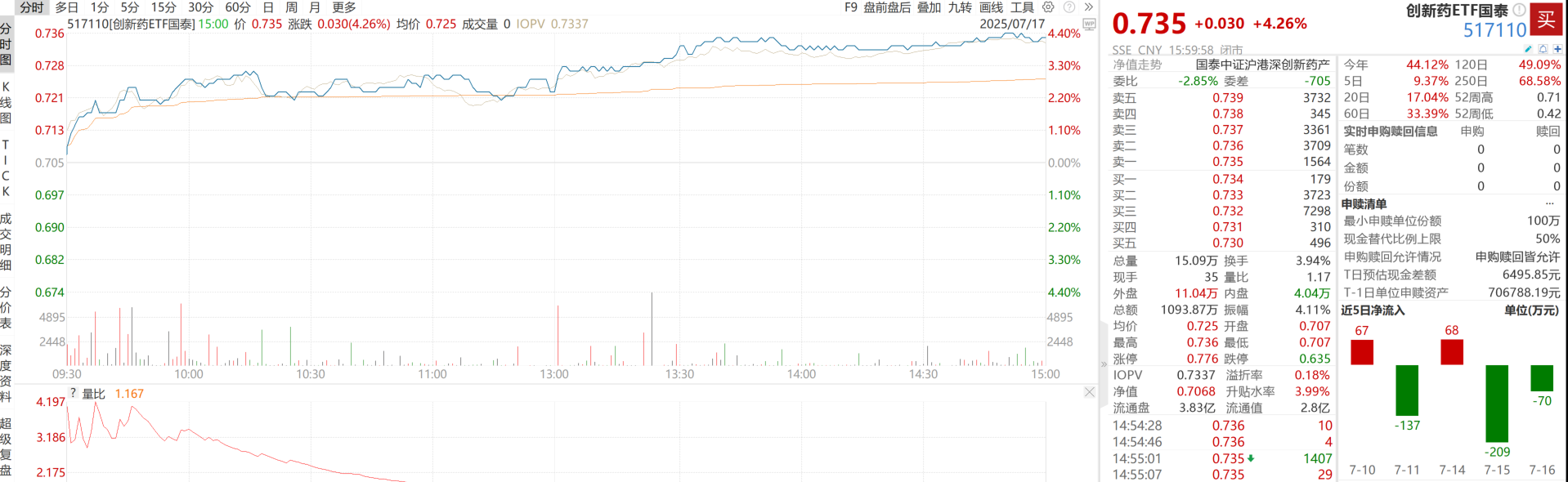
创新药ETF国泰大涨4.26%点评
Mei Ri Jing Ji Xin Wen· 2025-07-17 15:12
Core Viewpoint - The A-share market shows positive momentum with significant gains in major indices, driven by favorable policies and strong performance in the innovative drug sector [1][3]. Policy Support - The National Medical Insurance Administration has initiated the 11th batch of centralized drug procurement, focusing on mature "old drugs" while excluding innovative drugs from this process, which is expected to provide better economic support for innovative drugs [3]. - A dual-track payment system is being established, combining basic medical insurance with commercial health insurance for innovative drugs, enhancing the financial backing for drug companies [3]. - The resumption of the fifth set of listing standards for the Sci-Tech Innovation Board and the reduction of clinical trial review periods to 30 days are creating a favorable regulatory environment for innovative drug companies [3]. Healthcare Fund Performance - The healthcare fund is operating steadily, with a total surplus of 5.31 trillion yuan, and both income and expenditure are showing year-on-year growth [4]. - Employee health insurance income increased by 3.5%, while expenditures rose by 7.6%, indicating a healthy growth trend in the sector [4]. Clinical Developments - Innovative drug companies are achieving significant milestones, such as Heng Rui Medicine's GLP-1/GIP dual-target weight loss drug showing a 19.2% average weight reduction in clinical trials, marking a breakthrough in metabolic disease treatments [4]. - Other companies are also advancing in clinical trials, with several new drug applications expected soon, reflecting the long-term value of the innovative drug industry [4]. Market Outlook - The innovative drug sector is expected to maintain high growth, driven by policy implementation, clinical data releases, and international business development [5][6]. - The introduction of a commercial health insurance directory for innovative drugs is anticipated to create a more favorable pricing environment and significantly increase the scale of payments for innovative drugs in the long term [5]. International Expansion - The trend of domestic innovative drugs moving towards global commercialization is accelerating, with expectations of over $50 billion in business development transactions in 2025 [6]. - Major academic conferences in late 2025 are expected to reveal critical data for Chinese innovative drugs, potentially enhancing their market positioning and driving new licensing deals [6]. Financial Performance - Leading companies in the innovative drug sector are transitioning from heavy R&D spending to self-sustaining business models, with profitability expected to improve due to increased commercialization of key products and enhanced R&D efficiency [7][8]. - The overall investment environment for biotech and startup pharmaceutical companies is showing signs of recovery, with a notable increase in financing events in 2025 [8]. Investment Opportunities - The innovative drug ETF Guotai (517110) is closely tracking the performance of quality innovative drug companies across A-shares and Hong Kong stocks, providing a diversified investment option [9]. - The newly issued Sci-Tech Innovation Drug ETF Guotai (589723) is expected to outperform the broader market, reflecting a stronger rebound potential in the innovative drug sector [9].