司法独立

Search documents
美国宣布:对巴西最高法院法官实施签证限制
证券时报· 2025-07-19 10:38
Core Viewpoint - The article discusses the U.S. government's imposition of visa restrictions on Brazilian Supreme Court Justice Alexandre de Moraes and others following a ruling against former President Bolsonaro, highlighting tensions between the U.S. and Brazil regarding judicial independence and political interference [1][2]. Group 1: U.S. Visa Restrictions - The U.S. State Department announced visa restrictions on Brazilian Supreme Court Justice Alexandre de Moraes and his allies due to allegations of political persecution against former President Bolsonaro [1]. - Moraes ruled that Bolsonaro engaged in judicial coercion and actions that threaten national sovereignty, leading to strict measures including electronic monitoring and house arrest for Bolsonaro [1]. Group 2: Bolsonaro's Legal Troubles - Bolsonaro faces criminal charges related to an alleged coup attempt following his 2022 election loss, with potential sentences exceeding 40 years if convicted [2]. - Bolsonaro has publicly claimed that the legal actions against him are politically motivated, framing them as "political persecution" [2]. Group 3: Political Reactions - U.S. President Trump has called for Brazil to halt judicial investigations against Bolsonaro, which has sparked strong backlash from the Brazilian government and public opinion [2]. - Brazilian President Lula has firmly rejected U.S. interference in domestic affairs, emphasizing Brazil's commitment to sovereignty and judicial independence [2].


巴西联邦最高法院裁定前总统博索纳罗危害国家主权
Xin Hua She· 2025-07-18 19:25
Group 1 - The Brazilian Federal Supreme Court ruled that former President Bolsonaro engaged in actions that threaten judicial independence and national sovereignty, imposing restrictions on him, including electronic monitoring and house arrest during specific hours [1] - Bolsonaro is accused of attempting to influence U.S. officials to impose sanctions on Brazilian officials and obstructing the work of the Brazilian Constitutional Court, which constitutes an attack on judicial independence [1] - Bolsonaro faces serious criminal charges related to an alleged coup attempt following his 2022 election loss, with potential sentences exceeding 40 years if convicted [1] Group 2 - U.S. President Trump announced a 50% tariff on Brazil and demanded an end to the judicial investigation against Bolsonaro, provoking strong backlash from the Brazilian government and public opinion [2] - Brazilian President Lula firmly rejected U.S. interference in domestic affairs, emphasizing Brazil's commitment to defending its sovereignty and judicial independence [2]
特朗普政府惹上的那些官司,现在怎么样了?
Xin Hua She· 2025-06-14 08:01
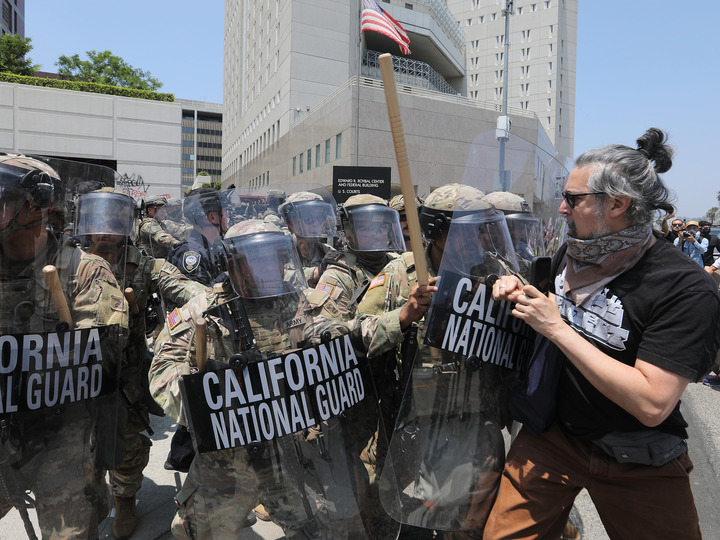
Group 1: Immigration Enforcement and Legal Conflicts - The U.S. Immigration and Customs Enforcement (ICE) has been conducting raids in Los Angeles, leading to clashes with local residents and the deployment of the National Guard by President Trump, marking the first time since 1965 that a president has mobilized state National Guard without a governor's request [2] - California's government has initiated a lawsuit against the Trump administration to block the use of military and National Guard in law enforcement activities within the state [2] - The legal battles between the executive and judicial branches in the U.S. have intensified, with over 300 lawsuits filed against the Trump administration since January, covering various issues including tariffs and immigration policies [2] Group 2: Tariff Lawsuits - The Trump administration's imposition of tariffs has led to at least seven lawsuits from various parties, including state governments and small businesses [3] - A coalition of 12 states filed a lawsuit against the Trump administration's "reciprocal tariffs," which was initially ruled illegal by a trade court, but the administration successfully appealed to temporarily suspend this ruling [3][4] - Legal experts predict that many of these tariff-related lawsuits will ultimately reach the Supreme Court, where Trump's appointed justices may play a crucial role [4] Group 3: Harvard University Lawsuit - The Trump administration's threat to freeze federal funding to Harvard University has escalated into a significant legal battle, with Harvard filing a lawsuit against the government [5] - The conflict represents a broader struggle between elite educational institutions and the Trump administration, which has sought to exert control over higher education [5] - Recent actions by the Department of Homeland Security to restrict international student admissions at Harvard have been temporarily halted, but further legal challenges are expected [7] Group 4: Broader Immigration Legal Issues - Multiple lawsuits are ongoing regarding immigration policies, including a recent ruling that deemed Trump's federalization of California's National Guard illegal without the governor's consent [10] - The Supreme Court is expected to hear cases related to the termination of temporary legal status for immigrants from specific countries, which could affect over 500,000 individuals [12] - The Trump administration's efforts to link federal funding to immigration enforcement have also faced legal challenges from multiple states [14] Group 5: Government Efficiency Department Lawsuits - The establishment of the Government Efficiency Department has led to numerous lawsuits regarding budget cuts and employee layoffs, with over 40 cases reported [15] - A federal court has issued a temporary injunction against the department's mass layoffs, which has been extended indefinitely [16] - The Trump administration has faced legal challenges regarding its decision to cut federal funding to public media, with lawsuits filed by major public broadcasting organizations [18] Group 6: Supreme Court Dynamics - The Trump administration's legal challenges are likely to reach the Supreme Court, where the current conservative majority may influence outcomes [20][23] - Trump's appointments of three conservative justices have created a favorable environment for the administration in legal disputes [20] - Analysts suggest that the Supreme Court's decisions may reflect the increasing polarization of American politics, complicating the judicial landscape [23]