气象预警

Search documents
三预警齐发!这些地区出行需注意
Qi Lu Wan Bao· 2025-08-12 00:40
Core Points - The Central Meteorological Administration issued multiple weather warnings on August 12, including a yellow typhoon warning for Typhoon "Yangliu" [2] - Typhoon "Yangliu" is expected to strengthen and make landfall on the southeastern coast of Taiwan around noon on August 13, with maximum wind speeds reaching up to 48 meters per second [2] - Heavy rainfall is forecasted for northeastern Taiwan, with expected precipitation of 50-60 millimeters [3] - A blue warning for severe convective weather was issued, predicting thunderstorms and hail in various regions, including parts of Inner Mongolia and North China [4] - A blue rainstorm warning was also issued, indicating heavy to torrential rain in several areas, with some regions expecting rainfall of 100-140 millimeters [5]
五预警齐发!这些地方出行需注意
Zhong Guo Ji Jin Bao· 2025-08-06 12:12
Group 1: Weather Warnings - The Central Meteorological Observatory issued a yellow rainstorm warning, predicting heavy rain in regions including Guangxi, Guangdong, and Yunnan, with rainfall amounts reaching 100-200 mm in some areas [1] - There is a high risk of small river floods in northern Guangdong and northern and southeastern Guangxi, with an orange warning indicating a significant risk in specific localities [2] - Geological disaster risks are elevated in regions such as western Henan, central and southeastern Guangdong, and eastern Guangxi, with orange warnings for high-risk areas [3] Group 2: Flood and Disaster Risks - An orange flood disaster warning was issued, indicating a high likelihood of mountain flood disasters in areas including western Inner Mongolia, northern Guangxi, and western Yunnan [4] - There is a high risk of waterlogging in central Henan, northeastern Qinghai, and central Gansu, with specific areas in Guangdong and Guangxi also at risk [6]
中央气象台发布暴雨橙色预警、高温橙色预警、强对流天气蓝色预警及渍涝风险气象警报
Yang Shi Wang· 2025-08-04 10:55
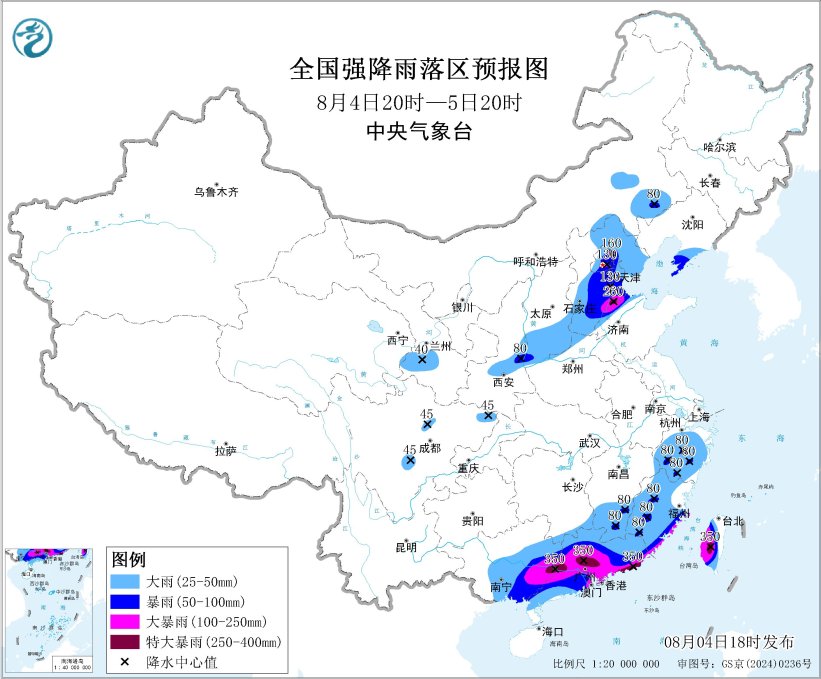
Core Viewpoint - The Central Meteorological Administration has issued multiple weather warnings, including orange alerts for heavy rain and high temperatures, indicating severe weather conditions across various regions in China, which may lead to significant impacts on daily life and infrastructure [1][4]. Group 1: Heavy Rain Alerts - An orange alert for heavy rain has been issued, predicting heavy rainfall in regions such as southeastern Gansu, central Shaanxi, western and northern Sichuan Basin, and parts of Inner Mongolia, with localized areas experiencing extreme rainfall of 250-350 mm [1]. - Specific areas like eastern Beijing, southern Tianjin, and southeastern Guangdong are expected to face torrential rain, with hourly rainfall potentially exceeding 80 mm [1]. - The risk of severe weather includes short-term heavy precipitation and strong convective weather, such as thunderstorms and strong winds [1]. Group 2: Flood Risk Warnings - A flood risk meteorological warning has been issued, indicating a high likelihood of flooding in areas like southern and northeastern Beijing, central and northeastern Hebei, and western Shandong due to the anticipated heavy rainfall [11]. - Certain regions, particularly southeastern Guangdong and central Guangxi, face a very high risk of flooding, which could lead to urban waterlogging and agricultural damage [11]. Group 3: High Temperature Alerts - An orange alert for high temperatures has been issued, forecasting temperatures between 35-39°C in regions including southern North China and parts of the Sichuan Basin, with some areas in Sichuan potentially exceeding 40°C [4]. - The high-temperature conditions pose risks for outdoor activities and require precautionary measures to protect vulnerable populations [7]. Group 4: Severe Weather Alerts - A blue alert for severe convective weather has been issued, predicting wind gusts of 8 or higher and possible hail in regions such as western Xinjiang and central Inner Mongolia [6]. - Areas like central Beijing and eastern Fujian may experience short-term heavy rainfall exceeding 50 mm per hour, with maximum rainfall potentially reaching over 80 mm [6].

暴雨橙色+高温橙色+强对流蓝色 中央气象台三预警齐发
Yang Shi Xin Wen Ke Hu Duan· 2025-08-04 00:48
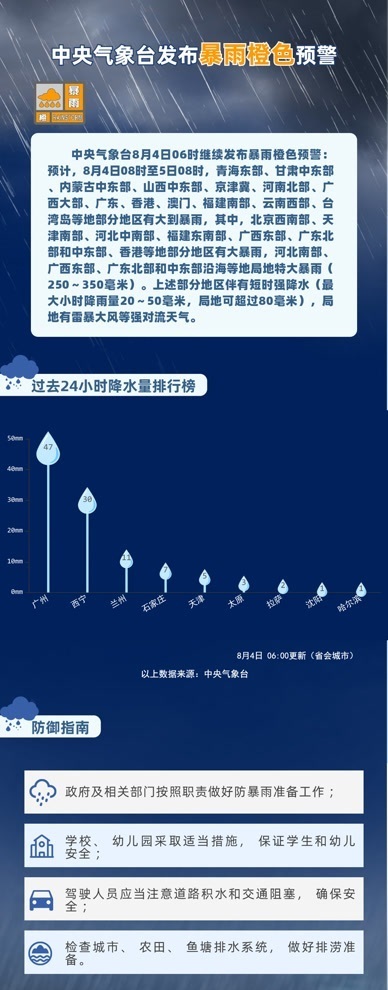
Weather Alerts - The Central Meteorological Observatory issued an orange alert for heavy rain, an orange alert for high temperatures, and a blue alert for severe convective weather on August 4 at 6 AM [1][5]. High Temperature Warning - It is expected that on August 4, parts of southern North China, central and southern Shaanxi, most of the Huanghuai region, Jianghan, western Jianghuai, western and central Jiangnan, Sichuan Basin, and Turpan Basin in Xinjiang will experience high temperatures ranging from 35 to 39°C, with some areas in southern central Shaanxi, western Hubei, and the Sichuan Basin potentially exceeding 40°C [3]. Severe Convective Weather Warning - The blue alert for severe convective weather indicates that from 8 AM on August 4 to 8 AM on August 5, parts of central and eastern Northwest China, northern North China, and southern South China may experience thunderstorms with winds exceeding 8 levels or hail. Additionally, areas in central and northeastern Hebei, southwestern Beijing, and north-central and southern Guangdong may see hourly rainfall exceeding 50 mm, with maximum amounts potentially reaching over 80 mm [6].
北京发布暴雨蓝色预警与雷电黄色预警
Xin Hua She· 2025-08-02 08:34
Summary of Key Points Core Viewpoint - Beijing Meteorological Station issued a blue rainstorm warning and a yellow thunderstorm warning, indicating severe weather conditions expected in the region [1] Weather Warnings - The blue rainstorm warning predicts hourly rainfall exceeding 30 millimeters in parts of Huairou, Miyun, Pinggu, Shunyi, Fangshan, Mentougou, Changping, and Yanqing from 18:00 on August 2 to 05:00 on August 3 [1] - The yellow thunderstorm warning forecasts thunderstorms with short-term heavy rainfall and winds of around 7 levels from 14:00 on August 2 to 06:00 on August 3 [1] Weather Forecast - The weather forecast for August 2 indicates cloudy conditions turning to overcast with scattered thunderstorms during the day, and thunderstorms expected in the evening with uneven rainfall distribution, particularly in the western and northern regions [1] Public Safety Measures - Emergency departments advise the public to stay updated on weather forecasts, carry rain gear, and avoid sheltering under tall buildings or large billboards during the blue rainstorm warning [1] - During the yellow thunderstorm warning, outdoor personnel should avoid high ground and trees, cease high-altitude and water operations, and refrain from touching exposed metal tools or items [1]
山东继续发布暴雨蓝色预警!临沂枣庄等7市有小到中雨局部暴雨并伴有雷电,最新天气预报→
Qi Lu Wan Bao· 2025-08-01 06:49
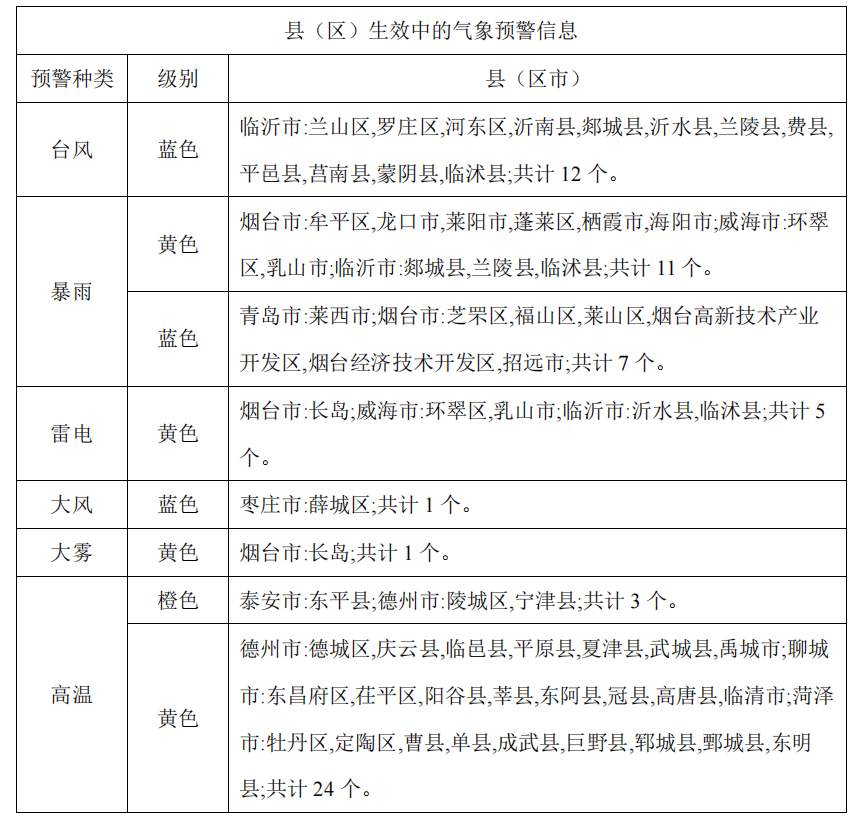
Summary of Weather Alerts and Forecasts Core Points - The Shandong Meteorological Observatory has issued multiple weather alerts, including blue and yellow warnings for typhoons, thunderstorms, strong winds, fog, and high temperatures across various cities in Shandong Province [1][2][3]. Weather Alerts - **Typhoon Alerts**: Blue warnings are in effect for 12 districts in Linyi City, while yellow warnings are issued for 11 districts in Yantai City and others [1]. - **Thunderstorm Alerts**: Yellow warnings are active in Yantai and Weifang, with a total of 5 districts affected [1]. - **Strong Wind Alerts**: Blue warnings are issued for Xuzhou City, with 1 district affected [1]. - **Fog Alerts**: Yellow warnings are in place for Yantai City, affecting 1 district [1]. - **High Temperature Alerts**: Orange warnings are issued for Tai'an and Dezhou, with a total of 24 districts affected [1]. Short-term Weather Forecast - **August 1-2**: Expect small to moderate rain with localized heavy rain and thunderstorms in Linyi, Zaozhuang, Rizhao, Weifang, Yantai, Weihai, and Qingdao. Maximum hourly rainfall is expected to reach 40-60 mm, with gusts of 7-9 levels during thunderstorms [2]. - **Temperature Forecast**: Minimum temperatures around 24°C in mountainous areas and 26°C in other regions. Maximum temperatures will reach approximately 35°C in Heze, Dezhou, and Liaocheng, while other areas will be around 31-34°C [2]. - **August 2-3**: Continued rain and thunderstorms expected in Zaozhuang, Linyi, and other areas, with similar temperature ranges [3]. Marine Weather Forecast - **Nearshore Warnings**: South winds with gusts of 6-7 levels expected in the central Yellow Sea, with thunderstorms and localized heavy rain forecasted [5]. - **Temperature Forecast**: Minimum temperatures around 27°C in the Bohai Sea and maximum temperatures around 29°C [5]. Extended Forecast - **August 3-4**: Continued rain and thunderstorms expected in the northern and central Yellow Sea, with temperatures ranging from 26°C to 29°C [6].
青烟威及日照4地局部大雨或暴雨!山东继续发布暴雨蓝色预警
Qi Lu Wan Bao· 2025-08-01 02:20
Core Points - Shandong Province Meteorological Station issued a blue rainstorm warning on August 1, predicting light to moderate rain in Linyi and Zaozhuang, with localized heavy rain and thunderstorms expected [1] - The impact of Typhoon "Zhu Jie Cao" on Shandong's weather has significantly weakened, with the typhoon's center located in Hefei, Anhui Province, and maximum wind force recorded at level 7 [5] Weather Forecast - On August 1, Linyi and Zaozhuang will experience overcast weather with light to moderate rain and localized thunderstorms, while other regions will have cloudy weather with possible thunderstorms [1] - The minimum night temperatures are expected to be around 24°C in the central mountainous area and 26°C in other regions, with maximum temperatures reaching approximately 34°C in Heze, Dezhou, and Liaocheng [2][4] - On August 2, Zaozhuang, Linyi, and coastal areas will have overcast weather with thunderstorms or showers, while other regions will remain mostly cloudy [1] Weather Alerts - As of August 1, the blue rainstorm warning is in effect for Shandong Province, with additional warnings for typhoons and high temperatures in various cities [6]
中国推“妈祖”气象AI 助力多国抗灾升级
Jin Tou Wang· 2025-07-31 06:23
Core Viewpoint - China has launched the "Mazu" meteorological warning system at the 2025 World Artificial Intelligence Conference in Shanghai, aimed at helping developing countries respond to natural disasters [1][2]. Group 1: System Overview - The "Mazu" system is named after a widely revered Chinese sea goddess in Southeast Asia and is designed for global coverage [2]. - The system integrates multiple disaster warnings into a single platform, emphasizing simplicity and collaboration in meteorological safety [3]. - The Chinese Meteorological Administration plans to enhance the meteorological warning system through training, providing forecasters with an open-source toolkit of AI models named "Wind Thunder," "Wind Clear," and "Wind Smooth," each tailored for different time frames from 10 minutes to 3 months [3]. Group 2: Global Context - The system is part of China's efforts to establish a network of warning partnerships with other countries to address extreme weather challenges [2]. - Advanced meteorological warning systems already exist in other countries, such as the U.S. National Weather Service and Japan Meteorological Agency, which rely heavily on local supercomputers and prioritize specific disaster types [2][3]. - The "Mazu-Urban" platform, a city-level disaster warning tool, has been donated to representatives from Djibouti and Mongolia, providing risk assessments, real-time monitoring, forecasts, automated disaster reports, and AI-generated emergency plans [3]. Group 3: Implementation and Reach - Since January, a pilot version of the "Mazu" system has been launched in 35 countries across Asia, Africa, and the Pacific [3]. - The system aims to facilitate global cooperation by making its AI models open-source [3].
暴雨+大风+台风多预警齐发 这些地区出门需注意安全
Zhong Guo Xin Wen Wang· 2025-07-30 00:42
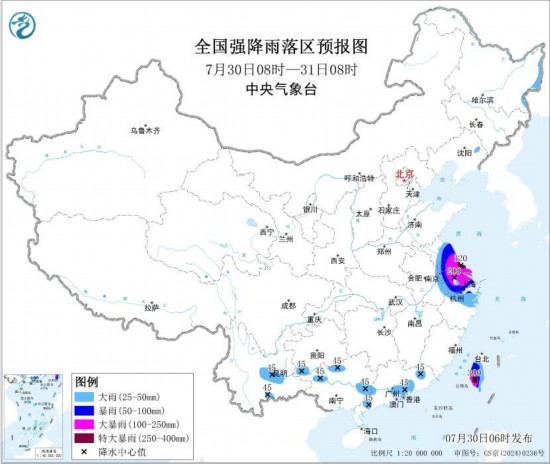
Core Viewpoint - Multiple weather warnings have been issued by the Central Meteorological Observatory, including orange alerts for heavy rain, yellow alerts for strong winds, and yellow alerts for typhoons, indicating severe weather conditions across various regions in China [1]. Group 1: Heavy Rain Alerts - From 08:00 on July 30 to 08:00 on July 31, areas including southern Jiangsu, Shanghai, northern Zhejiang, eastern Anhui, southern Guangdong, central Guangxi, southern Yunnan, Taiwan Island, eastern Heilongjiang, and northeastern Liaoning are expected to experience heavy to torrential rain, with some regions facing extreme rainfall (250-320 mm) [2][10]. - Specific areas such as southeastern Jiangsu, northern Shanghai, northern Zhejiang, and southern Taiwan may see localized extreme rainfall, with hourly precipitation potentially exceeding 70 mm [2]. Group 2: Strong Wind Alerts - From 08:00 on July 30 to 08:00 on July 31, regions including western and northeastern Inner Mongolia, eastern Xinjiang, northern and western Qinghai, Gansu's Hexi Corridor, Shanghai, northern Zhejiang, and southern Jiangsu are forecasted to experience winds of 5-6 levels, with gusts reaching 7 levels [4]. - In certain areas like Shanghai, northern Zhejiang, and southern Jiangsu, wind speeds may reach levels 7-8, with gusts of 9-10 levels [4]. Group 3: Typhoon Alerts - The 8th typhoon of the year, "Zhu Jie Cao," made landfall in Zhoushan, Zhejiang, with maximum wind speeds of 9 levels (23 m/s) and a minimum central pressure of 975 hPa [6]. - The typhoon is expected to move northwest at a speed of 10-15 km/h, potentially strengthening before making a second landfall between Ningbo, Zhejiang, and Qidong, Jiangsu, with wind speeds of 9-10 levels [8].
山洪、暴雨、地灾、渍涝 中央气象台多预警齐发
Yang Shi Wang· 2025-07-10 11:18
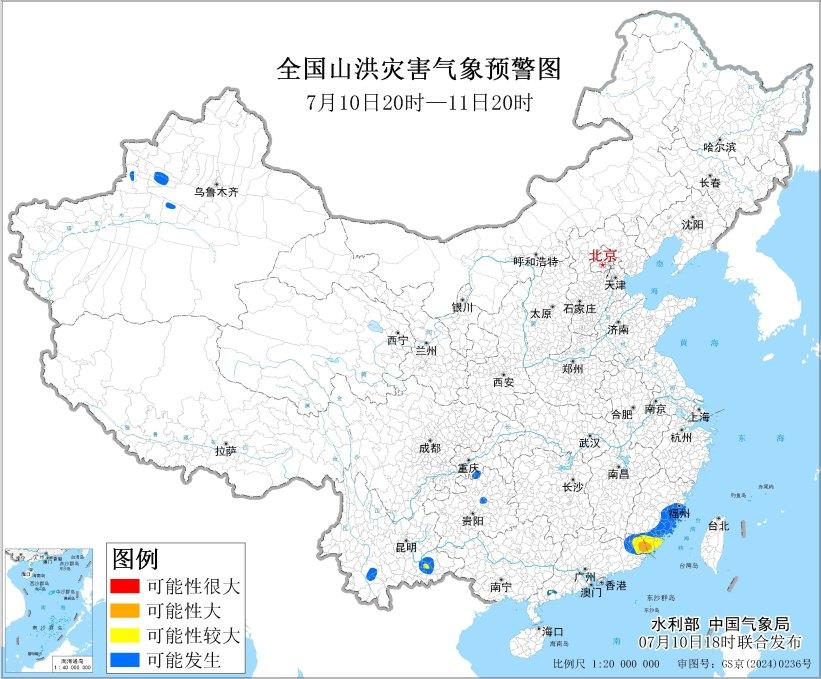
Group 1 - The Ministry of Water Resources and the China Meteorological Administration issued an orange warning for mountain flood disasters, predicting a high likelihood of such disasters in southern Fujian, eastern and southwestern Guangdong, and southeastern Yunnan from July 10, 20:00 to July 11, 20:00 [1] - The Central Meteorological Administration continued to issue a yellow warning for heavy rain, forecasting heavy to torrential rain in various regions including southern Fujian, most of Guangdong, and parts of Guangxi, with localized extreme rainfall expected to reach 250-300 mm [3] - The Ministry of Natural Resources and the China Meteorological Administration issued a yellow warning for geological disaster risks, indicating a high risk in eastern and southern Fujian, eastern Guangdong, southeastern Sichuan, western Chongqing, and northwestern Guizhou, with an orange warning for specific areas [5] Group 2 - The Central Meteorological Administration reported a high risk of waterlogging due to heavy rainfall, particularly in southern Fujian, eastern and southwestern Guangdong, and northern Guizhou, with a focus on urban flooding and agricultural waterlogging [7] - A nationwide flood risk meteorological warning map was released, indicating varying levels of risk across different regions, emphasizing the need for preparedness and monitoring [8]