水安全保障

Search documents
我国水安全保障能力全面提升——“十四五”以来新开工重大水利工程172项
Jing Ji Ri Bao· 2025-09-30 02:50
Core Insights - The Chinese government has made significant progress in water conservancy development during the "14th Five-Year Plan" period, with investments exceeding 5.4 trillion yuan, marking a 1.6 times increase compared to the "13th Five-Year Plan" [1] Group 1: Investment and Infrastructure - Water conservancy construction investment reached over 1 trillion yuan for the first time in 2022, continuing a three-year trend of breaking historical records [1] - A total of 172 major water conservancy projects have been initiated since the start of the "14th Five-Year Plan" [1] - By the end of last year, China had built 95,000 reservoirs, 200 large and medium-sized water diversion projects, and 6,924 large and medium-sized irrigation areas, forming the world's largest and most comprehensive water conservancy infrastructure system [1] Group 2: Flood Control and Disaster Management - The water and drought disaster prevention system has been continuously improved, successfully managing floods on 3,981 rivers that exceeded warning levels [1] - The proportion of flood disaster losses to GDP decreased from 0.28% during the "13th Five-Year Plan" to 0.18% [1] Group 3: Agricultural Support and Food Security - The water conservancy sector has strengthened water security for food production, focusing on major grain-producing areas with 30 significant water diversion and key water source projects [2] - Over the past five years, 1,959 large and medium-sized irrigation areas have undergone modernization, adding and restoring over 20 million acres of irrigated land [2] Group 4: Ecological Restoration and Community Benefits - The "Mother River Revival Action" has been implemented, restoring several rivers that had been dry for decades, achieving a 98.6% compliance rate for ecological flow standards in key rivers and lakes [2] - The water conservancy department has supported 122 happiness river and lake construction projects, creating green industrial chains and ecological agriculture, enhancing community welfare [3] - The Hu Creek watershed in Zhejiang has seen a revenue increase of over 13 billion yuan, growing by 18.7% year-on-year due to the integration of water and tourism [3]
我国水安全保障能力全面提升 “十四五”以来新开工重大水利工程172项
Jing Ji Ri Bao· 2025-09-29 22:17
Core Insights - The "14th Five-Year Plan" has led to significant advancements in China's water conservancy sector, with investments exceeding 1 trillion yuan in 2022, marking a historical record and a projected total investment of over 5.4 trillion yuan during the plan period, which is 1.6 times that of the previous five years [1] Investment and Infrastructure Development - The number of major water conservancy projects initiated during the "14th Five-Year Plan" reached 172, optimizing the layout, structure, function, and system integration of water infrastructure [1] - By the end of last year, China had constructed 95,000 reservoirs, 200 large and medium-sized water diversion projects, 6,924 large and medium-sized irrigation areas, and 318,000 kilometers of embankments, creating the world's largest and most comprehensive water conservancy infrastructure system [1] Flood Control and Disaster Management - The water and drought disaster prevention system has been continuously improved, successfully managing floods on 3,981 rivers that exceeded warning levels, reducing the economic loss from flood disasters as a percentage of GDP from 0.28% during the "13th Five-Year Plan" to 0.18% [1] Agricultural Support and Food Security - The water conservancy sector has reinforced water security for food production, focusing on major grain-producing areas with the construction of 30 significant water diversion and key water source projects, along with the modernization of 1,959 large and medium-sized irrigation areas, adding over 20 million acres of irrigated land [2] Ecological Restoration and Environmental Protection - The "Mother River Revival Action" has been implemented, restoring several rivers that had been dry for decades, achieving a compliance rate of 98.6% for ecological flow in key rivers and lakes [2] - The normalization of the "Four Chaos" rectification in rivers and lakes has addressed 140,000 issues related to illegal occupation, mining, dumping, and construction, effectively maintaining the flood storage capacity of rivers and lakes [2] Economic Impact and Community Benefits - The implementation of 122 "Happy Rivers and Lakes" construction projects has fostered green industrial chains and ecological agriculture, enhancing the quality of life for communities, as evidenced by the 18.7% year-on-year revenue growth in the Huxi River Basin, which exceeded 13 billion yuan last year [3]
松辽水利委员会持续强化西辽河流域水工程运行监管
Shui Li Bu Wang Zhan· 2025-09-22 14:39
Core Viewpoint - The Songliao Water Conservancy Committee is focusing on "water security" as a core task, enhancing the management of the watershed through scientific planning and precise implementation of measures to support ecological restoration and water security in the Xiliao River basin [1][2]. Group 1 - External water sources are being adjusted to introduce new momentum, with the Zhanguo-Jiliao project serving as a strategic water source for continuous flow in the lower reaches of the Xiliao River, ensuring reliable water supply [1]. - The East Taizi Reservoir is crucial for water resource regulation, and the success of land acquisition and resettlement efforts is vital for its operational efficiency, significantly enhancing the reservoir's water storage and regulation capabilities [1]. Group 2 - Digital empowerment is being utilized to create a smart monitoring system, enhancing real-time monitoring of key water projects in the Xiliao River basin, which supports scientific water resource scheduling and risk management during flood seasons [2]. - Safety reinforcement measures are being implemented to ensure the secure operation of water projects, with a focus on the safety assessment of critical water control structures and their inclusion in future investment plans [2]. Group 3 - Detailed management practices are being adopted to ensure the effective operation of water storage and regulation projects, with regular safety guidance and maintenance checks on important water infrastructure to eliminate flow obstacles [2].
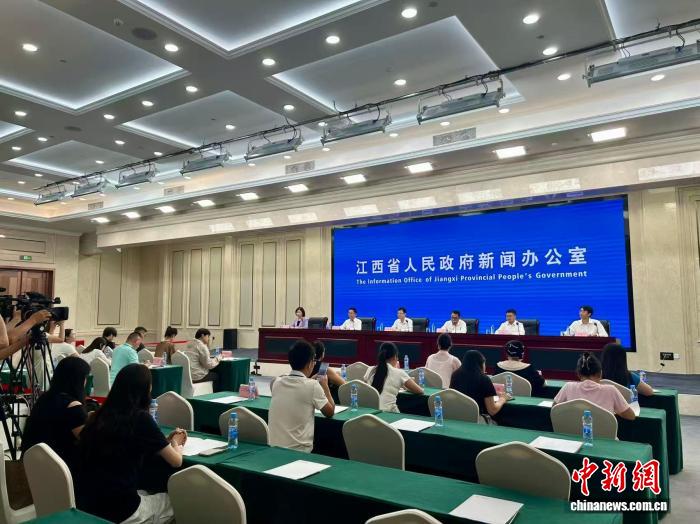
江西截至目前共落实水利投资2715亿元
Zhong Guo Xin Wen Wang· 2025-08-27 12:42
Core Viewpoint - Jiangxi Province has significantly increased its water conservancy investment during the "14th Five-Year Plan" period, with a total investment of 271.5 billion yuan, expected to reach nearly 300 billion yuan, which is 2.6 times the investment during the "13th Five-Year Plan" [1][3]. Investment and Infrastructure Development - As of now, Jiangxi has committed 271.5 billion yuan to water conservancy projects, with an anticipated total investment of nearly 300 billion yuan during the "14th Five-Year Plan" [1][3]. - The province has enhanced flood safety capabilities, completing emergency governance of the Yangtze River's bank erosion ahead of schedule and reinforcing 1,664 dangerous reservoirs three years ahead of the five-year plan [3]. Water Resource Management - The modernization of five large irrigation districts has been largely completed, with new irrigation areas adding 2.45 million acres [3]. - Rural tap water coverage has reached 94.1%, with 80.2% of the rural population benefiting from large-scale water supply projects [3]. Ecological Protection and Management - Jiangxi has implemented comprehensive management of soil erosion over an area of 5,497.03 square kilometers and constructed 126 eco-friendly small watersheds, achieving a soil conservation rate of 86.51% [4]. - The province has created 80 green small hydropower stations, ranking among the top in the country, and has five entries in the World Irrigation Heritage List, the second highest in the nation [4]. Reform and Innovation - Water rights reform has progressed, with 557 transactions completed, totaling 200 million cubic meters of water traded, placing Jiangxi among the leaders in the Yangtze River basin [4]. - Innovative financing mechanisms for water conservancy have been established, ensuring funding for water infrastructure projects [4]. Future Plans - Jiangxi aims to achieve modernization by 2035, focusing on developing a provincial water network and planning major water conservancy projects to support high-quality development in the sector [5].

“十四五”以来陕西完成水利投资1900余亿元
Shan Xi Ri Bao· 2025-08-10 22:42
Core Insights - As of June 30, Shaanxi has completed a total water conservancy investment of 192.85 billion yuan during the "14th Five-Year Plan" period, providing strong support for the province's high-quality economic and social development [1] - The scale of water conservancy construction investment in Shaanxi has reached new highs since the beginning of the "14th Five-Year Plan," leveraging national policies and multi-channel funding sources [1] - The provincial government has signed a strategic cooperation framework agreement with China South-to-North Water Diversion Group to promote three investment and financing models [1] Investment and Financing - Shaanxi has actively promoted the participation of state-owned and private enterprises in water infrastructure construction, continuously expanding water conservancy investment [1] - The provincial water conservancy department has held financing docking activities for four consecutive years, obtaining credit approvals exceeding 200 billion yuan from financial institutions [1] - Policy-based funds of 106 billion yuan have been implemented, leveraging social capital and market-oriented financing of 50.6 billion yuan to effectively meet the funding needs of major water conservancy projects [1] Project Development - Key water conservancy projects benefiting people's livelihoods, such as the second phase of the Hanjiang to Weihe River project and the expansion of the Wangyao Reservoir in Yan'an, are currently under construction [1] - The province is accelerating the preliminary work of several projects, including the third phase of the Hanjiang to Weihe River project and the supply project of the Dongzhuang Water Conservancy Hub, to enhance water security levels [1][2]
X @外汇交易员
外汇交易员· 2025-07-22 23:55
Key Focus - The Ministry of Water Resources emphasizes the need to balance high-quality development and high-level security in Tibet [1] - The Ministry of Water Resources aims to improve urban flood control systems, major water conservancy projects, and irrigation area modernization in Tibet [1] Projects and Locations - The research covers the Yarlung Zangbo River, Lhasa River, and Nyang River basins [1] - The research includes Lhasa and Shigatse city flood control projects [1] - The research involves the Pazhi Water Conservancy Hub Project (under construction) and the Manla Water Conservancy Hub Project [1] - The research involves the Manla Irrigation Area and the Saga Reservoir Irrigation System [1]
上半年四川完成水利投资352亿元 同比增长13%投资规模居全国第六位
Si Chuan Ri Bao· 2025-07-15 03:18
Group 1 - The core objective for this year is to achieve over 70 billion yuan in water conservancy investment [1] - As of June 30, Sichuan has raised a total of 51 billion yuan in various water conservancy funds and completed an investment of 35.2 billion yuan, marking a year-on-year increase of 13% [1][2] - Sichuan's investment scale ranks sixth nationwide, successfully achieving the "double over half" target [1] Group 2 - Currently, there are 2,425 ongoing water conservancy projects in Sichuan with a total investment scale of 300.8 billion yuan [2] - In the first half of the year, Sichuan completed the spring irrigation supply task, with rice planting area reaching 27.79 million mu, of which water conservancy projects supported 21.27 million mu, exceeding the plan by 170,000 mu [2] - Sichuan has planned and reserved over 4,400 water conservancy projects with a total investment scale of approximately 870 billion yuan [2]
库容翻倍!新疆这项重点水利工程全面升级
Zhong Guo Jing Ji Wang· 2025-07-01 09:28
Core Insights - The completion of the main structure of the Shartohai Water Conservancy Hub Phase II project, constructed by China Energy Engineering Group, marks a significant milestone for this multi-functional water conservancy project, which is crucial for irrigation, flood control, and future power generation [1] - The project is located in Jinghe County, Bortala Mongol Autonomous Prefecture, Xinjiang, and aims to enhance water resource allocation in the region [1] Group 1 - The Phase II project will increase the total reservoir capacity from 9.98 million cubic meters to 21.93 million cubic meters, effectively doubling the water storage capacity, which is equivalent to one West Lake [1] - The dam's top elevation will be 620.5 meters, with a normal water level of 618 meters and a design flood level of 617.92 meters, significantly improving flood control capabilities [1] - The project is part of the dual key initiatives outlined in the "14th Five-Year Plan" for water security in the Yellow River Basin and Xinjiang, ensuring robust ecological safety and public welfare in the region [1] Group 2 - Once completed, the Shartohai Water Conservancy Hub Phase II will effectively irrigate 208,500 acres of farmland, addressing seasonal water shortages in the Dahuai irrigation area and enhancing irrigation reliability [2] - The project is expected to provide a strong impetus for the modernization of local agriculture, optimization of the ecological environment, and high-quality economic and social development [2]
中办、国办印发!
证券时报· 2025-06-26 10:47
Overall Requirements - The article emphasizes the importance of implementing the "River Strategy" to enhance water security and ecological protection, guided by Xi Jinping's thoughts on ecological civilization and high-quality development [2][3]. Ensuring River Safety - A new flood prevention and disaster reduction framework will be established, focusing on optimizing flood control measures and enhancing emergency response capabilities [4][6]. - The flood control engineering system will be improved, including the construction of reservoirs and levees, and the management of flood storage areas [4][5]. - A monitoring and forecasting system for rainfall and water conditions will be developed to improve the accuracy of flood predictions [5]. - A comprehensive disaster prevention system will be established, focusing on decision-making support and efficient command mechanisms [6]. - Risk prevention measures will be strengthened, including the identification of flood risk areas and the promotion of population relocation to lower-risk zones [6]. Strengthening Water Resource Utilization - Water resource management will be strictly enforced, with a focus on sustainable usage and legal compliance [7]. - Efforts will be made to enhance water-saving practices across various sectors, including agriculture and industry [7][8]. - The allocation of water resources will be optimized to ensure that urban and ecological needs are prioritized [8][9]. - The capacity for safe water supply will be improved through the development of emergency water sources and rural water supply systems [9]. Enhancing River Ecosystem Protection - The ecological functions of river basins will be reinforced through integrated management of land and water resources [10][11]. - Specific strategies will be implemented to restore and protect river and lake ecosystems, focusing on both northern and southern regions [11][12]. - Measures will be taken to enhance water source conservation and soil preservation in critical areas [11][12]. Improving Water Environment - Drinking water source protection will be prioritized, with monitoring and emergency response mechanisms established [12][13]. - Comprehensive water environment governance will be pursued to improve the ecological quality of rivers and lakes [12][13]. - Cultural heritage related to water will be preserved and promoted, enhancing public awareness and appreciation of water culture [13]. Governance Mechanisms - A unified management approach for river basins will be adopted, integrating planning and governance across different levels [14][15]. - The role of river chiefs will be emphasized to ensure accountability and effective management of water resources [14][15]. - Legal frameworks will be strengthened to support water resource management and environmental protection [15][16]. Organizational Leadership - The article calls for strong leadership from the Party and government at all levels to ensure the effective implementation of these strategies [16][17].